
 E-Paper



Wildbuzz | Crimson magic of Chamba
Rhododendron blooms in the Himalayas are collected by villagers for tea, while artist Luci Jockel mourns declining bee populations through unique art.

 Prefer HTon Google


Rhododendron (Buransh) comes into bloom in the Himalayas in March-April. Images of crimson trees framing a distant, snowy peak or a ‘red carpet’ welcome of fallen blooms for those traversing forest trails are quite common. A recent photo essay from Chamba (Himachal Pradesh) casts the beauty of the bloom in a different light.
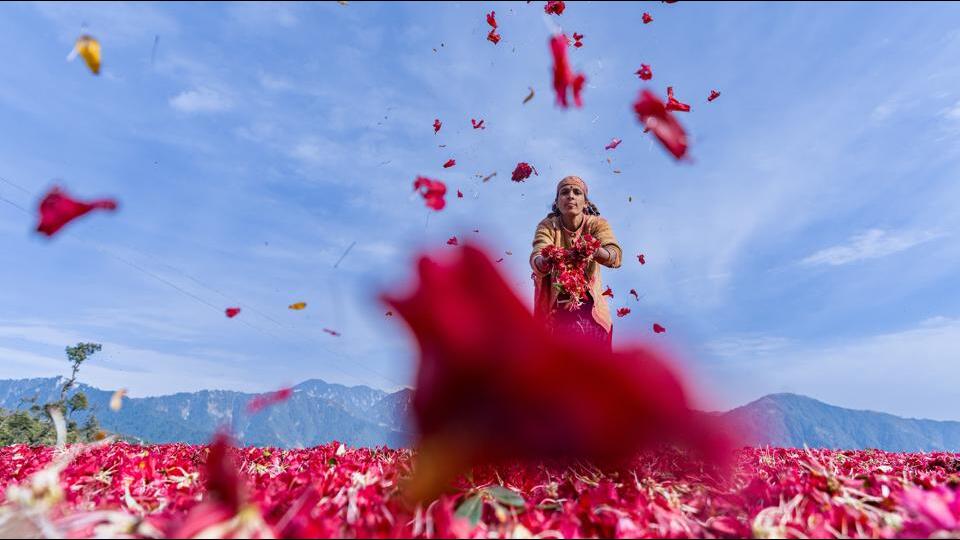
Jot is a quaint hamlet that sits on the pass between Chamba and Kangra districts at an altitude of more than 8,000 feet. It is ringed by forests and brooding mountains. Here, villagers collect Rhododendron blooms and dry them for pharma and medicinal tea factories. The flowers are purely organic, collected from forest slopes.
Since the flowers come packed in baskets, they have to be spread out to give each petal a place in the sun. The villagers fling them to do so and in the process, it seems as if offerings are being made to the sky gods, to heaven’s door above. The contrast between the colours of the petals and clear blue alpine skies makes for a visual feast. Once blooms are spread out, the colour splash of Rhododendron on austere mountain plateau tables reminds one of red-hot ‘chilli’ sprawls in other Indian states.
The photo-essay was authored by Kanwar Pal Singh from Chamba, a professional lensman who revels in curating Himachali culture, travel and birds. All these years, the novelty of the Jot scenes, the crimson magic, had skipped his muse. “Sometimes, all it takes is a shift in perspective to see a familiar landscape in a completely new light. I’ve lived in and photographed Chamba for years, yet I’m still surprised by how I missed the magic of Buransh blooms. Seeing these hillsides turn a deep, vibrant red was fascinating, but watching the local rhythm change with the season was the real highlight. From villagers carefully drying petals to the way it weaves into daily life here — it is more than just a flower, it is a lifeline,” Singh told this writer.
The poet in him paid tribute: “On the first day of summer, the sun warms my old bones. As I watch the last Rhododendron blossom give itself to earth, time rolls over the woman and the flower.”
Bee-utiful, but wounded
The doorbell rings naggingly in spring and summer at our Chandigarh home. Outside are beehive removers, unemployed youths who prowl the gardens and groves spotting hives. They offer to have the hive removed (by smoking or burning them down) and sell residents honey. These youths have no licence to remove the critical agents of pollination but find mutual convergence in residents, who, suffering from bee paranoia, gladly pay to have hives taken down. They relish honey, which was actually produced by bees for their babies (larvae).
There is scarcely any citizen voice in our midst that protests bee eviction or expresses poetic lament. Law-enforcement and environment/biodiversity departments are too preoccupied with “weightier matters of the state” to bother about bees. It can only end in a silent spring, the abundant flora and groves devoid of the buzz of busy bees.
But there are hearts out there which beat for tiny, industrious bees — assessed to pollinate 85% of planetary vegetation. Perhaps, it takes a sensitive and creative artist to pay poignant tribute, serve warning and kindle a lost empathy. Luci Jockel is an American artist from Baltimore, who has gained appreciation for unique works. She painstakingly fashions lace work and veils from wings ethically collected from dead bees, thereby transforming loss into art.
Her work, ‘Gold Veil’, has been acquired by the Smithsonian American Art Museum. Jockel used archival glue to fuse together 21,600 bee wings to create a long mourning veil. Her work has been described as giving a voice to deceased beings in the hopes of building an interconnectivity between human and animal.
In Jockel’s own words: “It began with the idea to memorialise and mourn honey bees due to their decline, making a veil from their wings. My works are memorials for the animals. Can the touch of bee wings on one’s shoulders serve as a reminder of the fragility of life? In my work, the bee is a martyr for our ecosystem — a symbol of the influence we have upon non-human counterparts and how we rely on these beings to keep our environment livable.”
vjswild2@gmail.com


