
 E-Paper



Wildbuzz | Loving the owl brat
A lovable rescued owl chick glides into the dark night after enjoying the hospitality of a birder; butterflies indulge in mud-puddling on the rotten carcass of a young sambar deer


When it comes to rescuing, rearing and releasing a little owl, the compassionate human may not get a ‘thank you’ note from the bird when it finally glides into the dark night.
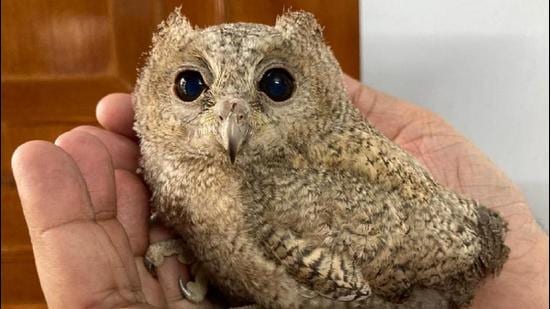
On the face of it, one of the most endearing chicks is that of the Indian scops owl (ISO). But its looks are deceptive as the unflaggingly patient and compassionate Sanjiv Khanna was to discover. He runs ‘Aashray’, a bird shelter in Jalandhar, and has rescued more than 1,300 birds since 1994. The ISO chick was discovered on the roadside by passersby and was blessed enough to somehow be delivered to the warm cup of Khanna’s palms.
“For the first few days, the chick was totally dependent on us and overawed by human presence. When I would feed it chicken morsels, it would fold its sharp talons (claws) so that they did not prick into the palms of my hands. But later, after it gained confidence and once it had its daily feed, the chick grew a bit cocky. While sitting in the palm of my hand, it would frequently unfurl its talons and prick my flesh, sometimes even petulantly pecked at my fingers while I fed it,” Khanna told this writer.
The adorable tramp would regale the Khannas with what they perceived as a dance: the chick would sway its body and couple it with varied movements of the head. The supposed ‘dance’ was actually the owl’s way of enhancing situational awareness or sharpening its three-dimensional view. An owl’s eyes are fixed in the socket but the head rotates fully and even dips sideways (180 degrees) to bring the world to its eye level.
With Khanna’s house brimming with rescued birds, he has constructed a shelter for them on the first floor. But at night when diurnal birds go silent, captive owls can be a pain in the wrong place. “Owls are generally quiet during the day, but at night they create such a racket that sleep is impossible! So, they leave their perch on my arm or within my hands and I relocate them to the first floor during the night. Rescued barn owls hiss like enraged cobras at night and give humans trying to sleep the real jitters. The ISO is vociferous, it utters a medley of hisses, shrieks and cackles. However, rescued spotted owlets tend to keep the volume down at night,” revealed Khanna.
Death begets new life
On the graves of the dead, do the most beautiful flying flowers bloom.
Nature has little time or emotive energies to spare and mourn the young dead. The remains of the jungle’s mortals, be it a fawn or an aging lion, offer the glimmer of new life to an opportunistic army of manual scavengers. What is still left after the scavengers are done with, assimilates into the soils and enriches the flourish of floral eruptions from the womb of mother earth. Each part of Death’s stillness is requisitioned to serve a movement and finds a designated slot in the endless reinvention and recycling of life forms, from animate to inanimate and vice versa.
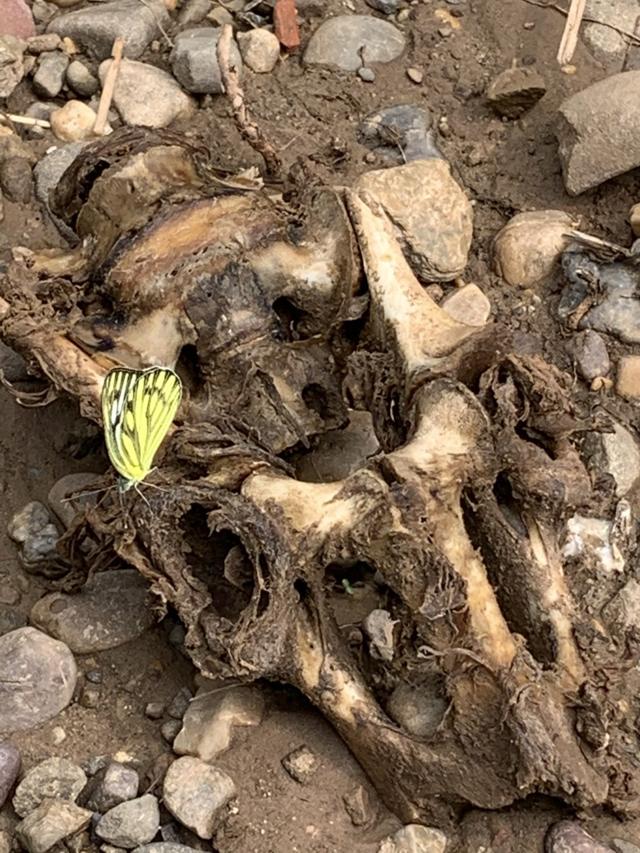
I stumbled upon this amoral truism of nature in the guise of a vividly contrasting spectacle: an ugly, rotting skeletal piece fancied by beautiful butterflies. I was on a ramble along the western hillsides flanking Perch Check Dam, situated a few miles behind the PGIMER. The pelvic girdle of a young sambar deer was degenerating speedily in the monsoon humidity. But common gull butterflies seemed to rejoice at death. The butterflies were indulging in a bout of mud-puddling, while being so prettily perched on rotting bones, flitting to and fro at the faintest shadow cast upon them as they nibbled away at the wholesome girdle.
Mud-puddling is the generic term for a natural phenomenon. Male butterflies gather on substrates like wet soil, dung and rotting animal bodies to obtain nutrients such as mineral salts, sodium and ammonium ions, amino acids and simple carbohydrates, which may be absent in the nectar they otherwise feed on. Male butterflies pass on these collections to females as nuptial gifts through the spermatophore (a sac of nutrients combined with the sperm). In turn, females apportion these gifted nutrients towards improving egg viability.
Death had enhanced the butterflies’ capabilities to breed new lives and stamp their genes on the tireless turns of mother earth that mark time’s passage.
vjswild1@gmail.com


