
 E-Paper



Limit public transport capacity, maximise social distance: CRRI
Experts recommend a social distance of at least six feet between people, as well as reducing physical contact, to minimise the spread of the coronavirus disease (Covid-19).


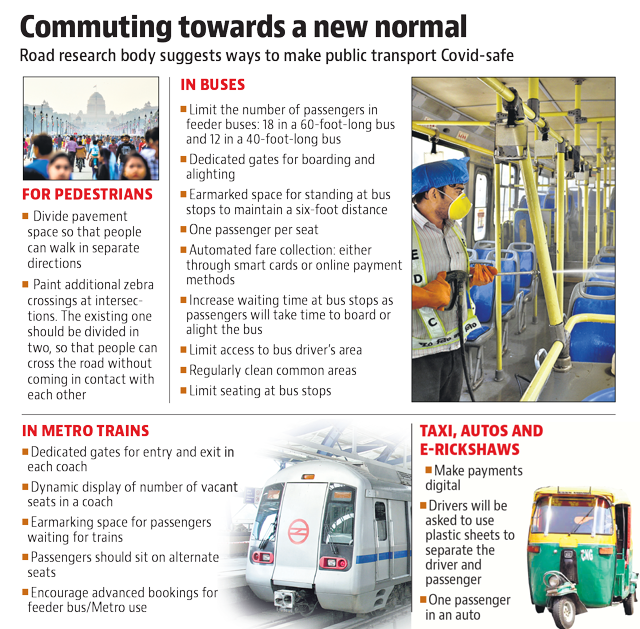
The Central Road Research Institute’s (CSIR-CRRI) recommendations for the safe use of public transport, once the nationwide lockdown is lifted, include limiting the number of passengers in buses and separate gates for boarding and alighting Metro coaches.
The guidelines, to be shared with all state governments and ministries in the central government, also propose creating a partition between the driver’s seat and the back seat in taxis using a plastic sheet, a dynamic display showing the number of available seats in Metro trains and buses, and earmarking the waiting area in stations, among others. The guidelines also propose painting additional zebra crossings at each intersection to ensure pedestrians crossing on to opposite sides do not come in contact with each other.
Transport experts at CSIR-CRRI say these moves will help manage crowds, ensure the presence adequate transport infrastructure to discourage people from using private vehicles, encourage pedestrians and cyclists to ensure social distancing.
Experts recommend a social distance of at least six feet between people, as well as reducing physical contact, to minimise the spread of the coronavirus disease (Covid-19).
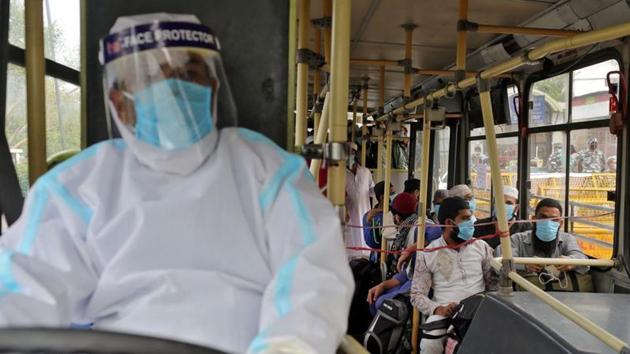
Satish Chandra, director CSIR-CRRI, said, “The biggest challenge is crowd management in public transport so that social distancing is effectively implemented. As only 50% occupancy is allowed in public transport currently, there is a need to immediately enhance the capacity and also manage the demand by ensuring staggered office timings.”
If this is not done, Chandra said, a lot of public transport users might switch to private vehicles to protect themselves from contracting Covid-19.
Public transport services have been shut in the national capital since March 23, two days before Prime Minister Narendra Modi announced a nationwide lockdown to curb the spread of Covid-19.
Officials said the Delhi government is working a plan to ensure social distancing in public transport once the lockdown is lifted and public transport resumes.
“We are working on a plan to decide how we will reopen public transport. We will also have to work out a plan to sanitise public transport,” a senior Delhi transport official said.
Union transport minister Nitin Gadkari on Wednesday said public transport may resume soon, and that the Central government was formulating guidelines for the same.
Officials of the Delhi Metro, the Capital’s transport lifeline, said the organisation would follow guidelines framed by the Union and state governments.
Anuj Dayal, executive director, corporate communication, Delhi Metro Rail Corporation, “We will follow all guidelines set by the government while framing advisories for passengers. Additionally, models adopted by metro systems across the world are also being studied to ensure that the resumption of services is smooth, convenient and safe for Delhi Metro’s commuters.”
With schools shut and inter-state movement banned, experts said a lot of private buses, including chartered buses, are currently unused. “These buses can be made part of the public transport system to help meet the increase in demand, ensure quality by observing social distancing measures, and discourage people from shifting to private vehicles. Staggered office timings and better work-from-home norms will also be helpful,” said E Madhu, head, transport planning division, CSIR-CRRI.
Anumita Roychowdhury, executive director transport at the Centre for Science and Environment, said Delhi could easily induct the unused buses into its public transport fleet.
“The Delhi government has used private buses during the odd-even scheme. They just have to build on it. Though these are testing times, it is an opportunity to address the issue of overcrowding in public transport,” Roychowdhury said.
“Pre-booking travel time slots in buses and Metros will help manage crowds,” Madhu said.
The guidelines recommend that the existing seating arrangements be changed in e-rickshaws, which are an essential part of the city’s last-mile connectivity mechanism. The CRRI recommends that e-rickshaw passengers not face each other and that the number of people who travel together in one vehicle be limited.
To reduce the load on public transport systems, the guidelines suggest short trips be encouraged and infrastructure provided for cycle-rickshaws, e-rickshaws, bicycles and pedestrians.
Rowchowdhury asked that plans be prepared to improve local infrastructure for travel over short distances. “With bollards and paint, we can create more space for pedestrians on the road and ensure their safety. People can make these trips either by walking or cycling. This will bring down the load on public transport.”
Experts also pointed to innovative public transport systems other countries had adopted.
Amit Bhatt, director transport, WRI India, said, “Bogota, the capital of Colombia, has converted 100km of streets into cycle lanes to reduce the load on its bus systems. Mexico City is planning to quadruple its cycle network to reduce the pressure on its metro. Budapest, the capital of Hungary, is creating cycle lanes as a safe alternative for the commute as the city has seen a 90% drop in public transport use,” Bhatt said.

Stay updated with all top Cities including, Bengaluru, Delhi, Mumbai and more across India. Stay informed on the latest happenings in World News along with Delhi Election 2025 and Delhi Election Result 2025 Live, New Delhi Election Result Live, Kalkaji Election Result Live at Hindustan Times.


