E-Paper



Govt to investigate Uttarakhand’s 5,700 Waqf properties, check records: Pushkar Singh Dhami
Pushkar Dhami said the “government will ensure Waqf properties are used for the welfare of poor Muslim brothers and sisters, without any religious bias”

 Prefer HTon Google


DEHRADUN: Uttarakhand chief minister Pushkar Singh Dhami on Friday said the state government will conduct a comprehensive investigation into 5,700 Waqf properties registered in Uttarakhand to identify encroachments and ensure strict action where violations are found.
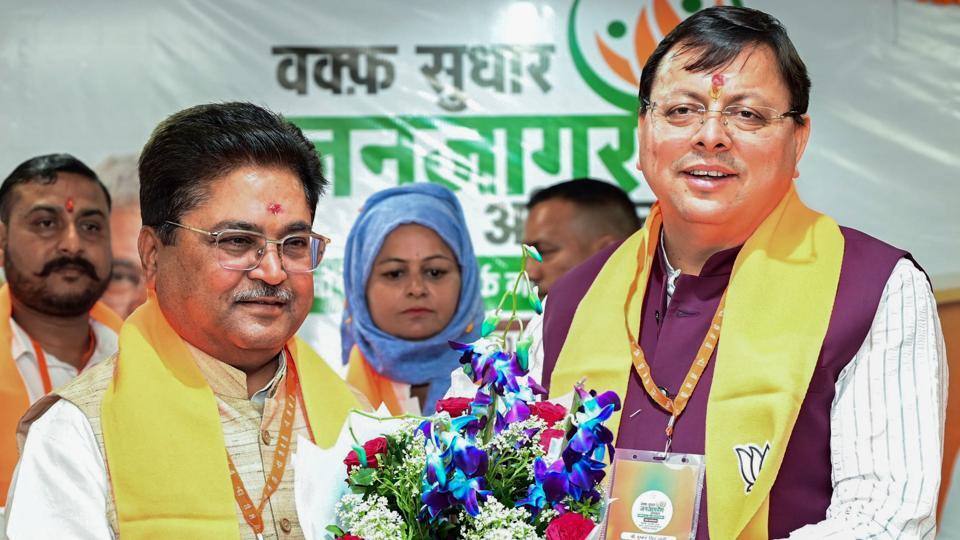
Dhami made the announcement at a state-level workshop on a public awareness campaign on the Waqf Amendment Act at the state BJP headquarters in Dehradun. The campaign will begin on April 20 and continue till May 5.
Also Read | Congress attacks Dhami for drive against madrasas, calls it ‘politics of polarisation’
“A thorough probe of all 5,700 Waqf properties in the state will be undertaken… Wherever encroachment is found, the government will take strict action. Records will be updated after full verification, and every inch of Waqf land will be examined. There is a rule of law in Uttarakhand, and the government will ensure Waqf properties are used for the welfare of poor Muslim brothers and sisters, without any religious bias,” he said.
To be sure, Dhami did not refer to implementation of any specific provisions of the law that was passed by Parliament earlier this month.
The Supreme Court, which is hearing a batch of petitions challenging the constitutional validity of the Waqf Amendment Act, on Thursday recorded the Centre’s assurance that no Waqf, including a Waqf by user, whether declared by way of notification or by way of registration, shall be de-notified, nor will their character or status be changed. The Centre also said that no appointment would be made to the Central Waqf Council and the Waqf Boards in the states until the next hearing scheduled in the first week of May.
Dhami said the amendment was a historic, transformative step under Prime Minister Narendra Modi’s leadership. “This reform is in the interest of the country and society, ensuring the rights of the poor. It will not impact anyone’s religious freedom. Instead, it will help orphaned children, widows, divorced women, and other needy members of the Muslim community,” he said.
BJP national general secretary and Uttarakhand in-charge Dushyant Gautam, said the party aims to use freed Waqf land to build homes for underprivileged Muslims. “This amendment is not new,” he said. “We are correcting the mistakes of the past—those made by Congress governments in 1995 and 2013. Wakf properties must be used properly for public welfare.”
BJP state general secretary (organisation) Ajay Kumar urged party workers to spread awareness about the law.
“This public awareness campaign will help counter misinformation spread by the opposition and guide a large section of society toward the truth,” Kumar said.
BJP leader and Uttarakhand Waqf Board chairman Shadab Shams said unlimited powers given to the Waqf board in the past were misused on a large scale. “Not only were its lands encroached upon, but the board also claimed government and private properties,” he said.
Congress state senior vice president Suryakant Dhasmana said the law was a tool to divert attention. “BJP’s central and state governments, which have failed to solve the problems of the people of the country and the state, have now made Waqf law a new weapon to divert the attention of the public from inflation, unemployment and falling GDP,” he said.