
 E-Paper



Delhi Government launches pilot project to conserve rainwater
The project was launched jointly by union Jalshakti minister Gajendra Singh Shekhawat and Arvind Kejriwal, chief minister of Delhi, on Friday.


The Delhi government on Friday launched a pilot project of its ambitious plan to conserve rainwater on the floodplains of the River Yamuna in a bid to meet the capital’s drinking water needs.
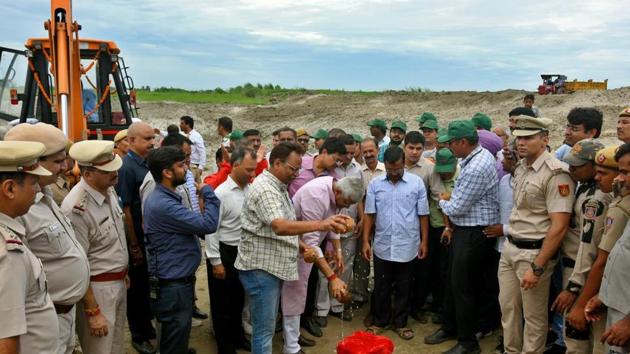
Speaking at the launch, union Jalshakti minister Gajendra Singh Shekhawat said the project, which aims to solve the national capital’s water crisis in the coming years, could become a model for the entire world.
This is a first-of-its-kind project in the country, which aims to conserve water in the Yamuna floodplains by creating a mega reservoir between Palla and Wazirabad, a government release had earlier stated. Even though this is a pilot project, the Delhi government plans to scale it up from next year.
“This is a unique experiment. The success of this pilot project of Delhi government can be a milestone in water conservation and water security. In the coming time, this pilot project can become a Delhi model to be showcased not only in India but across the world,” said Shekhawat.
The project was launched jointly by Shekhawat and Arvind Kejriwal, chief minister of Delhi, on Friday.
“On their own, farmers had been taking steps but it is for the first time probably in history that a state government has initiated such a pilot on such a big scale,” Kejriwal said.
Even though the peak-demand of water in Delhi shoots up to around 1,150 MGD during summer months, the Delhi Jal Board can produce only around 936 MGD, leaving a shortfall of more than 200 MGD.
This results in an acute water shortage in the national capital. Groundwater in several parts of Delhi is also ‘over-exploited’, many reports have warned in the past.
“During the monsoon season, at least six lakh cusecs (around 3.5 lakh MGD) of rainwater flows down the Yamuna every day. If we can conserve this water in the river’s floodplains, it would help us to solve the Delhi’s water problem for almost a year,” Kejriwal had said in June while laying the foundation stone for the Chandrawal Phase-2 water treatment plant.
In this pilot project, artificial reservoirs are being created on the Yamuna floodplains of one metre depth, in which floodwater will be collected. This water will gradually recharge and come back to Yamuna through a natural process.
“Due to farming and other activities, water was unable to go beneath the surface. In this project, the soil will be removed from the surface and after digging up to a metre and a half, it will be possible for the water to percolate quickly and water recharging can be done,” Kejriwal said.
Views of experts in the field of water conservation and recharging vary from whether water percolates at a speed of two metres per day or 10 metres per day.
“Speed of recharging will be measured and so will the area till which underground water reaches will also be ascertained. This will form the basis of launching the project on a bigger scale next year, once when results of the pilot will be known,” the chief minister added.
The plan got all the nods required for moving ahead with the pilot project in the last week of July. An Expert Technical Committee comprising CR Babu, AK Gosain and Brij Gopal recommended this project in their Technical Committee report submitted to the National Green Tribunal (NGT), which later became part of the NGT order for Rejuvenation of the Yamuna in 2015.

Stay updated with all top Cities including, Bengaluru, Delhi, Mumbai and more across India. Stay informed on the latest happenings in World News along with Delhi Election 2025 and Delhi Election Result 2025 Live, New Delhi Election Result Live, Kalkaji Election Result Live at Hindustan Times.


