
 E-Paper



Delhi: Air crisis sets dismal new streak in Jan, exposes ineffectual Grap
More alarmingly, Delhi has never recorded four consecutive “severe” air days in January, a threshold it now stands perilously close to breaching.

 Prefer HTon Google


Residents of Delhi are gasping for breath through the city’s worst January air in at least five years, with the air quality index (AQI) in the Capital remaining above 400 for three consecutive days – a grim milestone that has few recent parallels.
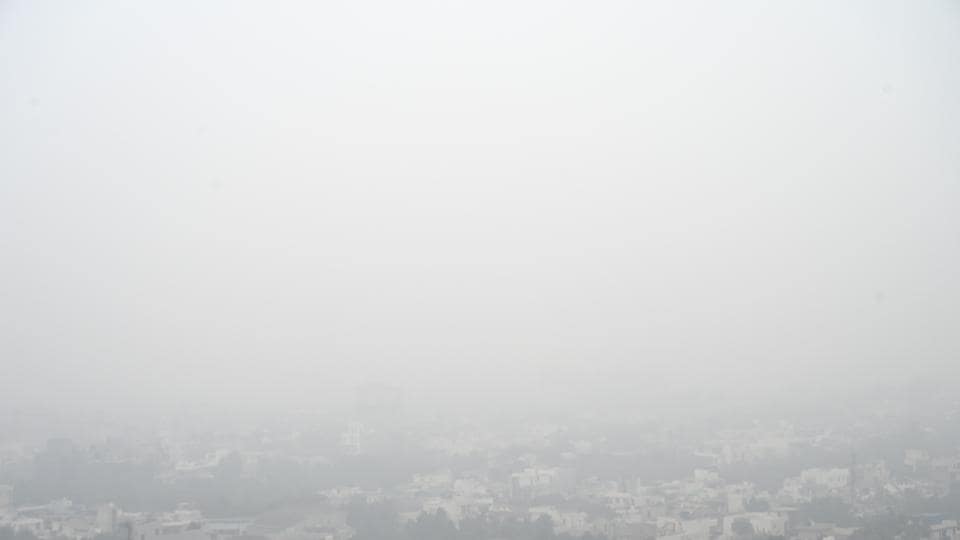
On Monday, the AQI in Delhi stood at 410, marking the third straight day above the 400 threshold. This streak matches a record set only once before, in January 2021.
More alarmingly, Delhi has never recorded four consecutive “severe” air days in January, a threshold it now stands perilously close to breaching.
Monday’s reading also comes on the back of a severely polluted weekend. On Sunday, the AQI was 440, and it was 400 on Saturday – a day that began badly and deteriorated steadily by evening, prompting the Commission for Air Quality Management (CAQM) to invoke the strictest Stage-4 measures under the Graded Response Action Plan (Grap). Those emergency curbs remain in force, but have so far failed to significantly improve the air in the city.
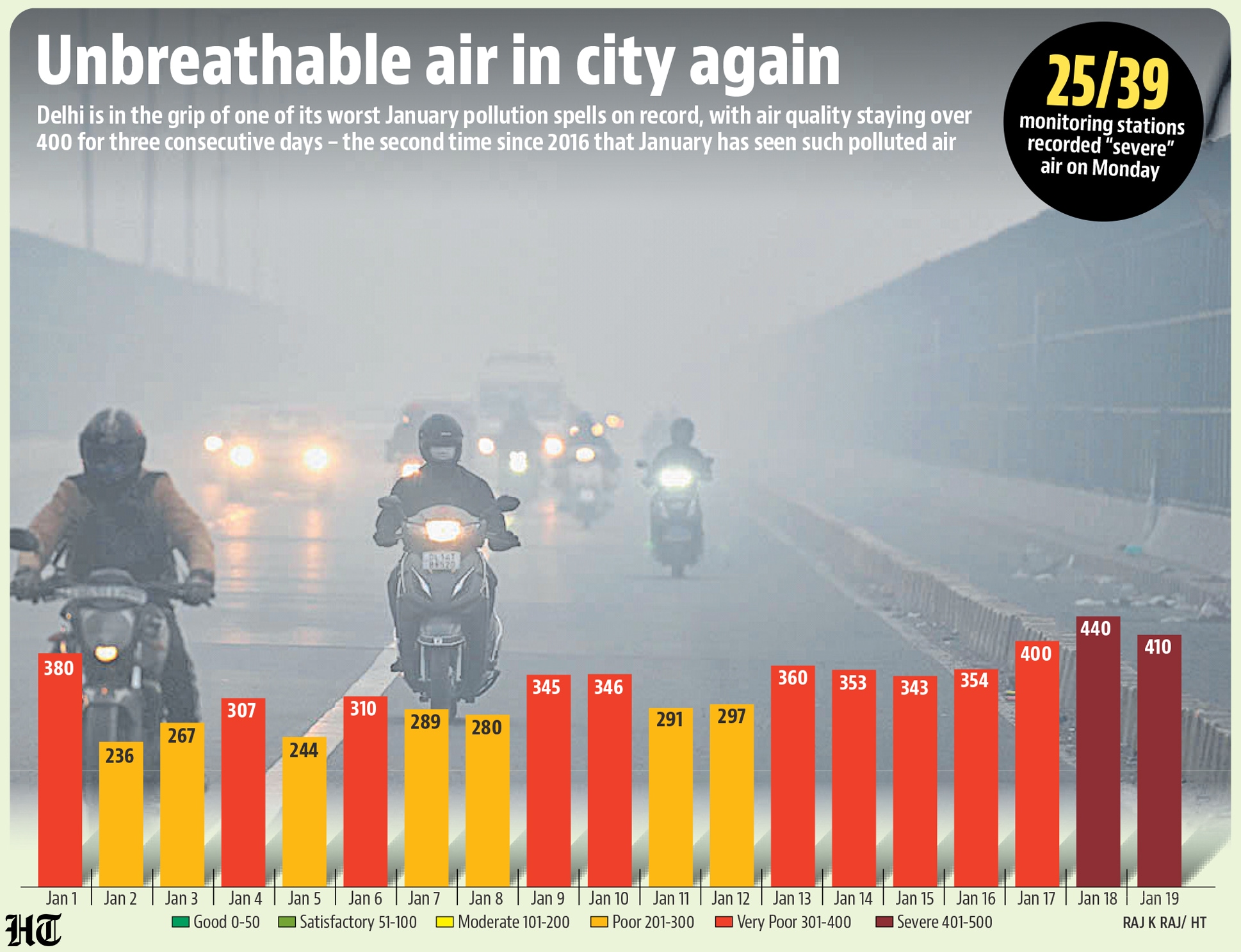
Data from the Central Pollution Control Board (CPCB) underscores how widespread the crisis is. Of the 39 active ambient air quality monitoring stations across the city, at least 25 were reporting “severe” air through Monday. Several areas were gasping under near-toxic conditions. Wazirpur in northwest Delhi recorded a staggering AQI of 473, followed closely by Vivek Vihar at 472. On Sunday, Anand Vihar peaked at 497 – just three points short of the maximum possible reading of 500, effectively brushing against the upper limits of the index.
This crisis is particularly jarring as mid-January typically heralds a period of gradual improvement, offering residents some relief after a punishing pollution season that usually sets in by late October. Instead, residents are facing an intensified and prolonged toxic spell, following a December that was the most polluted in five years.
Forecasts offer little immediate comfort. The Centre’s Air Quality Early Warning System (EWS) has warned that air quality is likely to remain unbreathable over the coming days. While there is a chance that AQI could slip marginally into the “very poor” range on Tuesday, conditions are expected to stay hazardous.
“Delhi’s air quality is likely to be in the ‘very poor’ category from January 20 till 22. The outlook for the subsequent six days from January 23 shows the AQI is likely to be between ‘poor’ and ‘very poor’,” the EWS said in its Monday bulletin.
Experts warn that emergency measures alone will not suffice without strict enforcement on the ground.
Mohammad Rafiuddin, programme lead at the Council on Energy, Environment and Water (CEEW), said authorities must ensure that restrictions under Stage-4 of Grap are actually implemented. “This includes preventing the movement of polluting vehicles, enforcing dust control at construction sites, and curbing open biomass burning,” he said, urging citizens to follow the GRAP charter, minimise outdoor exposure, use public transport where possible and wear masks to reduce health risks.
The latest spell has also revived questions about systemic failure in tackling Delhi’s pollution. On January 6, the Supreme Court pulled up CAQM, calling its inability to clearly identify pollution sources and their relative contribution a “complete failure of duty”. The court directed the body to complete a source identification and apportionment exercise within two weeks and place the findings in the public domain.
In December, the court had gone further, describing existing measures as a “total failure” and calling for a comprehensive long-term strategy.
To be sure, the only saviour – weather conditions – have also offered little respite this month. respite. Moderate fog was recorded in the early hours of Monday, with visibility dropping to 200 metres at Safdarjung and 700 metres at Palam. The minimum temperature rose to 7.7°C, close to normal for this time of year, up from 5.3°C a day earlier. The maximum temperature climbed sharply to 26.7°C – nearly seven degrees above normal – aiding pollutant accumulation near the surface.
Some relief may only arrive towards the end of the week. The India Meteorological Department has forecast light rain in Delhi around January 23, linked to an active western disturbance. “We can expect an active western disturbance to bring rain to Delhi-NCR beginning the night of January 22, into January 23,” said Mahesh Palawat, vice president at Skymet

Stay updated with all top Cities including, Bengaluru, Delhi, Mumbai and more across India. Stay informed on the latest happenings in World News along with Delhi Election 2025 and Delhi Election Result 2025 Live, New Delhi Election Result Live, Kalkaji Election Result Live at Hindustan Times.


