
 E-Paper



Air emergency looms as farm fires rage with rains receding
Satellite data from Nasa, collated by the Indian Agricultural Research Institute, showed Punjab recorded 169 fires on Saturday, while Haryana recorded 36 fires. There were no fires recorded in UP

 Prefer HTon Google


At 205, the breadbasket states of Punjab, Haryana and Uttar Pradesh recorded the season’s highest single-day count of farm fires over the weekend, pushing the Capital’s air quality into the poor category after 11 days.
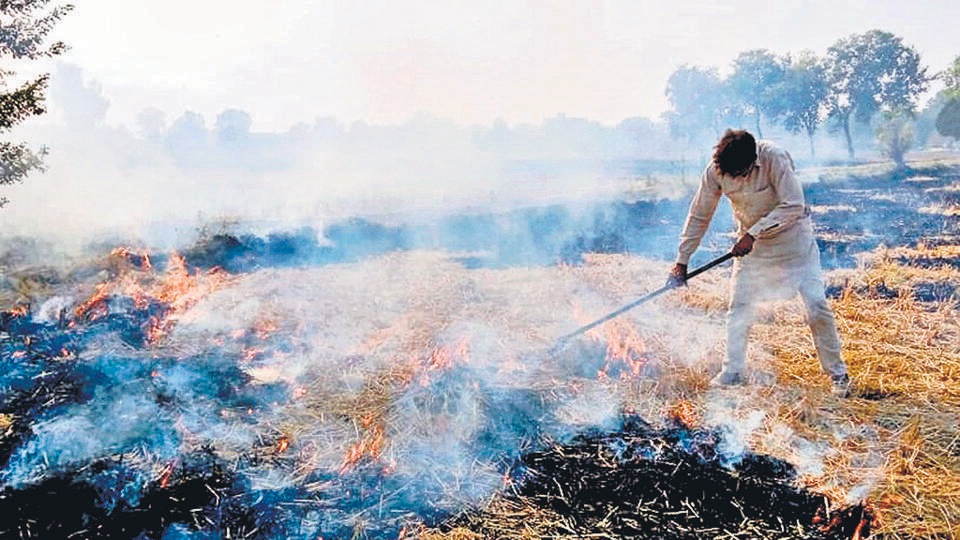
Before this, the highest number of fires in the three states was 135 on October 13.
Satellite data from Nasa, collated by the Indian Agricultural Research Institute, showed Punjab recorded 169 fires on Saturday, while Haryana recorded 36 fires. There were no fires recorded in UP.
With the harvest season progressing, experts say this number is likely to go up over the next two weeks.
“We saw Punjab and Haryana’s highest count so far this season on Saturday and this number is expected to increase further over the next two weeks. The peak stubble season normally starts around October 26-27 and continues till November 10,” VK Sehgal, professor and principal scientist at IARI and part of CREAMS, said, adding that with the new measures being employed by state governments the figures might remain low.
The Consortium for Research on Agroecosystem Monitoring and Modelling from Space (CREAMS), under IARI, began analysing satellite data from Nasa on September 15 this year.
The data in the one month since, shows Punjab, Haryana and Uttar Pradesh are all faring better than the last two years.
Till October 15, Punjab recorded a total of 1,238 fires, down from 1,946 that it recorded in the same period last year. In 2020, the figure was 4,665 — nearly four times the 2022 number.
In neighbouring Haryana, 168 fires were recorded over the last month, compared to 850 last year, and 702 in 2020.
Uttar Pradesh, meanwhile, has recorded 91 fires so far, down from 460 fires at the same time last year and 320 in 2020.
Farmers in the region set fire to paddy stubble during the end of October and early November, so as to not incur expenses associated with use of multiple stubble management machines, very short time available before the rabi (winter) crop is sown in the first week of November; the lack of transportation services to ship out stubble that has been cut and baled; and other systemic issues, including the lack of financial incentives.
This year, the two rain spells, between September 21 and 24, and between October 7 and 11, across the northern plains are also likely to have played a part in the reduced fire count so far.
“We saw a reduction in fire counts during these rains spells and continuous rains would also have delayed burning. We will have to wait for a clear trend to emerge in the coming weeks,” said Anumita Roychowdhury, executive director, research and advocacy at the Centre for Science and Environment.
Despite a low count of farm fires so far, Delhi recorded an air quality index of 232 on Sunday, with experts warning that the complete withdrawal of monsoon and a reduced windspeed will create unfavourable conditions for dispersal of air pollution.
An AQI between zero and 50 is considered “good”, 51 and 100 “satisfactory”, 101 and 200 “moderate”, 201 and 300 “poor”, 301 and 400 “very poor”, and 401 and 500 “severe”.
“The wind speed has reduced since Saturday evening and temperatures have started falling this is why we are also seeing a rise in air pollution levels. The winds are northwesterly and there are farm fires in Punjab and Haryana. In Haryana, farm fires are less compared to last year during this period. We do not expect relief from these conditions till October 19 when wind direction is expected to become easterly temporarily. The ventilation index is too low for dispersal of pollution,” said Vijay Soni, scientist at IMD’s air quality early warning system for Delhi.
The ventilation index on Sunday was around 4000 m2/s. A ventilation index lower than 6000 m2/s with average wind speed less than 10 kmph is unfavourable for dispersion of pollutants.
“Fire count numbers have touched 200 overall and while the wind direction is favourable too, the wind speed at the transport level is not strong and so the impact on Delhi’s air quality is negligible at present. At this rate at which the fire count is increasing and with weather conditions expected to become adverse gradually, we can see farm fires contributing to Delhi’s overall PM 2.5 count from this coming week onwards,” Gufran Beig, founder project director at the System of Air Quality and Weather Forecasting And Research (SAFAR), said.
On Sunday, the wind speed was 8 kmph at Palam and 6 kmph at Safdarjung around 5.30 PM.
Last year, the share of farm fires in Delhi’s PM 2.5 concentration was as high as 48% on November 7 — nearly half of Delhi’s pollution came from farm fires on the day.



