
 E-Paper



Alarm bells ring as Delhi’s AQI enters ‘severe’ zone
Delhi’s AQI hit the season’s high so far on Saturday, when pollution gauges read 397 at 4pm.


Delhi’s air quality continued its alarming descent deep into noxious levels, as the pollution climbed into the ‘severe’ zone on Monday evening, stoked by smoke from farm fires in Punjab and helped by calm winds and dipping temperatures in the city.
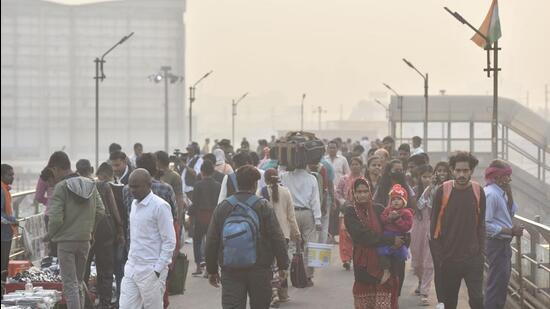
Though the Central Pollution Control Board’s (CPCB) daily 4pm bulletin logged an air quality index (AQI) of 392 (‘very poor’) on Monday, worse than 352 a day ago and the second-highest so far this season, this number climbed hour-on-hour and crept to 403 (‘severe’) at 10pm, according to the agency’s Sameer app.
An AQI between 301 and 400 is categorised as very poor and one between 401 and 500 is severe, the worst band on the index.
Delhi’s AQI hit the season’s high so far on Saturday, when pollution gauges read 397 at 4pm, a number it settled to after briefly inching past the 400 mark that afternoon.
Also read: CPCB live air quality feed hits pause for 11 hours after tech glitch
To be sure, Delhi’s AQI is yet to touch severe on the 4pm bulletin, the value considered for air quality records, so far this season.
Smoke from raging farm fires in Punjab, and Haryana to a lesser degree, share significant blame for Delhi’s pollution levels.
On Monday, Punjab recorded 2,131 farm fires, showed state government data, the most in a day so far this season, with experts and officials warning that this number will only climb over the next few days, with nearly half the state’s paddy fields still to be cleared for the winter crop.
On Monday, 22% of Delhi’s PM2.5 concentration was down to pollutants from farm fires, a marginal dip from 26% a day ago, according to the Centre’s System of Air Quality Management and Weather Forecasting And Research (Safar).
Between September 15 and October 31 this year, Punjab has recorded 16,004 farm fires – nearly 3,700 more than at the same time last year. While the count in this period last year was 13,269 fires, it was 33,243 in 2020.
Haryana, meanwhile, clocked just 70 farm fires on Monday. The state has clocked 1,921 paddy fires so far this season.
To be sure, local factors, including domestic emissions, dipping temperatures and calm winds are trapping pollutants and pushing the AQI up.
Worse still, residents of the city will likely keep breathing air this hazardous for at least 72 more hours, with agencies predicting little change in meteorological conditions.
The AQI will be between very poor and severe on Tuesday and very poor on Wednesday and Thursday, according to the Early Warning System (EWS) used by the Commission for Air Quality Management (CAQM) to chalk out pre-emptive action under the Graded Response Action Plan (Grap).
“Meteorological conditions in Delhi and the National Capital Region (NCR) are unfavourable to disperse pollutants at the moment. Winds are mostly calm and coming from the northwest. Atmospheric conditions are also stable, which is favourable for accumulation of pollutants,” said VK Soni, scientist at IMD and part of CAQM.
The mixing height was dropping and is less than 500 metres, he said.
Also read: Delhi air pollution: 586 teams to enforce construction ban, says Gopal Rai
The mixing height or boundary layer is an invisible layer in the atmosphere within which particulate matter gets trapped. The lower the mixing height, the more pollution rises, as pollutants are closer to the surface and are unable to disperse.
Early October gains lost in last week
Despite what has been a highly polluted end to the month, CPCB data shows that Delhi ended this October with an average AQI of 210, the second cleanest the month has been in eight years, behind only last year, when the average AQI was 173.
Delhi’s enjoyed a clean start to the season, with a spell of rain between giving the city two straight days of ‘good’ air on October 9 and 10, with the AQI falling to 44 on the latter — the cleanest air the Capital has breathed since August 31, 2020.
These early gains were, however, quickly lost after Diwali, said experts.

Stay updated with all top Cities including, Bengaluru, Delhi, Mumbai and more across India. Stay informed on the latest happenings in World News along with Delhi Election 2025 and Delhi Election Result 2025 Live, New Delhi Election Result Live, Kalkaji Election Result Live at Hindustan Times.


