
 E-Paper



Another ‘severe’ day in Delhi-NCR, spell may continue till Nov 7
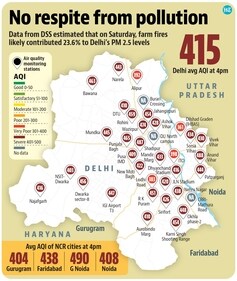
Delhi's air quality remained in the "severe" category for a third consecutive day, with an Air Quality Index (AQI) of 415 on Saturday.


Delhi spent another day negotiating a soupy haze that left residents struggling to breathe, as the air quality index (AQI) on Saturday spent a third consecutive day in the “severe” category, even as no relief was in the offing, with weather agencies predicting that the city’s pollution levels will remain similar for the next three days.
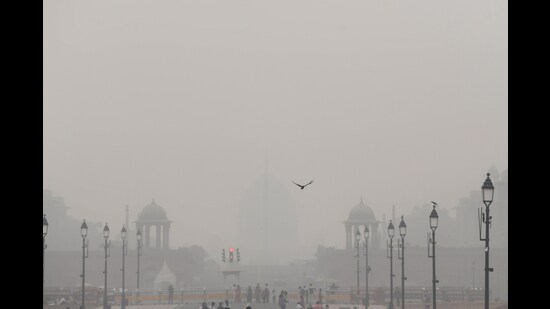
The national capital clocked an AQI of 415 on Saturday, as idle winds, smoke from farm fires and low temperatures kept pollutants concentrated close to the ground. On Friday, Delhi recorded an AQI of 468, the highest in nearly two years. And while the city’s official reading according to the Central Pollution Control Board’s (CPCB) 4pm bulletin on Thursday was 392, a shade short of the “severe” category, this number spilled past 400 just an hour later.
Of the 34 functioning pollution monitoring stations at 4pm on Saturday, 23 were in the “severe” category. The AQI was at its worst in Shadipur (475) and Anand Vihar (473).
Greater Noida was the most polluted city in the National Capital Region (NCR) — and indeed the country — with an AQI of 490. Noida clocked an AQI of 408, while Gurugram logged an AQI of 404.
Kuldeep Srivastava of the India Meteorological Department (IMD) said conditions were unlikely to change over the next three days.
“A western disturbance is expected on November 7, but it is unlikely to impact the plains, so we may not see any major change yet,” he said, attributing the pollution to calm winds.
Delhi environment minister Gopal Rai in a press conference, said that despite the slight improvement from the past two days, Delhi will be in a “critical situation” over the next few days. He wrote to the central government to ban entry of polluting vehicles into the NCR, and asked the Centre to convene a meeting with the environment ministers’ of the states concerned.
“Considering the coincidence of Diwali and more parali burning incidents expected in neighbouring states, the ambient air quality of the city is expected to deteriorate... Hence, may I request you to effectively ban entry of vehicles non compliant to BS6 norms into Delhi... I further request you to convene an emergency meeting of neighbouring states’ environment ministers including UP, Haryana, Rajasthan, Punjab and Delhi to address this important issue,” said the letter.
The Aam Aadmi Party (AAP) government itself, however, took no further steps to tamp down the toxic pollution levels.
Data from the Decision Support System (DSS), under the ministry of earth sciences (MoES), on Saturday estimated that stubble burning would be a key cause of Delhi’s PM2.5 levels, at 23.6%, a number which is expected to be at around 25.4% on Sunday.
To be sure, this number was lower than 35.4% on Friday.
Read Here: Greater Noida most polluted in country for second day in row; AQI reaches 490
Paddy fields continued to burn in Punjab and Haryana, but, crucially, they are still only at a fraction of their annual average so far, with the numbers likely to rise over the next few days.
Indian Agricultural Research Institute (IARI) data showed Punjab recorded 1,360 farm fires on Saturday.
Dipankar Saha, former head of CPCB’s air laboratory said a strong weather system is needed to blow away pollutants accumulating over Delhi. “Due to Delhi’s geographical position, pollutants tend to accumulate at this time of the year, aided by stubble intrusion. The only thing we can do is control our local sources and reduce them to a large extent,” he said, stressing Delhi’s local emissions were high already, but further pollution — coming from stubble burning and beyond NCR was also gradually adding up to Delhi’s total pollution load.
And while action remained absent, the political blame game around the pollution repeated itself on Saturday, with Rai hitting out at the Centre for accusing the AAP government of allegedly stopping the anti-smog tower at Connaught Place.
The Bharatiya Janata Party said Delhi’s pollution crisis has become an annual affair.
“It is high time to stop blame game and initiate measures on war footing. Studies suggest that continuous rise in pollution level in Delhi has reduced the average lifespan of resident by 12 years,” BJP leader and North East Delhi MP Manoj Tiwari said in a letter addressed to CM Kejriwal.
Thermal inversion makes matters worse
While local pollutants — tailpipe gases, dust and industrial emissions in Delhi — and smoke from farm fires in Punjab and Haryana are the primary causes for the crisis, an atmospheric phenomenon called thermal inversion is making matters worse, creating an invisible lid that is trapping pollutants instead of letting them disperse.
Experts said strong external winds are needed in such a scenario to break the inversion pattern. “In such a scenario, there is considerable built-up of pollutants and visibility starts to drop, because of the density of pollutants. Wind speed picked up on Friday afternoon, which was ultimately able to help disperse pollutants,” said Mukesh Khare, an air pollution expert and professor at IIT Delhi.

Stay updated with all top Cities including, Bengaluru, Delhi, Mumbai and more across India. Stay informed on the latest happenings in World News along with Delhi Election 2025 and Delhi Election Result 2025 Live, New Delhi Election Result Live, Kalkaji Election Result Live at Hindustan Times.


