E-Paper



‘AQI severe’: Delhi bans BS-III petrol and BS-IV diesel four-wheelers till Dec 9
On Monday, the AQI showed an improvement, dropping down to the ‘very poor’ category with a reading of 347 at 4 pm, a drop of 60 points from Sunday’s 407

 Prefer HTon Google


After the air quality index (AQI) in the national capital turned severe on Sunday at 407, the Delhi transport department on Monday, in compliance with measures under Stage III of the graded response action plan (Grap), banned the plying of BS-III petrol and BS-IV diesel four-wheeler vehicles in Delhi with immediate effect.
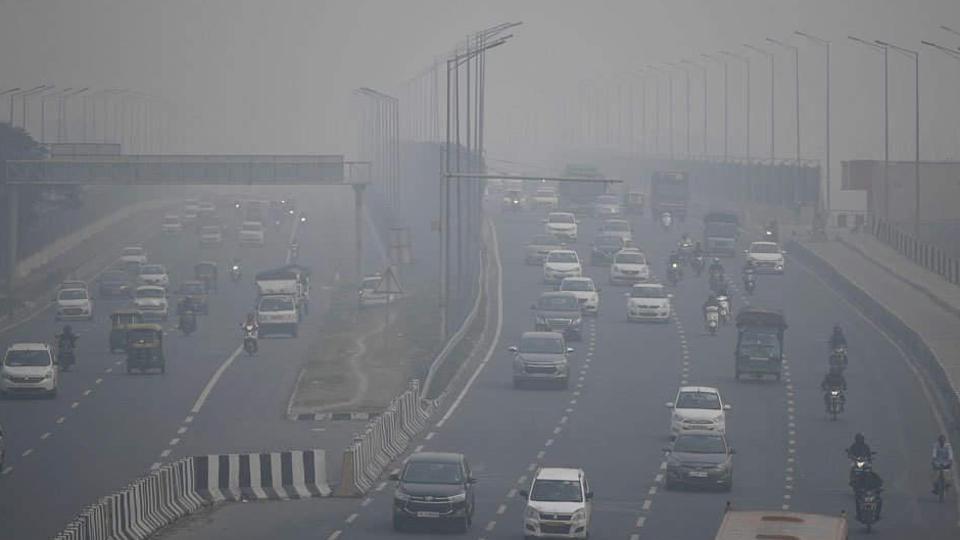
City’s transport department while issuing notice on Monday said, “As per directions provided under Stage-III of the Grap and under Section 115 of the Motor Vehicle Act, 1988, it is hereby ordered that there shall be restrictions to ply BS-III Petrol and BS IV diesel light motor vehicles (four-wheelers) in Delhi with immediate effect, till December 9, 2022, or till downward revision in the Grap stage, whichever is earlier.”
Also Read: Delhi’s air quality improves to ‘very poor’ day after touching ‘severe’ mark
The ban will remain till December 9, 2022, unless the CAQM removes Stage III restrictions earlier than that, it said.
On Monday, Delhi’s air quality improved slightly to return to the “very poor.” An AQI of 366 was recorded at 7am compared to 407 at 4pm on Sunday.
The order specified that diesel four-wheelers involved in providing emergency services or government/election work were exempted from this ban.
Further, according to the order which has also been shared with the city traffic police, violators can be fined ₹20,000, as per section 194 of the motor vehicle act, 1988.
“Instructions have been relayed to the traffic police to comply with the order from immediate effect and fines can be issued based on this,” said a transport official, on condition of anonymity.
After the AQI deteriorated to the ‘severe’ category for the first time in a month on Sunday, the commission for air quality management (CAQM) held an emergency meeting and invoked all measures under Stage III with immediate effect which includes a ban on private construction activities across Delhi-NCR, closure of all brick kilns and hot mix plants not operating on clean fuels, closure of all stone crushers in NCR and a ban on mining and its associated activities.
Also Read: Delhi’s air quality touches ‘severe’ category; CAQM invokes stage III measures
As per Stage III of Grap, states have an option to enforce such a ban, while in Stage IV (AQI of 450 or higher), it is mandatory to impose such a ban. At present, there are around 0.3 million BS IV diesel four-wheelers registered within Delhi, while there are around 0.2 million BS III petrol vehicles.
Anumita Roychowdhury, executive director, research and advocacy at the centre for science and environment (CSE) said, “Such measures can be avoided in the future if long-term action is taken. As per Grap, these bans should also be lifted as soon as the AQI improves,” adding that these curbs are aimed at controlling a spike in air pollution.
An AQI between 0-50 is considered “good”, 51 and 100 “satisfactory”, 101 and 200 “moderate”, 201 and 300 as “poor”, 301 and 400 “very poor” and over 400 severe. Severe air quality was recorded on Saturday for the fourth time this season since November 1 (424). It was earlier recorded last on November 4 (447).