
 E-Paper



ASI embarks on phase two of Barapullah bridge revival
When HT visited the site on Monday, the bridge stood sealed behind iron gates—both to protect the structure and to prevent further encroachment

 Prefer HTon Google


Once a Mughal-era marvel, Delhi’s 400-year-old Barapullah bridge is undergoing a careful restoration by the Archaeological Survey of India (ASI), expected to be completed by year-end, officials told HT on Monday.
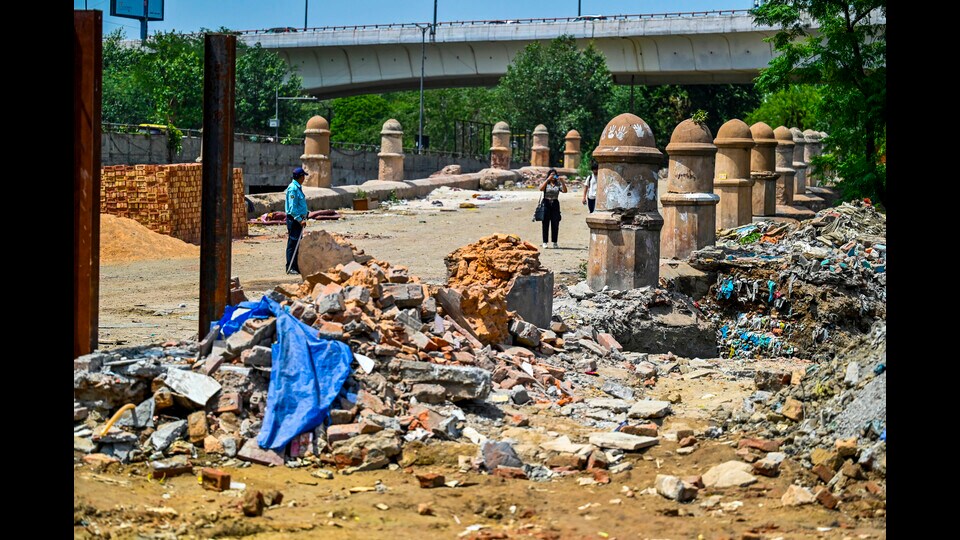
Tucked beneath the modern Barapullah flyover and straddling what is now a wide drain, the 17th-century bridge—named after its twelve distinct piers—has begun to emerge from the layers of urban neglect. The two-phase restoration project, led by the ASI, aims to return the heritage structure to its original form after years of encroachment and civic decay.
“We are yet to put an exact date on when phase two will start as the plans are still in the process of being approved, but we hope to wrap up the entire restoration work by the end of this year,” said an ASI official involved in the effort, requesting anonymity.
The restoration effort
The restoration effort gained momentum following a site visit by Delhi lieutenant governor VK Saxena in August 2024. At the time, the bridge had become indistinguishable from the fringes of the Madrasi colony in Jangpura-B, its corridor converted into a makeshift market.
Phase one, completed over the past nine months, focused on clearing the site for conservation. Agencies including the Municipal Corporation of Delhi (MCD) and the Public Works Department (PWD) cleaned and desilted the Barapullah drain while removing encroachments that had compromised the bridge’s foundation.
“The colony and encroachments that were damaging the bridge structure were removed. About 168 families, whose houses were located in the colony, were relocated to Narela and nearby locations,” the ASI official said.
When HT visited the site on Monday, the bridge stood sealed behind iron gates—both to protect the structure and to prevent further encroachment. Officials said these gates would reopen for pedestrian use after the restoration is completed, but the bridge will remain closed to vehicles to preserve its integrity.
Phase 2
Unlike the clearing and relocation-driven first phase, the upcoming phase will focus on the structural restoration of the bridge.
“The corridor of the structure is very uneven due to layers of debris that were probably laid down again and again over the ages. It is one foot deep at some places and up to three feet deep in the middle of the structure,” said the ASI official.
To understand the original materials and construction, ASI carried out a trial excavation. “We dug a three-foot by three-foot patch at one end of the bridge to identify the materials used. We found ashlar stones—rectangular, durable blocks used in masonry—below all the debris layers. So in the next phase, we are going to remove all those layers and level the bridge out to reveal and preserve the original surface,” he added.
The twelve piers that give the bridge its name will be a key focus. When viewed from the end formerly engulfed by the colony, the first pier on the right and the eighth on the left are visibly damaged and lie in fragments. “These two piers will be reconstructed. The rest will be repaired, covered with fresh plaster, and restored,” the official said.
The history
Spanning 195 metres in length and 14 metres in width, the Barapullah bridge was constructed during the reign of Mughal emperor Jahangir, in 1621-22. Built over a Yamuna tributary—now reduced to an open drain next to Nizamuddin Basti—the bridge once served as a passage for the Mughal court.
According to Delhi and Its Neighbourhood, a 2001 ASI publication, “It [the Barapullah bridge] consists of 11 arched openings but twelve piers, which appear to have given it its name, meaning ‘twelve piers.’ Each pier is surmounted by a two-metre-high minar.”
The book also references an inscription—no longer traceable—on one of the arches, stating that the bridge was built in 1030 A.H. (Islamic calendar) by Mihr Banu Agha, the chief eunuch in Jahangir’s court. This translates to 1621-22 A.D. in the Gregorian calendar.

Stay updated with all top Cities including, Bengaluru, Delhi, Mumbai and more across India. Stay informed on the latest happenings in World News along with Delhi Election 2025 and Delhi Election Result 2025 Live, New Delhi Election Result Live, Kalkaji Election Result Live at Hindustan Times.


