
 E-Paper



Author’s talk on how railways carried India to freedom
Mukul Kumar's lecture explored how Indian Railways, initially a colonial tool, became vital for freedom fighters and mass nationalism in India's struggle for independence.

 Prefer HTon Google


The colonial legacy of Indian Railways and its role in the country’s freedom struggle was the focus of a public lecture by bureaucrat-author Mukul Kumar on Tuesday.
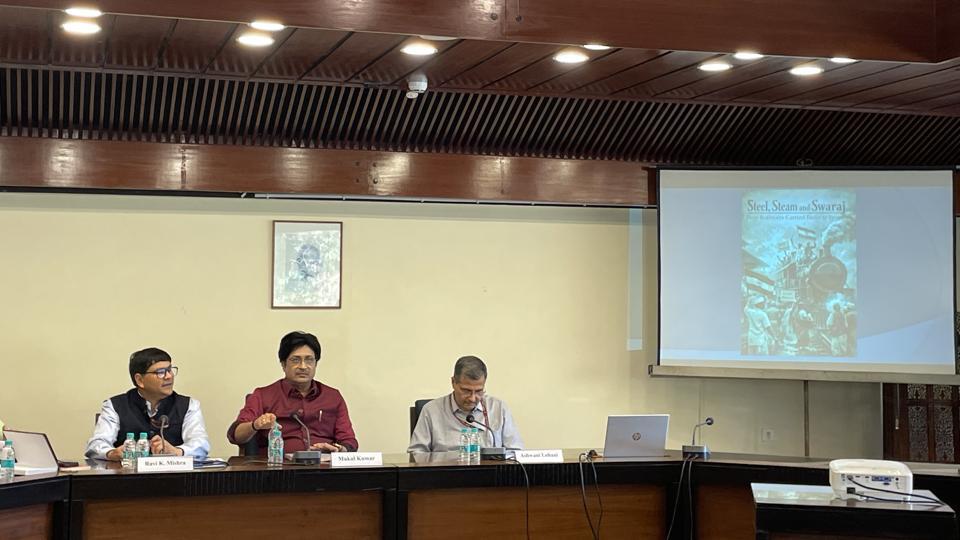
Speaking at the Prime Ministers Museum and Library, Kumar explored how the infrastructure built by the British to tighten their grip on India became a powerful tool for both mass mobilization and revolutionary attack. The event, organised by the Ministry of Culture, was attended by dozens of scholars and researchers.
In his talk, “Steel, Steam and Swaraj: How Railways Carried India to Freedom”, Kumar argued that while the railways were introduced by the colonial rulers primarily to facilitate resource exploitation and troop movement, they were later effectively co-opted by freedom fighters.
He categorised his narrative into two distinct streams. “The first part brings out how Mahatma Gandhi used railways to foster mass nationalism,” Kumar said. “The second part brings out the totally contrasting way in which the revolutionaries used railways to hit the colonial empire.”
Kumar noted that the railway network was rigidly divided into three classes: first for European officials, second for the Indian elite, and third for the masses. By choosing to travel exclusively in third class, Gandhi made his allegiance clear.
“When Gandhi returned to India in 1915, his political mentor Gopal Krishna Gokhale advised him not to rush into politics but to first travel, listen, and understand the country,” Kumar said. “He chose to travel third class—not as a symbolic act, but as a matter of principle.”
At the time, third-class travel meant extreme overcrowding, poor sanitation, and harsh conditions. “This was the everyday reality for most Indians—farmers, workers, pilgrims, traders, and families. Gandhi consciously chose to share and experience their lived conditions,” Kumar added, noting that the Mahatma turned the railway journey into a confessional, a classroom, and a court of appeal all at once.
In contrast, the lecture highlighted what Kumar termed “Revolution on Rails”. He detailed incidents such as the Alipur Gang’s actions in 1908, the Kakori train robbery of 1925, and the 1929 attempt by the Hindustan Socialist Republican Association (HSRA) to bomb the Viceroy’s train near Delhi.
“The revolutionaries understood railways much like a military strategist understands terrain,” Kumar explained. “For them, the railways were the nervous system of British colonial control—moving troops, transporting revenues, linking administrative centers, and supplying garrisons. To attack the railways was to strike the empire at its most visible and vulnerable point.”
Kumar concluded by describing how the railways also served as a means of “refuge” and escape for iconic figures like Bhagat Singh and Subhash Chandra Bose in their campaigns against colonial rule.

Stay updated with all top Cities including, Bengaluru, Delhi, Mumbai and more across India. Stay informed on the latest happenings in World News along with Delhi Election 2025 and Delhi Election Result 2025 Live, New Delhi Election Result Live, Kalkaji Election Result Live at Hindustan Times.


