
 E-Paper



CAQM has issued 95 directions to curb pollution in NCR: Centre tells Parliament
The CAQM issued 95 directives to combat air pollution in Delhi-NCR, with stricter norms and a monitoring mechanism in place, amid worsening air quality.


The Commission for Air Quality Management (CAQM) has so far issued 95 statutory directions aimed at guiding and enforcing targeted measures to curb air pollution across Delhi-NCR, the Union environment ministry informed the Lok Sabha on Monday.
Union environment minister Bhupender Yadav said that a monitoring mechanism is already in place to oversee compliance with these directions, and stressed that CAQM has introduced stricter emission norms for several categories of polluting activities in the region compared to national standards.
Yadav was responding to questions raised by Congress MP Krisan Namdeo on whether the Centre is aware of Delhi’s worsening air quality, its impact on public health during winter, and whether the Delhi government has adequately utilised central funds earmarked for pollution control. Namdeo also sought details on reasons for underutilisation of funds, accountability measures taken by the Centre, and the status of ongoing interventions.
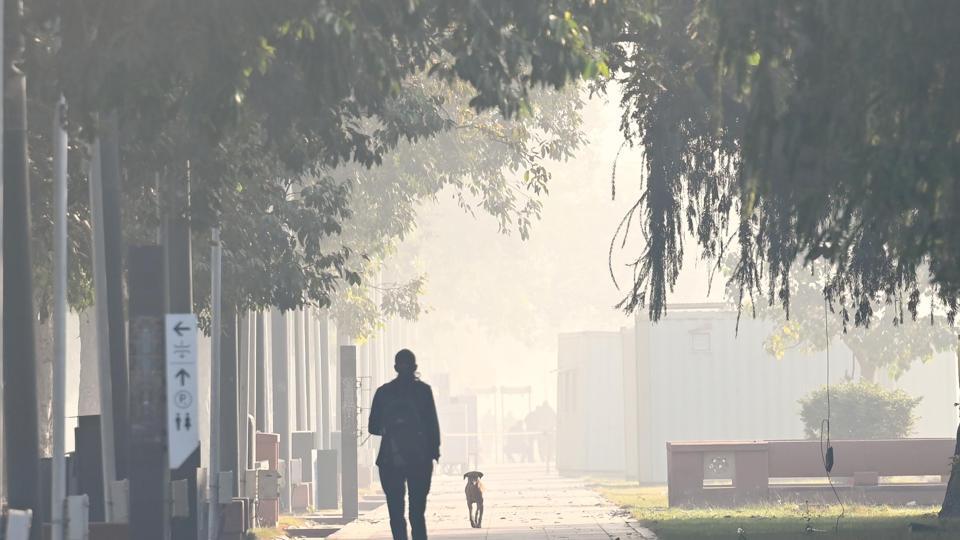
Delhi recorded a 24-day stretch of “very poor” air quality between November 6 and 29 this year, when the Air Quality Index (AQI) remained above 300. During this period, three days – November 11, 12 and 13 – slipped into the “severe” category, underscoring the city’s chronic winter pollution crisis.
In his written reply, Yadav said the Centre established CAQM under the Commission for Air Quality Management in NCR and Adjoining Areas Act, 2021, to ensure better coordination and scientific planning for pollution control across the region. “The commission has been provided powers under the Act to take measures and issue directions to the various agencies in NCR for protecting and improving air quality. It has addressed the issue of air pollution in Delhi-NCR in a collective, collaborative and participative mode involving all major stakeholders.”
A key component of the commission’s work is the Graded Response Action Plan (Grap), an emergency framework that prescribes escalating measures depending on predicted pollution levels, the reply stated. Based on daily weather and pollution modelling by the India Meteorological Department (IMD) and the Indian Institute of Tropical Meteorology (IITM), CAQM invokes stages 1 to 4 of Grap in advance, depending on anticipated AQI levels. Yadav said the commission recently conducted a comprehensive review of Grap and made the measures under each stage “more stringent” to reflect the evolving pollution scenario.
The minister said regular review meetings were held on August 8, September 16, October 10 and November 11, chaired by him. A separate inter-ministerial meeting at the ministerial level was convened on October 7 to review crop residue burning – a major contributor to Delhi’s winter air pollution – jointly chaired by Yadav and the Union agriculture minister.
Yadav also highlighted an improvement in the city’s air quality trends over the longer term, stating that the number of “good” AQI days (AQI < 200) in Delhi increased to 200 days in 2025, compared to 110 such days in 2016.
Responding to a separate question from Congress MP Imran Masood, minister of state for environment Kirti Vardhan Singh said the Centre launched the National Clean Air Programme (NCAP) in January 2019 to systematically reduce air pollution in 130 “non-attainment” and million-plus cities across 24 states and UTs. These cities are required to implement detailed clean air action plans at national, state and city levels.
A total of 17 cities in Uttar Pradesh are covered under NCAP, Singh informed the House. The state has received ₹2,941.15 crore under the programme to implement a range of air-quality interventions listed in their city-specific action plans.
The Central Pollution Control Board (CPCB) has also identified 13 industrial clusters in Uttar Pradesh as critically or severely polluted – 10 critically polluted areas and three severely polluted ones. The UP Pollution Control Board has prepared action plans for these clusters, which are being implemented by industries to reduce emissions and comply with environmental norms.
Out of 777 industries in the state classified under the 17 highly polluting “Red” categories, 690 have installed Online Continuous Emission Monitoring Systems (OCEMS). Directions have been issued to the remaining 87 industries that have yet to comply.


Stay updated with all top Cities including, Bengaluru, Delhi, Mumbai and more across India. Stay informed on the latest happenings in World News along with Delhi Election 2025 and Delhi Election Result 2025 Live, New Delhi Election Result Live, Kalkaji Election Result Live at Hindustan Times.


