
 E-Paper



Centre moves to cut powers of Delhi govt
The amendment introduced on Monday decisively tilts the balance of power in favour of the L-G. It bars the Delhi govt from making any rule to enable itself or its committees to consider the matters of day-to-day administration of the Capital.

 Prefer HTon Google


The Union government on Monday introduced in Parliament a controversial bill giving overarching powers over the city’s daily functions to the Centre-appointed Lieutenant Governor, prompting fierce protests from the Delhi government and reviving an old power tussle for control of the Capital.
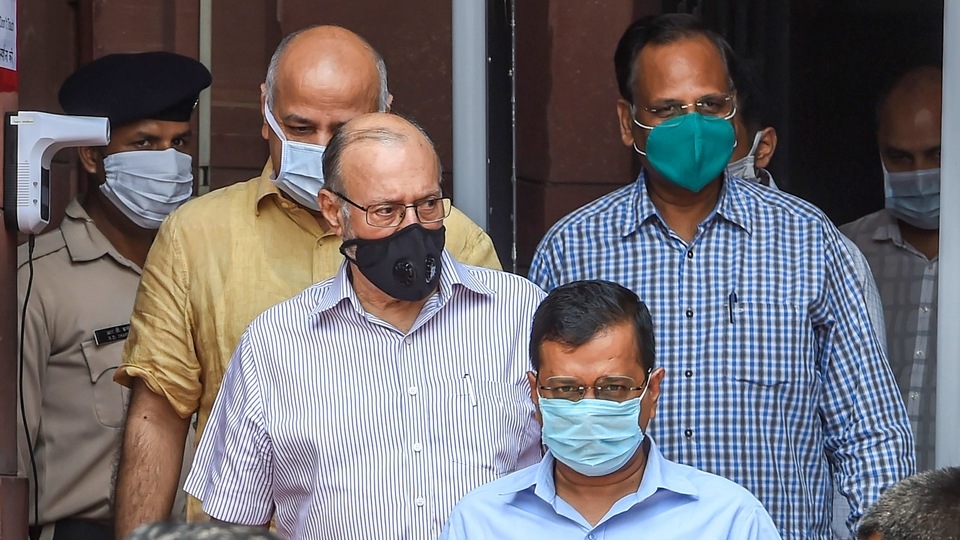
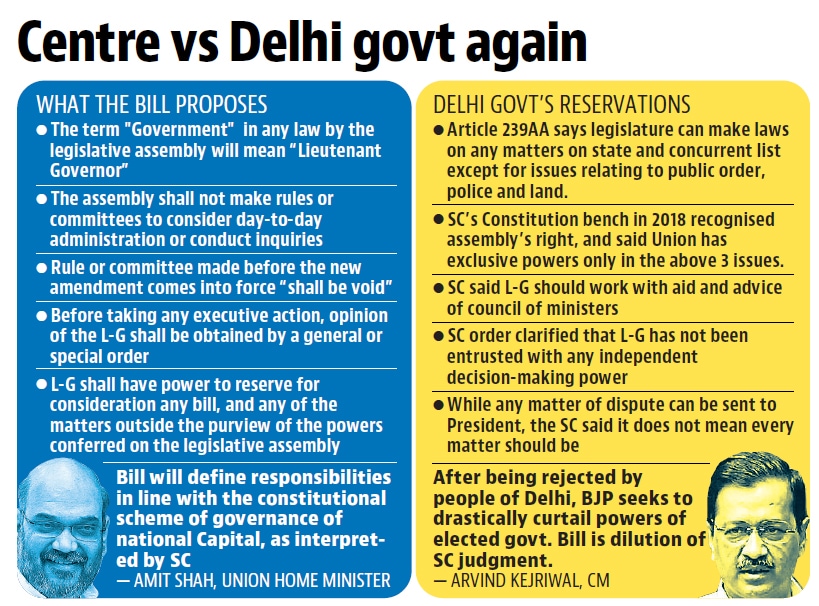
Union minister of state for home G Kishan Reddy introduced the Government of National Capital Territory of Delhi (Amendment) Bill, 2021, in the Lower House, where the government has a comfortable majority. The bill said “government” in Delhi will mean the L-G in context of all legislation passed by the city-state’s assembly and made it mandatory for the city government to seek the L-G’s opinion before any executive action.
“The said bill will promote harmonious relations between the legislature and the executive, and further define the responsibilities of the elected government and the lieutenant governor, in line with the constitutional scheme of governance of National Capital Territory of Delhi, as interpreted by the Hon’ble Supreme Court,” read a statement of objects and reasons, attached with the draft legislation, attributed to Union home minister Amit Shah.
Shortly after the bill was introduced, chief minister Arvind Kejriwal accused the Bharatiya Janata Party (BJP) of seeking to ically curtail the powers of an elected city government.
“After being rejected by people of Delhi (8 seats in assembly, 0 in MCD bypolls), BJP seeks to drastically curtail powers of elected government through a Bill in LS today. Bill is contrary to Constitution Bench judgement. We strongly condemn BJP’s unconstitutional n anti-democracy move,” he said.
On July 4, 2018, the Supreme Court ruled that the L-G couldn’t interfere in every decision of the Delhi government and must act on the aid and advice of the council of ministers.
Deputy chief minister Manish Sisodia called the bill unconstitutional and undemocratic. “After this bill is implemented, the elected government of Delhi will mean nothing. This is a dangerous amendment,” he told a press conference.
Delhi holds a unique position in India’s administrative framework. As a Union territory, it is governed by the 1991 Government of National Capital Territory of Delhi Act that provides for both an elected assembly and an L-G appointed by the Union home ministry. But unlike full states, many important departments such as land, police and personnel appointments don’t come under the purview of the city government and report directly to the L-G. Political conflict for administrative control of the prestigious national capital is decades old but came to a head in 2015, when the Aam Aadmi Party (AAP) swept to power and repeatedly clashed with the BJP over transfer and appointment of top bureaucrats. The former also accused the latter of trying to rule the city by proxy.
In July 2018, the top court ruled the L-G was bound to listen to the city’s elected government and couldn’t act independently, prompting the AAP government to claim victory. All decisions by Delhi’s council of ministers must be communicated to the L-G but his concurrence was not required, the five-judge bench headed by then Chief Justice of India Dipak Misra ruled.
The amendment introduced on Monday decisively tilts the balance of power in favour of the L-G. It bars the Delhi government from making any rule to enable itself or its committees to consider the matters of day-to-day administration of the Capital or conduct inquiries in relation to the administrative decisions. Any rule made till this act comes into effect will be void, according to the bill. It further says that the Delhi assembly won’t be able to make rules for regulating, its procedure and the conduct of its business which are inconsistent with the Rules of Procedure and Conduct of Business in Parliament. According to the Centre, the amendments seek to clarify the expression of government in order to give effect to the interpretation made by the Supreme Court.
“The Government of National Capital Territory of Delhi Act, 1991 was enacted to supplement the provisions of the Constitution relating to the legislative assembly and a council of ministers for the National Capital Territory of Delhi and for matters connected therewith or incidental thereto. Section 44 of the act deals with conduct of business and there is no structural mechanism provided in the act for effective time bound implementation of said section. Further, there is no clarity as to what proposal or matters are required to be submitted to Lieutenant Governor before issuing order thereon,” the statement of objects and reasons stated.
“It further seeks to ensure that the Lieutenant Governor is necessarily granted an opportunity to exercise the power entrusted to him under proviso to clause (4) of article 239AA of the Constitution, in select category of cases and also to make rules in matters which incidentally encroach upon matters falling outside the preview of the legislative assembly,” the statement added.
The AAP government opposed these provisions. “The Bill says- 1. For Delhi, “Govt” will mean LG Then what will elected govt do? … 2. All files will go to LG. This is against 4.7.18 Constitution Bench judgement which said that files will not be sent to LG, elected govt will take all decisions and send copy of decision to LG,” Kejriwal said in another tweet. Sisodia said the BJP was trying to dilute elections and electoral mandate by using unconstitutional means to pass undemocratic laws. “This Bill will stall Delhi’s progress by giving undue powers to the L-G. All the decisions taken by the Delhi Government, for the growth of the city, have seen an intrusion by the L-G. Files regarding the progress of Mohalla Clinics, CCTV installations, free electricity, water and schools have collected dust in the L-G’s office, owing to lack of support from his office,” he said.
The BJP rejected the charges and welcomed the amendment. “Public money is being wasted due to which Delhi is in a state of mess. No new development works have been initiated by this government. As Delhi continues to be a Union Territory, the L-G has the ultimate power. The Centre has only defined the powers more clearly,” said BJP and leader of Opposition in the Delhi assembly RS Bidhuri.
Lawyer Gautam Bhatia argued that the amendment violated the Supreme Court’s 2018 judgment. “Most of the provisions are specifically designed to nix the ongoing enquiry by the Delhi assembly into the 2020 riots...look at the proposed amendment to Section 33, which specifically bars the Delhi assembly from constituting committees to enquire into ‘the day-to-day affairs of the administration’, and makes it applicable with retrospective effect,” he said on Twitter.


