
 E-Paper



Delhi: Cabinet clears Jan Vishwas Bill, to be tabled in Assembly
The bill will replace jail terms for minor offences with civil prosecutions that can be handed out at the level of the executive magistrate.


The Delhi government on Tuesday stepped one step closer to decriminalising minor offences under seven Delhi Acts — from the 1954 Shops and Establishment Act to 2010 Delhi Industrial Act — after the Cabinet cleared the Delhi Jan Vishwas (Amendment of Provisions) Bill, 2026. It follows from a similar move made by the Union government earlierwith regards to federal laws.

The bill, under which seven laws will be amended, will replace jail terms for minor offences with civil prosecutions that can be handed out at the level of the executive magistrate. “Steep penalties and fines can act as enough of deterrent for minor technical lapses,” official said. The government did not share which exact provisions could be decriminalised.
The bill will be tabled in the upcoming assembly session.
In a statement, Delhi chief minister Rekha Gupta said that the bill aims to simplify compliance procedures and decriminalize minor violations to reduce the burden on courts and make the administrative system more effective. “Under the Jan Vishwas (Amendment of Provisions) Act, implemented by the central government in 2023, minor, technical, and procedural violations in central laws were decriminalised. Accordingly, states and union territories were also advised to review their laws. In this direction, the Delhi government conducted a thorough review of its various laws under state-level legislative reforms and found that in many cases, civil penalties are more appropriate and practical than criminal penalties,” she added.
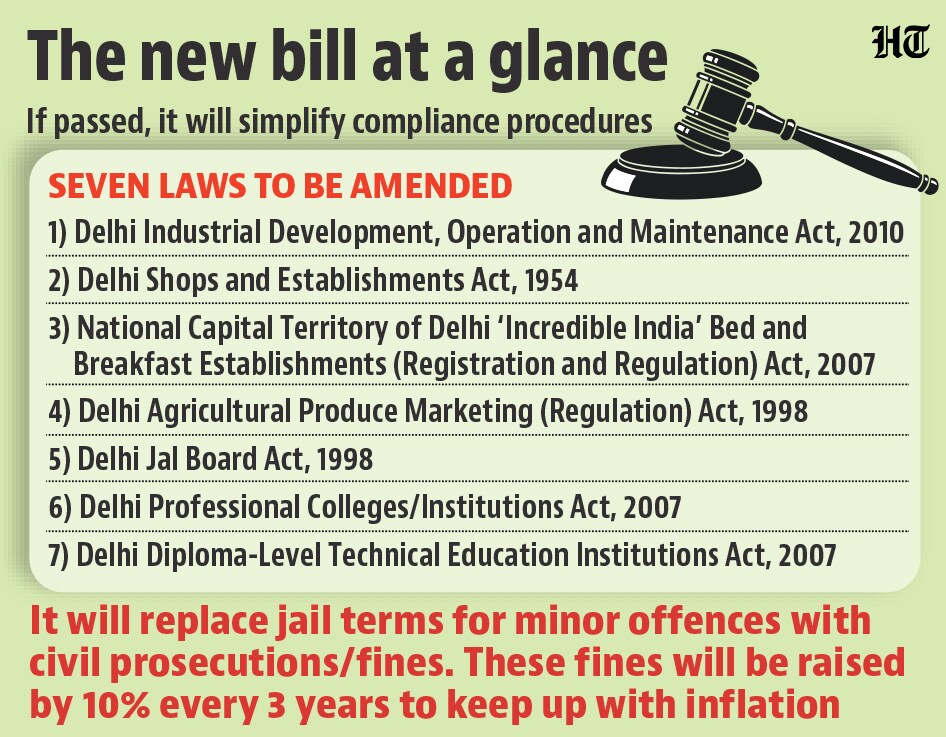
The seven acts to be amended include Delhi Industrial Development, Operation and Maintenance Act, 2010; Delhi Shops and Establishments Act, 1954; National Capital Territory of Delhi ‘Incredible India’ Bed and Breakfast Establishments (Registration and Regulation) Act, 2007; Delhi Agricultural Produce Marketing (Regulation) Act, 1998; Delhi Water Board Act, 1998; Delhi Professional Colleges/Institutions Act, 2007 and Delhi Diploma Level Technical Education Institutions Act, 2007.
Gupta said that the bill is not intended to promote lawlessness, but to ensure proportionality of punishment. “The proposal is to decriminalise minor offences in all these acts and convert them into civil penalties. The implementation of this bill will eliminate criminal prosecutions for minor, technical, and procedural violations, replacing them with civil penalties, administrative fines, and an appeals process. Strict provisions will remain in place for serious offences and matters related to public health, safety, and life,” she added.
The bill further proposes a 10% automatic increase in the fine amounts every three years after the act comes into force so that they stay in line with inflation and cost increases.
Gupta that this bill will not impose any additional financial burden on the government since no new posts will need to be created and implementation will be carried out using existing departmental resources, adding that the finance department has not raised any objections to the proposal.
The winter session of the Delhi assembly will begin on January 5 with the customary address from the lieutenant governor, VK Saxena, at 11am, after which the House will take up regular business. The session is scheduled to run until January 8, with sittings on the first day being held in the morning while proceedings on subsequent days starting at 2pm.

Stay updated with all top Cities including, Bengaluru, Delhi, Mumbai and more across India. Stay informed on the latest happenings in World News along with Delhi Election 2025 and Delhi Election Result 2025 Live, New Delhi Election Result Live, Kalkaji Election Result Live at Hindustan Times.


