
 E-Paper



Delhi CM revives Ladli scheme, urges LG to fast-track Master Plan 2041
On Wednesday, Gupta and Saxena inaugurated 81 development projects across 50 villages under the Dilli Gramodaya Abhiyan (DGA). The works—ranging from renovating community halls and chaupals to building parks and multipurpose centres—were launched from Pooth Khurd in Rohini


While inaugurating several development projects across rural Delhi on Wednesday, chief minister Rekha Gupta urged lieutenant governor VK Saxena to fast-track the long-pending Delhi Master Plan 2041, the draft of which was completed nearly three years ago.
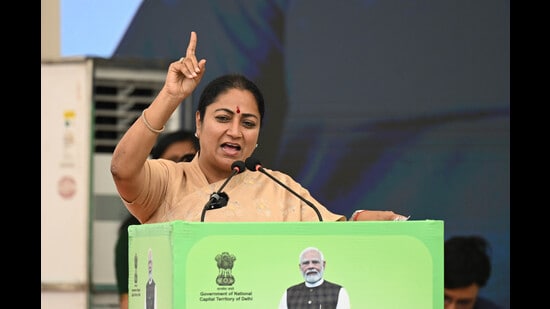
She said the plan was discussed in one of the first meetings after she took charge and that some proposed changes are already being reviewed.
“The new master plan should address the present development challenges that we are facing along with providing solutions that will benefit the upcoming generations for the next 100 years. I hope that the LG will work on getting [it] released for the people of Delhi at the earliest,” Gupta said.
She also announced that the Delhi government will credit honorarium to nearly 40,000 beneficiaries under its Ladli scheme on October 1, reviving the Sheila Dikshit-era programme after more than a decade. Earlier this year, the Women and Child Development department launched a district-wise drive to identify Ladli Yojana beneficiaries who had not claimed their entitlements.
Launched on January 1, 2008, the Ladli scheme aims to empower girls born in Delhi by providing financial support through term deposits. It offers assistance of ₹11,000 for institutional births, ₹10,000 for home births, and ₹5,000 at key stages of education—entry into Classes 1, 2, 6, 9 and 10. The scheme applies only to girls born in Delhi to families residing in the city for at least three years, with an annual income not exceeding ₹1 lakh.
On Wednesday, Gupta and Saxena inaugurated 81 development projects across 50 villages under the Dilli Gramodaya Abhiyan (DGA). The works—ranging from renovating community halls and chaupals to building parks and multipurpose centres—were launched from Pooth Khurd in Rohini.
Officials said the projects span five zones of Delhi, including 16 in Dwarka, 10 in East Delhi, 13 in Narela, 20 in the North Zone and 22 in Rohini. Largely executed by the Delhi Development Authority (DDA), they also feature open-air gym parks in Old Seemapuri and Karala, upgrades to rural roads and civic infrastructure improvements in villages such as Bhalaswa, Holambi Khurd, Ghoga, Sannoth, Bankner and Mohammadpur Majri.
The CM said the initiative was aimed at correcting the neglect of earlier governments. “When none cared about Delhi’s rural areas, the LG visited these villages himself, heard people’s grievances and ensured projects were taken up through DDA. Now meaningful steps are being taken and even the villages of Delhi are progressing like the central city areas,” Gupta said.
The Dilli Gramodaya Abhiyan, launched in December 2023 to extend civic amenities to villages, was funded by ₹960 crore transferred from unused state allocations to DDA. Since then, 854 projects worth ₹760 crore have been sanctioned, of which 156 are under execution, officials said.
Gupta also inaugurated a newly developed sports complex at CM Shri School in Hiran Kudna village, Outer Delhi. Built at a cost of around ₹3.5 crore, the facility is meant to provide rural youth with modern sports infrastructure and better training opportunities.
The complex includes a 200-metre, five-lane synthetic athletics track with a 100-metre sprint section; facilities for long jump, triple jump, high jump, shot put and discus throw; and a multipurpose turf for handball and other field sports. Gupta noted that nearly ₹20,000 crore from the state’s ₹1 lakh crore budget has been allocated to education, with a particular focus on improving sports infrastructure in villages and schools.
Along with transport minister Pankaj Singh and power minister Ashish Sood, Gupta also opened six modern switching sub-stations to strengthen Delhi’s electric bus charging network.
Five of these, developed by BSES Rajdhani Power Limited (BRPL) at Peeragarhi, Nangloi, Ambedkar Nagar, Srinivaspuri and Okhla Central Workshop, will provide charging for 970 electric buses. The sixth, built by Tata Power Delhi Distribution Ltd (TPDDL) in Narela, will cater to 200 buses. Together, the facilities will support reliable, clean and sustainable public transport for about 1,170 electric buses in Delhi.
Stay updated with all top Cities including, Bengaluru, Delhi, Mumbai and more across India. Stay informed on the latest happenings in World News along with Delhi Election 2025 and Delhi Election Result 2025 Live, New Delhi Election Result Live, Kalkaji Election Result Live at Hindustan Times.


