E-Paper



MCD’s heritage plaques to link past with present, 50 buildings to get mark first
The oval plates, to be made of fibre-resin mixture, will have a white circumference and golden lettering over a navy blue background

 Prefer HTon Google


The Delhi civic body will install blue, oval plaques at prominent heritage buildings across the national capital to serve as historical markers, in a hat-tip to London’s iconic blue plaques that link places with legendary people or landmark events.
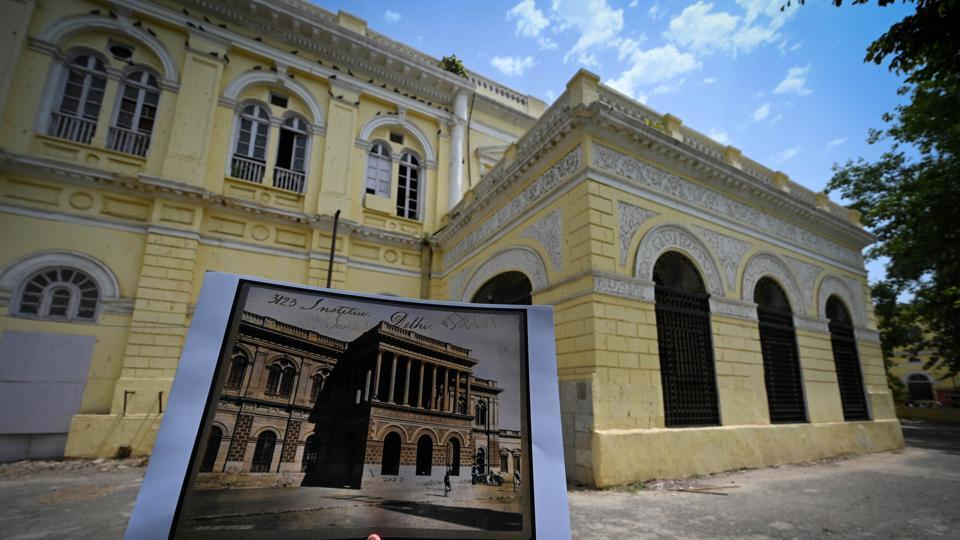
Around 50 buildings will be plastered with these plaques in the first phase of the programme, said Municipal Corporation of Delhi (MCD) officials aware of the plan, which will eventually cover all 775 notified heritage buildings in the city.
The oval plates, to be made of fibre-resin mixture, will have a white circumference and golden lettering over a navy blue background. Each plaque will read “Municipal Corporation of Delhi – Heritage Building”, along with the civic body’s logo, the name of the site and its year of origin.
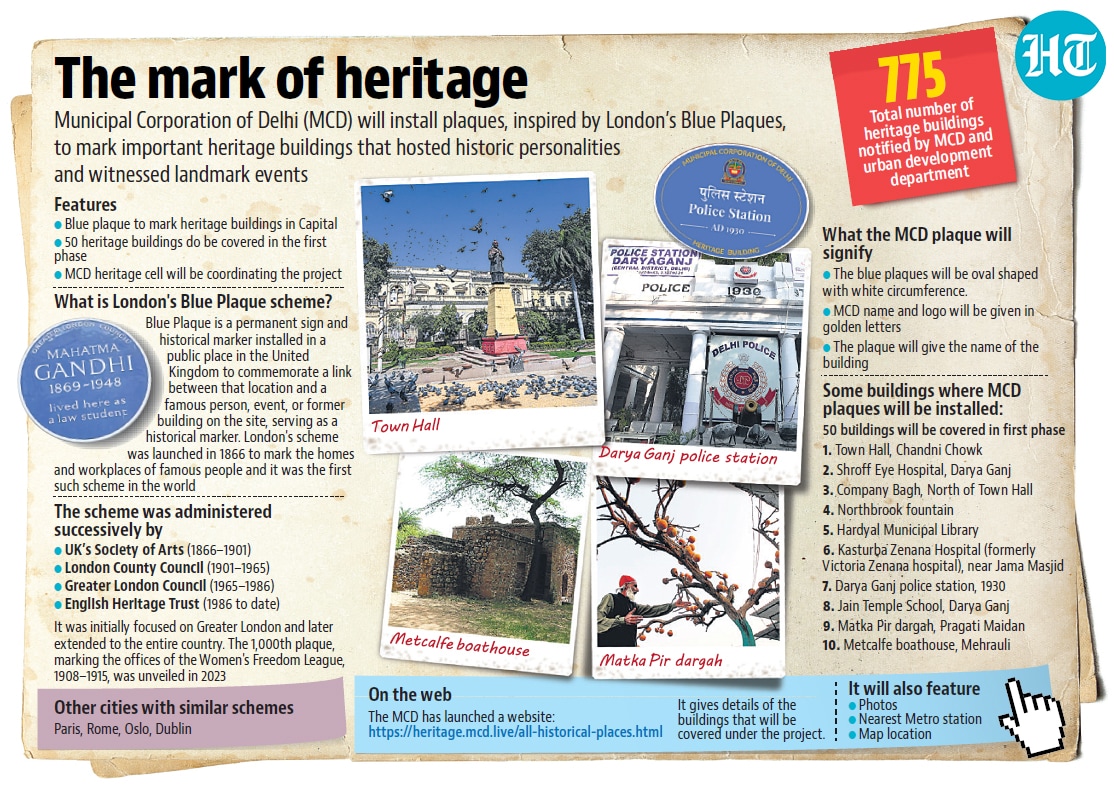
“Some of the buildings that will be covered in the first phase include the Northbrook fountain, Daryaganj police station, Town Hall, Shroff Eye Hospital, Hardyal Library – which was earlier called Hardinge library – and Company Bagh,” said Sanjeev Singh, executive engineer at MCD’s heritage cell.
MCD before its trifurcation in 2012, made similar attempts to install stone signs near heritage complexes, and roped in the Indian National Trust for Art and Cultural Heritage (Intach). But the project withered away in the absence of a dedicated heritage department, and was eventually disbanded.
The municipality’s heritage cell is, concurrently, also cataloguing the city’s heritage buildings on its website, with photographs, descriptions, map locations and nearby metro stations to make the sites more accessible.
“More than 108 places have been covered so far and we have also uploaded three digital volumes of heritage sites in the city covering more than 407 sites,” a second civic official said.
Nod to a 150-year-old programme
London’s blue plaque programme was started in 1866 to link “the people of the past with the people of the present”, according to English Heritage, the agency in charge of the legendary medallions that adorn over 1,000 spots in the England capital.
The plaques were initially focused on the Greater London area, but later extended to cover the entire city. Following in London’s footsteps, similar commemorative plaques have been installed in cities across the world, including Paris, Rome, Oslo and Dublin.
Some of the most famous plaques in the city include the home on Barron’s Court where Mahatma Gandhi lived while a law student, the residences of authors Charles Dickens and Agatha Christie, the building on Brixton Road where Charlie Chaplin lived between 1908 and 1910, as well as the Feltham house where rock legend Freddie Mercury started making music.
The number and location of plaques have, over the years, been extended to cover more women, people of colour and queer people.
In Delhi, officials hope the blue plaques will help add a crucial interface between residents and tourists and prominent heritage structures, most of which are still in use as public infrastructure. The plaque programme is a component of the civic body’s ambitious plan to rejuvenate and revive the city’s crumbling British-era heritage.
An MCD official said the corporation will cover notified heritage buildings ranging from Grade 1 to 3 heritage sites. According to union ministry of urban development's classification, heritage grade-I comprises buildings and precincts of national or historic importance, embodying excellence in architectural style, design, technology and material use. Heritage grade-II comprises buildings and precincts of regional or local importance possessing special architectural features. Grade-III comprises buildings and precincts of importance for townscape; that evoke architectural aesthetic, or sociological interest.
Boost for tourism?
The plaques will shed light on the historic roots of several sites in the city, said officials.
A third official said the Victoria Zenana Hospital, now known as Kasturba Hospital, which is the Capital’s oldest women and children’s hospital, will also get a blue plaque.
“It is located near Jama Masjid. The hospital started with just 10 beds in 1905. They expanded their operations gradually and were administering 450 patients by 1975. This was also the year that the hospital was named after Kasturba Gandhi, an Indian political leader who played a major role in mobilising women protesters during the independence struggle,” said the official from MCD’s heritage cell.
The Northbrook fountain in the hearth of Chandni Chowk opposite Gurudwara Sisganj was built in 1876.
“This structure is so named because the viceroy of India from 1872 to 1876, Lord Northbrook, donated money for its construction. It is a living monument with a large floral motif adorned with a multi-petalled design. It has become a site of Sikh history and is now covered by the holy symbol of Sikhism as it is associated with the site of martyrdom of reverent Guru Teg Bahadur,” according to the book, Delhi The Built Heritage
Company Bagh is located between the Northern end of Townhall and the Old Delhi Railway station. According to the National Mission on Monuments and Antiquities, the site was originally a garden built by Jahanara Begum, one of Mughal emperor Shahjahan’s daughters in 1650.
“Princess Jahanara ordered the construction of a caravan sarai for the comfort of Persian and Uzbek merchants coming to the city for business. It is said that Mughal Emperor Shahjahan once visited the garden with his minister Saadullah Khan. The pristine gardens had overwhelmed him as he quoted renowned poet Amir Khusro Gar Firdaus Bar Ruh-e-Zameenast, Hameenasto hameenasto Hameenast,” the book says.
The British redesigned the garden after the Revolt of 1857.
Sohail Hashmi, chronicler of Delhi’s history, filmmaker and heritage conservationist, said the present Town Hall site used to host the caravan sarai (inn or guest house) of Jahanara Begum. When the British took over the city, they wanted to remove the symbol of powers, he said.
Earlier, the city spread largely horizontally, on an east-west axis, with the Yamuna river, the Red Fort and Lahori Darwaza, with Chandni Chowk as the city’s central thoroughfare, said Hashmi.
“The British wanted to shift the axis of the city and set up railways in the north, with the Old Delhi Railway station, for which huge space was vacated. The focus of the city was to be shifted to a North-South axis. The caravan sarai of Begum Jahan Ara was razed and the Begum ka Bagh became Company Bagh. They also built the Nai Sarak to cut through the heart of the city for better policing. The Sarai was replaced by this building housing a library and club for Europeans where the municipality later formed the Town Hall,” he said.
AK Jain, former DDA commissioner (planning) and an urban planning expert, said Delhi has a rich history full of heritage sites and structures and lauded the plan to string them all together in the form of identity markers.
“There are more than 2,000 sites that are of historical importance in Delhi and recognising non-protected sites will help conserve them and convey their importance to people,” he added.
Hashmi, however, said the agencies were reinventing the wheel.
“During the Sheila Dikshit regime, Intach started a project to put up signboards, covering more than 100 structures in Walled City. The heritage cell should extend that project. We should not be imitating the English who treated our heritage structures very badly till the Archaeological Survey of India was formed in the 1860s,” he added.
He also said adding plaques will do little if the structures are not conserved.
“The previous project had covered places like Indraprastha Hindu Kanya Vidyalaya – the first girls' school near Jama Masjid. However, two floors were later added to it. Similarly, Phatak Teliyan has seen many modifications, and even an air-conditioner was installed. After putting up signboards, we need to protect these structures,” he added.