E-Paper



Delhi in 2024 clocked highest PM2.5 since 2019: CPCB data
Experts said the lack of active western disturbances, coupled with a possible increase in local pollution, could be the cause for increased pollution levels.

 Prefer HTon Google


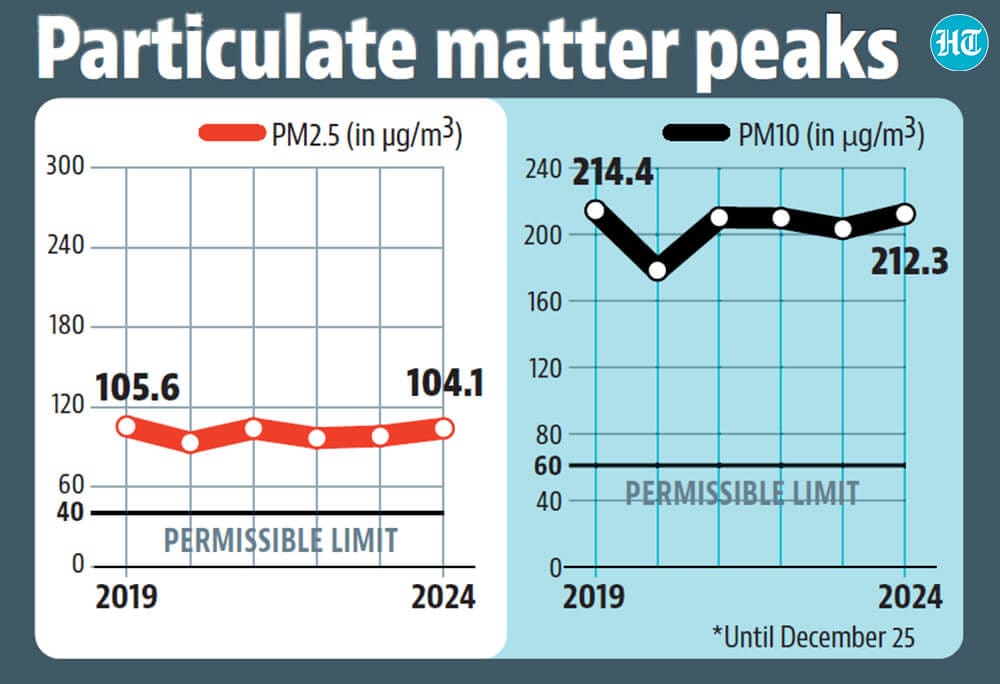
New Delhi: The annual average concentration of PM2.5 (particulate matter having a diameter of 2.5 microns or less), a key pollutant responsible for the Capital’s annual pollution cycle, clocked a five-year high till December 25, according to data provided by the Central Pollution Control Board (CPCB). Until December 25 this year, Delhi recorded a PM2.5 concentration of 104.08 micrograms per cubic metre (µg/m3)—over two-and-a-half times the safe limit of 40µg/m3—which was the worst since Delhi clocked an average of 105.57µg/m3 in 2019.
Further, the data suggested that Delhi is on course to record its most polluted year in terms of annual PM2.5 concentration since 2021, when the annual average PM2.5 concentration (till December 31) was 104.95µg/m3. Delhi’s annual PM 2.5 average last year was 100.21µg/m3 and it was 98µg/m3 in 2022.
Experts said the lack of active western disturbances, coupled with a possible increase in local pollution, could be the cause for increased pollution levels this year.
“The first half of the year was fairly dry, with a number of heatwave days recorded not just in Delhi-NCR. If there is no rain, PM2.5 and PM10 levels remain high due to local sources. We saw an improvement during monsoon period as there was ample rain, but again, post September, we barely saw any rain activity, barring in the last few days,” said Mahesh Palawat, vice president at Skymet
Admitting that although western disturbances were recorded in the region, he said they were mainly feeble, thus keeping wind speeds in check too. “If the western disturbance is strong, it can bring rain, which helps settle pollutants. If it is feeble, it will simply bring some cloudiness and slow down wind speed, which worsens pollution,” he said.
Delhi has had its driest start to the year this year since 2018, with only 44.7mm of rainfall recorded till May 31. Between June and September, the four monsoon months, it logged 1,029.9 mm of rainfall, which was significantly higher than the long-period average of 640.4mm. There was zero rainfall in October and November, with further spells only recorded in the last week of December.
Experts said like 2023, this year too is likely to be worse than its previous year, snapping a trend seen till 2022, where there was a gradual improvement in PM2.5 concentration.
In 2018, Delhi’s annual PM 2.5 concentration was 113.99µg/m3. It was 108.25µg/m3 in 2019; 94.93µg/m3 in 2020 (Covid-19 lockdown year); 104.95µg/m3 in 2021 and 98µg/m3 in 2022. This streak of a gradual dip was snapped last year, when the PM2.5 concentration rose marginally, touching 101.21µg/m3.
Anumita Roychowdhury, executive director, research and advocacy at the Centre for Science and Environment (CSE), said 2024 shows that last year’s spike in pollution was not an aberration. “The fact that the curve turned upwards last year and may possibly be even higher in 2024, shows that pollution levels have increased in the region, despite action. We have seen the overall winter averages increasing too. While this could be down to meteorological conditions, it also shows local and regional pollution is fairly high and is, thus, not allowing the average to dip. Thus, we need focused action and better planning,” she said.
While PM2.5 is an indication of combustion sources, PM10—slightly coarser particles that are an indication of dust pollution—were also higher than in previous years. CPCB data showed till December 25, the rolling PM10 average was 212.29µg/m3—over two-and-a-half times the safe limit of 60µg/m3. The annual PM10 average last year (till December 31) was 205.36µg/m3; it was 210.53µg/m3 in 2022; 210.70µg/m3 in 2021; 180.63µg/m3 in 2020 and 217.28µg/m3 in 2019.
Sunil Dahiya, lead analyst at the think-tank Envirocatalysts, said the data clearly showed Delhi was still largely at the mercy of meteorological conditions. “If the conditions are unfavourable, as they have been most of this year, the pollution will rise and if you see significant rain, spread out through the year, like we did in 2022, then there could be a marginal improvement. This shows us that background emissions are still fairly high and not much has changed there. We are still far from achieving breathable air and thus tackling sources is the only solution,” he said.