
 E-Paper



Delhi Jal Board underestimated sewage by around 20%, says CAG report
The report warned that without realistic figures on the sewage generated in Delhi, an effective treatment plan to reduce Yamuna pollution would be elusive.

 Prefer HTon Google


The Delhi Jal Board (DJB) underestimated the capital’s overall sewage generation by nearly a fifth, compromising efforts to clean the Yamuna, shows data from a Comptroller and Auditor General (CAG) report that examined the utility’s functioning from 2017 to 2022.

The report, tabled in the Delhi Assembly on Monday, warned that without realistic figures on the sewage generated within the capital, an effective treatment plan to reduce the pollution load on the Yamuna, where all of the sewage is discharged, would remain elusive. The report also said none of the 56 new sewage treatment plants proposed to be built during Phase-II of the DJB’s Sewage Master Plan that ran from 2017 to 2021 materialised.
Also read: BJP makes ‘Rehman Dakait’ jibe at Kejriwal; AAP hits back
The report added that the board was not testing faecal coliform bacteria levels in effluents from existing STPs to aid the Yamuna clean-up.
Citing “anomalies in the estimation of sewage generated in Delhi,” the report said according to the Delhi Pollution Control Committee (DPCC), the total water flow to the Yamuna from Delhi through untapped drains, STPs, and common effluent plants differs from DJB’s data.
Also read: Ghaziabad seeks 800 buses for Noida airport opening day, schools to go online
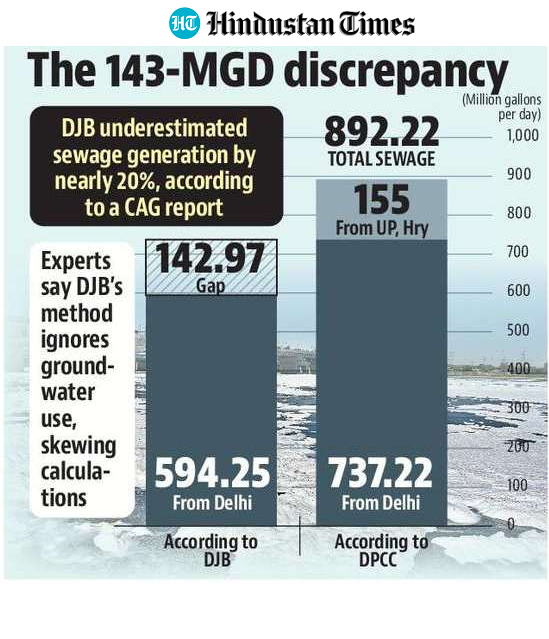
A March 2022 report by DPCC estimated outfall into Yamuna at 892.22 million gallons per day (MGD), including 155 MGD sewage received from Haryana and Uttar Pradesh, according to the CAG report. DJB, meanwhile, estimated that 594.25 MGD of sewage generated in Delhi ends up in the Yamuna.
“Thus, there is a clear gap of 142.97 MGD in the sewage/waste-water generation estimates of DJB and that of DPCC,” the report concluded.
Also read: ECI removes 7 CAPF officers from West Bengal for attending Iftar party during poll deployment
To be sure, experts have previously noted that DJB’s estimate that 80% of potable water reaching Delhi residents becomes sewage is flawed as it does not account for water sourced from borewells and other groundwater resources across the city.
Other findings
DJB had finalised the Sewage Master Plan-2031 in June 2014, with infrastructure to be improved in four phases. The CAG said DJB failed to implement the plan. “For this purpose, 32 STPs with treatment capacity of 118.9 MGD were planned to be constructed by 2021 which were later revised to 56 STPs. Though the period of Phase-II (2017-21) of SMP has ended in 2021, not a single new STP against the proposed 56 STPs were constructed,” the report states.
The deadline for achieving standards for existing STPs was April 2018, but CAG observed that of the 35 functional STPs as of March 2022, only 10 were designed as per DPCC parameters. “The objective of restoring the Yamuna waters to bathing standards could not be achieved as under-treated effluent was continuing to be discharged into the river,” it noted.
The report pointed to clear failures in treatment, disposal, and testing infrastructure, noting that “all sewage generated in Delhi finds its way into the river (whether treated or untreated).”
“[DJB] did not have reliable figures of water usage and sewage generation in Delhi to address the problem of pollution in Yamuna effectively… Biological treatment process at the STP continued to deteriorate, despite intimations from the quality control wing resulting in poor quality of treated effluent and bad odour in and around the plants of DJB. 74% of the treated effluent was not fit for reuse,” the report stated.
CAG noted that during joint inspections of 22 STPs between April and December 2022, auditors noticed that DJB was monitoring only dissolved oxygen, biochemical oxygen demand, and total suspended solids. “This is not only in violation of the orders NGT but also the Yamuna waters cannot be restored to bathing standards without monitoring the FC levels... regular monitoring of FC level in treated effluent emanating from all STPs’ were not being done even till December 2023,” it noted.
A DJB official, who asked not to be identified, said several plants are very old and treatment norms have become stricter over the years. “DJB is undertaking a phased action plan to upgrade old STPs and nine more will be revamped under the project. New STPs could not be set up due to acute shortage of land during that period,” the official said, adding that sewage generation continues to be estimated on 80% of water supplied.


Stay updated with all top Cities including, Bengaluru, Delhi, Mumbai and more across India. Stay informed on the latest happenings in World News along with Delhi Election 2025 and Delhi Election Result 2025 Live, New Delhi Election Result Live, Kalkaji Election Result Live at Hindustan Times.


