E-Paper



Delhi Metro stations may soon display occupancy count; trial on at Magenta Line
A DMRC spokesperson said if trials are successful, the technology could be implemented on the Pink Line of the Delhi Metro, adding the data being displayed on the Magenta Line PIDS was still under scrutiny

 Prefer HTon Google


Ever reached a Metro station and wondered which coach to head to, which one could possibly be the least occupied? Now, the Delhi Metro Rail Corporation (DMRC) is carrying out trials on the Magenta Line to analyse passenger occupancy in each coach and display it on the Passenger Information Display System (PIDS) on platforms.
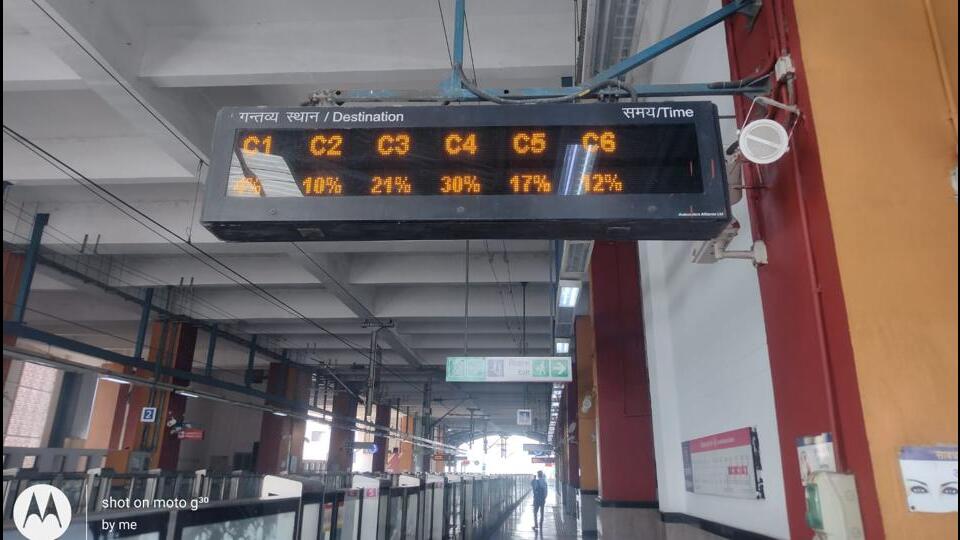
“Over the years, we observed that passengers tend to board coaches randomly. They face problems after boarding crowded ones, even though there are other relatively less occupied coaches on the same train because they are not aware of the occupancy status of the other coaches,” said a DMRC spokesperson.
He added that displaying the occupancy status of various coaches has also become more important due to the pandemic, as maintaining social distancing is important.
Currently, in all Metro stations, the PIDS displays how long it will take the next train to reach a platform. As part of the trial, PIDS in stations on the Magenta Line are also displaying the occupancy percentage of each coach, allowing passengers to gauge which coaches are less occupied. The occupancy percentage is calculated by a software which determines the weight of the load in each coach and compares it to the weight of an empty coach, an official working on the plan said.
A DMRC spokesperson said if trials are successful, the technology could be implemented on the Pink Line of the Delhi Metro, adding the data being displayed on the Magenta Line PIDS was still under scrutiny.
“Our engineers are still scrutinising its accuracy. An exact timeline for its implementation cannot be indicated. A decision shall be taken only after we carry out proper tests and trials of the system,” said the DMRC spokesperson.
The Magenta Line is spread across 37.46km and runs from Janakpuri West to Botanical Garden, with 25 stations in total.
DMRC’s executive director, corporate communication, Anuj Dayal said the PIDS said the new system aims to result in uniform loading of the train and help passengers maintain social distancing.
“The work is initially being undertaken at Line-8 (Magenta Line) as a proof of concept. Once the system stabilises, it shall be implemented on Line-7 (Pink Line) also in due course,” he added.
The DMRC spokesperson said the occupancy will be displayed on the screen when the arrival time of a train reduces to two minutes. In two frames of 10 seconds each, the screen will first display the destination of the train along with the countdown to arrival, and in the second frame, display the occupancy from coach C1 to C6.