E-Paper



Delhi shivers at season’s lowest max temperature
The rain, coupled with low clouds also created a haze that prevailed during the day, keeping visibility between 400 and 1,200 metres, which led to a slight deterioration in air quality, despite the rain, IMD scientists said.

 Prefer HTon Google


Delhi witnessed overcast and gloomy conditions on Wednesday.
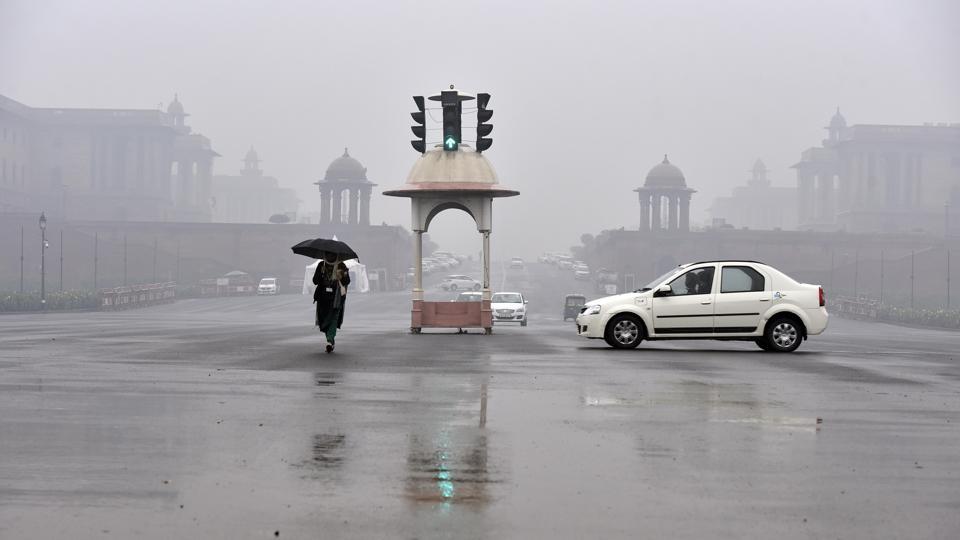
Light rain persisted throughout the day, and maximum temperature fell to 15.7 degrees Celsius, four notches below normal -- the lowest maximum temperature recorded so far this season, according to India Meteorological Department. However, the minimum temperature was recorded at 10.9°C -- four notches above normal.
The rain, coupled with low clouds also created a haze that prevailed during the day, keeping visibility between 400 and 1,200 metres, which led to a slight deterioration in air quality, despite the rain, IMD scientists said.
Delhi’s air quality index was recorded at 397 (very poor) according to Central Pollution Control Board’s daily 4 pm bulletin, up from Tuesday’s reading of 378 (very poor).
Safdarjung, Delhi’s base station for weather data, received 7.3mm of rainfall between 8.30am and 5.30pm on Wednesday, and Palam and Lodhi Road stations recorded 6.1mm and 6mm rain respectively. The IMD, despite the lowest maximum of the season, did not classify it as a ‘cold day’ in Delhi, stating that the criteria for the minimum temperature was not met.
The IMD classifies it as a ‘coldwave’ if the minimum temperature is 4.5 degrees below normal, or when it drops to 4 degrees or lower. Similarly, it classifies a ‘cold day’ when the maximum is 4.5 degrees below normal, along with the minimum at 10 degrees or lower. On Wednesday, Delhi’s minimum was 10.9 degrees – four notches above normal.
“This is the lowest maximum of the season so far, however, it is not a cold day as the minimum was above 10 degrees. The low clouds and consistent rain did not allow the maximum temperature to cross the 15-16 degree mark and we can expect a similar spell on Saturday, with perhaps an even more rain and wind speed,” said RK Jenamani, scientist at IMD.
He said the visibility improved to 1,200 metres by afternoon at Palam, but it remained around 400 to 500 metres at Safdarjung.
The IMD has forecast light rain on Thursday as well. But, Jenamani said there were good chances of the sun coming out during the day. “It will be cloudy and we will see some drizzle activity, but the maximum will be around 20 degrees on Thursday. From the night again, it will become overcast and the intensity of rain can increase gradually, peaking on Saturday,” he said.
Prior to this, Delhi’s lowest maximum temperature was recorded on December 19, when it fell down to 17.8 degrees Celsius. It was also the season’s only ‘cold day’ so far, with the maximum at the time, five degrees below the normal mark.
The air quality is also expected to see an improvement, with wind speeds likely to pick up between January 6 and 8, the System of Air Quality and Weather Forecasting And Research (Safar), a government forecasting body, said.
Gufran Beig, founder project director at Safar, said when temperatures are low during winter and there is a drizzle, there are chances of the air becoming heavier, and instead of removing pollutants immediately, it traps local pollutants in the air. “There was a slight haze and the pollutants remained trapped in the air longer. This is possibly why the AQI increased slightly, but an increase in wind speed and the gradual impact of the rain will lead to an improvement in air quality by Thursday,” he said.