
 E-Paper



Delhi to seek funds from Centre for EV charging infra in residential areas
The Delhi government plans to seek central funding to boost EV charging infrastructure in residential areas, shifting from reliance on RWAs.

 Prefer HTon Google


New Delhi
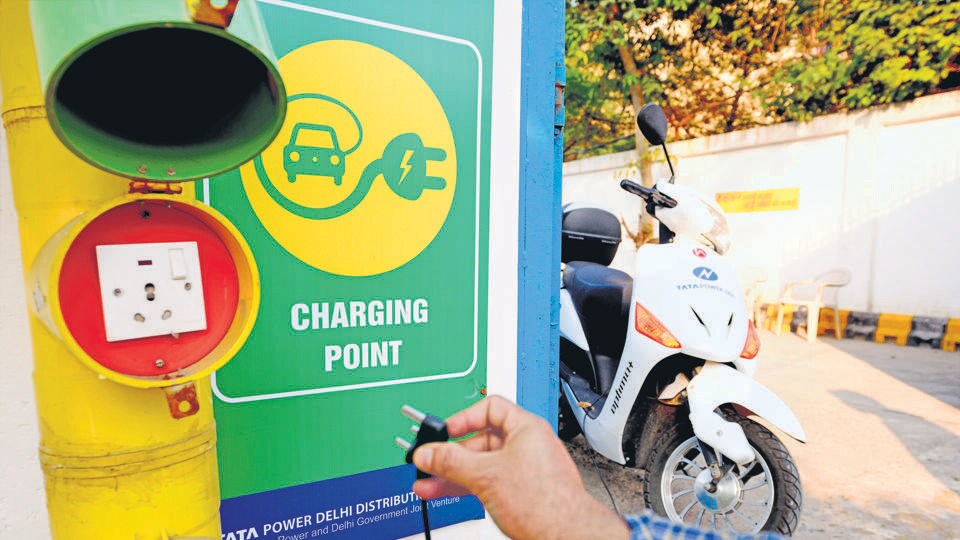
The Delhi government is set to approach the Centre for financial support to expand electric vehicle (EV) charging infrastructure in residential areas, marking a shift from its previous reliance on cost-sharing with residents’ welfare associations (RWAs), according to officials aware of the matter. The government will submit a proposal under the PM E-Drive scheme of the ministry of heavy industries, seeking funds to augment public and community charging, as well as battery swapping infrastructure across the Capital.
The move comes after the previous EV policy’s target of installing around 18,000 public and semi-public charging points by 2024 fell significantly short, with fewer than 2,500 stations set up on ground. Officials attributed the shortfall largely to hesitation among RWAs, which were expected to bear up to 50% of the installation cost.
Many resident bodies were reluctant to invest without clarity on utilisation levels and long-term returns.
“The earlier model required substantial participation from RWAs, which did not scale up as expected. We are now exploring central assistance to reduce the financial burden on local stakeholders and accelerate deployment. We are now going to write to the Centre to assist with setting up of charging infrastructure,” a senior government official, who did not wish to be named, said.
The new policy framework places the responsibility of planning and implementation with Delhi Transco Limited (DTL), which will act as the nodal agency for EV charging and battery swapping infrastructure. DTL will aggregate demand, identify suitable locations and assess load requirements to ensure grid readiness and phased deployment.
According to a document prepared on the proposal by the state government, a copy of which was accessed by HT, the government will also allocate additional funds to strengthen public and community charging networks, particularly in residential clusters.
DTL will develop standard operating procedures (SOPs), covering technical specifications, approval timelines and service benchmarks. A dedicated digital portal is also proposed for end-to-end management of charging infrastructure, including site on-boarding, approvals, monitoring and reporting.
“The idea is to create a unified system where operators can apply, track approvals and manage operations seamlessly. This should significantly reduce delays and improve coordination across agencies,” the official said.
Experts said that the PM E-DRIVE provides a strong push for charging infrastructure, with support for chargers above 12 kW (fast chargers) for two- and three-wheelers and up to 80% subsidy for upstream infrastructure for Category D cities. “Delhi must move quickly to leverage this opportunity, scale up public and private charging and remove one of the biggest barriers to EV adoption,” said Amit Bhatt, India managing director at the International Council on Clean Transportation.
To address bureaucratic bottlenecks, the policy also proposes a single-window clearance system for charging points and battery swapping, which will expedite approvals and enable faster installations.
To be sure, a single-window clearance system was proposed under the previous policy period as well for installing and maintaining 30,000 charging points at private and semi-public sites, with the provision of availing of a charging point for ₹6,000. Under the single-window process, chargers were available for less than ₹2,500. However, just 594 charging points, against a target of 30,000, were installed across 304 locations under the single-window mechanism.
A high-powered committee chaired by the chief secretary will be constituted to oversee implementation. The committee will include representatives from key departments such as transport, power, planning, environment and finance, along with distribution companies (DISCOMs) and other relevant agencies, officials said.
Officials said the renewed push aligns with Delhi’s broader goal of increasing EV adoption, particularly in the two- and three-wheeler segments, which rely heavily on accessible and affordable charging infrastructure.
“The focus is now on ensuring that charging facilities are available closer to residences, especially in densely populated areas. With central support, we expect faster and more widespread roll-out,” the official said.
The government is expected to finalise and submit its funding proposal to the Centre in the coming weeks.


Stay updated with all top Cities including, Bengaluru, Delhi, Mumbai and more across India. Stay informed on the latest happenings in World News along with Delhi Election 2025 and Delhi Election Result 2025 Live, New Delhi Election Result Live, Kalkaji Election Result Live at Hindustan Times.


