
 E-Paper



Delhi’s air quality likely to deteriorate to ‘very poor’ on Thursday
According to Safar, the effective fire count of stubble burning in the northwest region of Delhi is 656 currently and its share in PM2.5 is 16%

 Prefer HTon Google


Delhi sky is likely to be clear of clouds on Thursday but the air quality is expected to deteriorate to very poor, as per the forecasts by monitoring agencies.
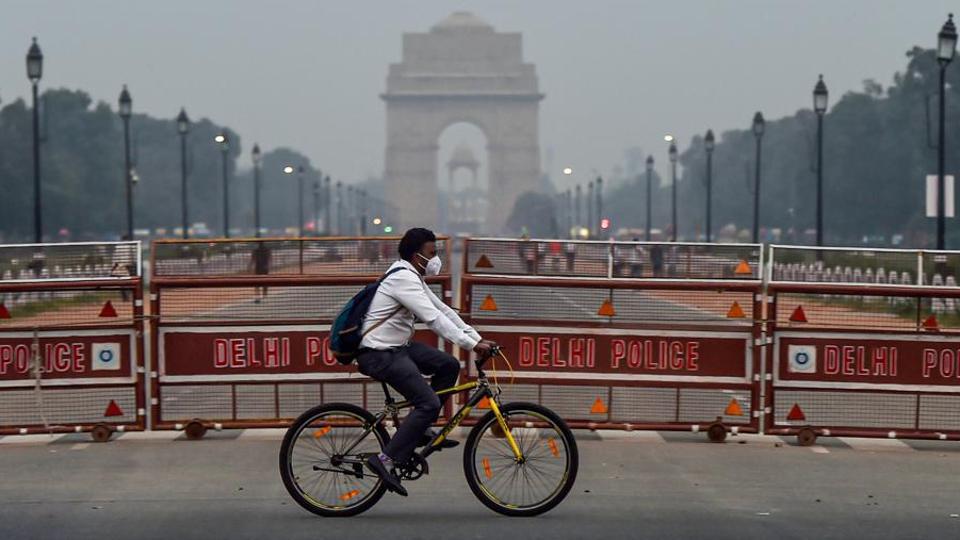
The System of Air Quality and Weather Forecasting And Research (Safar) had said that the air quality will deteriorate during the day to touch “very poor” on Thursday and then hit the higher end of the “very poor” category by Friday.
On the weather front, the India Meteorological Department (IMD) has said that the minimum temperature on Thursday is likely to be 14 degrees Celsius while the maximum temperature is predicted to reach 29 degrees Celsius.
The maximum temperature was 28.2 degree Celsius on Wednesday which was three degrees below normal and the minimum temperature was 14.6 degree Celsius – two notches below normal.
IMD has forecast the minimum temperature in the national capital to remain around 14 degrees Celsius till Friday, and possibly dip to 13 degrees by Saturday. The maximum temperature, meanwhile, is expected to remain below 30 degrees Celsius till the end of the week.
Delhi’s air quality was in the “poor” category on Thursday morning. Data from the Central Pollution Control Board showed that the hourly air quality index (AQI) at 8am stood at 261. On Wednesday, the average 24-hour AQI had been 232, which is also in the “poor” category.
AQI reading between zero and 50 is considered ‘good’, 51 and 100 ‘satisfactory’, 101 and 200 ‘moderate’, 201 and 300 ‘poor’, 301 and 400 ‘very poor’, and 401 and 500 ‘severe’.
Also Read: Delhi: In first for the season, temp below 15°C as AQI worsens
On Wednesday, the Union ministry of earth science’s air quality monitoring centre, Safar, said, “Effective fire count of stubble burning in the northwest region of Delhi is 656 and its share in PM2.5 is 16% as transport level winds are north westerly. Calm local winds combined with highly favourable transport level winds (North-north westerly) enhance stubble burning related intrusion. Any increase in fire counts in the next 3 days would increaser finer particle levels of Delhi.”
Particulate matter are extremely small and are graded by measuring their diameter in microns. The most important types of particulate matter are PM2.5 and PM10 (both microscopic in size) from a public health perspective.
Prior to Wednesday, the highest contribution of stubble burning in Delhi’s air was 15% on October 21.


