
 E-Paper



Delhi’s AQI jumps to 15-week high on back of dusty winds
This was the highest reading on the city’s pollution gauges since June 13 this year, when the meters hit 187.

 Prefer HTon Google


The Capital’s air quality index (AQI) spiked to a 15-week high on Saturday, before stronger winds swept out some of the pollutants in the evening.
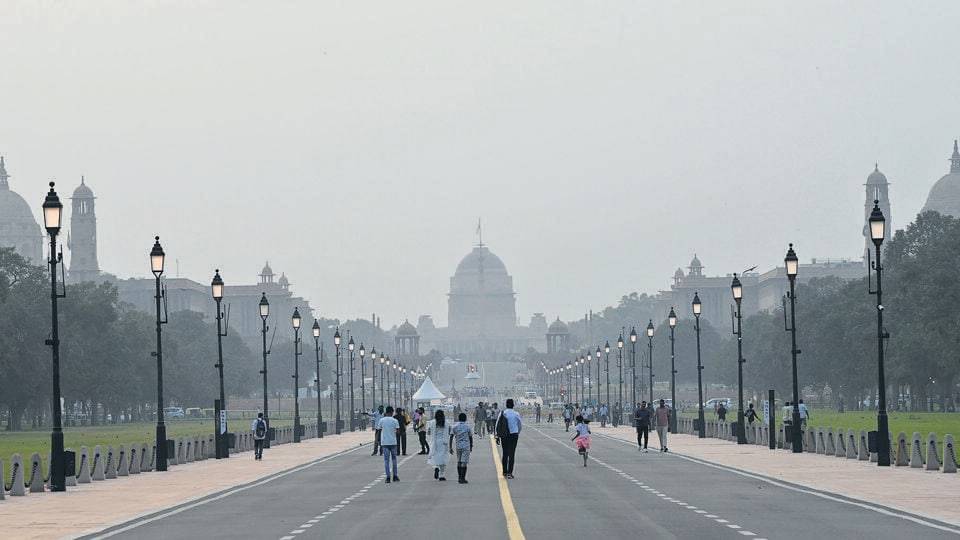
Delhi clocked a 24-hour average AQI of 169 (classified as “moderate”) at 4pm on Saturday, according to the Central Pollution Control Board’s (CPCB) evening bulletin. This was the highest reading on the city’s pollution gauges since June 13 this year, when the meters hit 187.
However, Saturday’ AQI improved to 155 by 11pm.
The 24-hour average AQI was 120 (moderate) on Friday as well as Thursday.
CPCB classifies an AQI of 0 to 50 as good, 51 to 100 as satisfactory, 101-200 as moderate, 201-300 as poor, 301-400 as very poor and 401-500 as severe.
Since early June, Delhi has enjoyed a largely unusual streak of relatively clean air, owing largely to regular rain and dispersal of pollutants due to strong winds.According to CPCB data, the first half of this year has recorded the cleanest average AQI since 2016, which is when the board started collecting data.
However, the air quality is set to plunge in the coming weeks. With the monsoon having withdrawn from the city, transport winds, which travel several metres above the surface, are likely to blow in from the northwest, bringing in plumes of toxic smoke from Punjab, where farmers have started setting fire to paddy stubble.
To be sure, experts said daily fluctuations are routine before the winds shift direction.
Mahesh Palawat, vice president at Skymet, said, “There was a change in wind direction from the dry westerlies to more humid easterlies. As a result, the humidity pulled in dust and smoke, thus increasing the pollution level. In the evening, however, the speed of the winds increased, slightly improving the AQI.”
Saturday afternoon was also hazy due to the spike in pollution and the moisture in the air, Palawat added.
Anumita Roychowdhury, executive director at the Centre for Science and Environment, said, “Fluctuations like this in this season are normal. We see a lot of variation in the meteorological conditions post-monsoon, before the cold weather conditions start to set in. These meteorological conditions, in turn, can cause fluctuations like this and cause a sudden spike in pollution level.”
According to forecasts by the Air Quality Early Warning System (AQEWS) for Delhi, the AQI will continue to remain moderate for the next few days..
Meanwhile, the city’s maximum temperature was 37.2 °C on Saturday, 2.9°C above the normal. The minimum was 25.7°C, 1.8°C above the normal.

Stay updated with all top Cities including, Bengaluru, Delhi, Mumbai and more across India. Stay informed on the latest happenings in World News along with Delhi Election 2025 and Delhi Election Result 2025 Live, New Delhi Election Result Live, Kalkaji Election Result Live at Hindustan Times.


