Broken birdhouses, withered nests and damaged visitor facilities are all that is left at Delhi’s first “Goraiyya Gram”, or sparrow village, which was opened in May 2022 as a haven for Delhi’s state bird. Woven into the dense green fabric of the Garhi Mandu city forest in east Delhi, on the Yamuna floodplains, the village was planned as a bustling habitat for the species, complete with artificial bird boxes and nests, insect hotels and native plants. But nature’s fury has decimated the place — first, the floods in 2023 submerged most of the 42-acre city forest, and the recent spell of squalls has decimated the remnants.
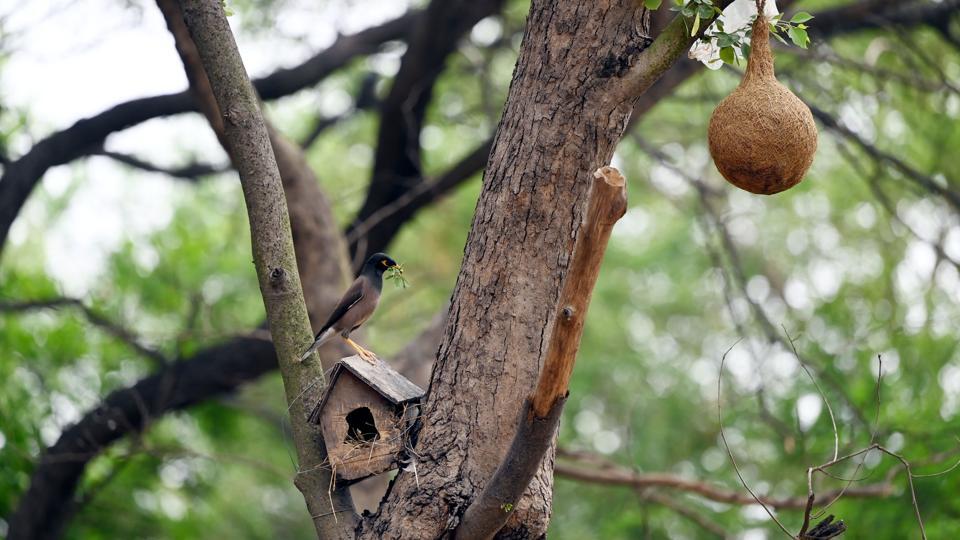
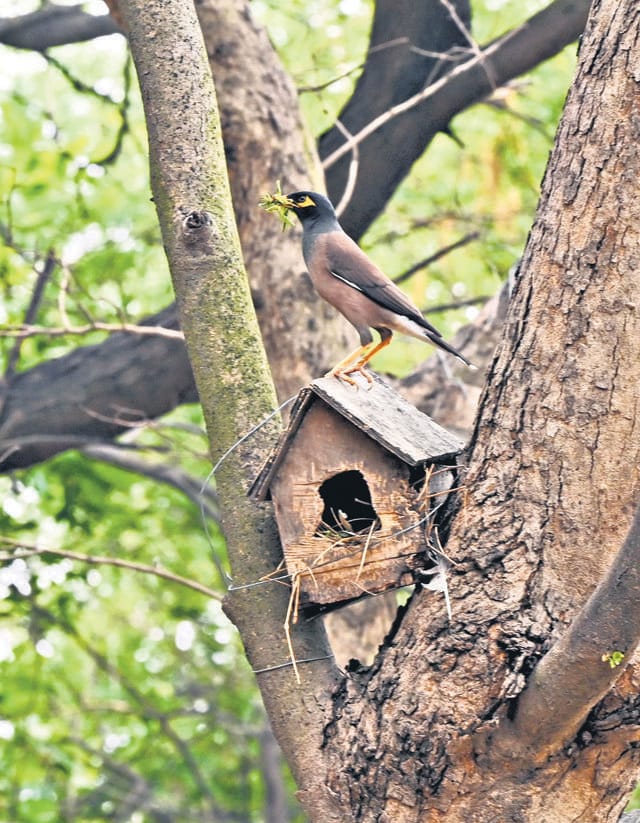
A bird nest for sparrows but there are no sparrows inside it. (Arvind Yadav/HT Photo)
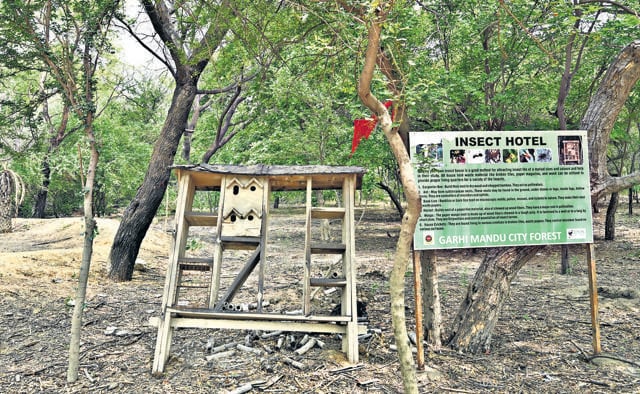
Noticeable by their absence at the site were two large signages, labelling the place as “Goraiyya Gram”, placed at the forest outset, as noticed by HT during a spot visit on June 18. A gazebo built for visitors had a gaping hole as well, as a part of the structure’s roof collapsed during the recent gusts. Two insect hotels–meant to be a natural source of food for the sparrow, stood like skeleton shells in the mud—their wooden frames beat down by the water but intact, while the wood, bamboo, pinecones and leaves, typically hosting nesting insects such as ants or solitary bees, had all been swept away.
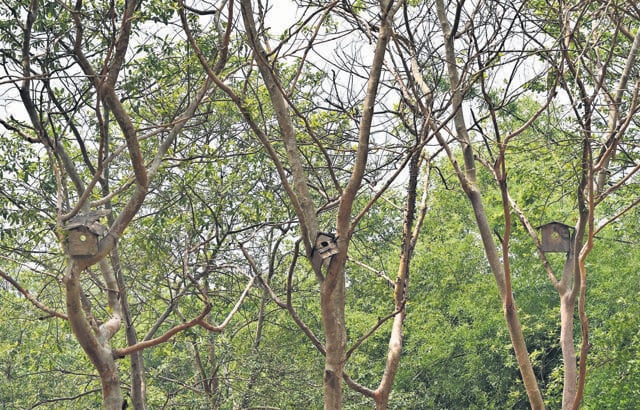
The forest department installed artificial bird boxes and nests, native plants, and insect hotels for the sparrows to consume, in the Garhi Mandu city forest in east Delhi. Pre-2023, before monsoon, the city forest had around 300 sparrows, but flooding in 2023 and squalls over the past month have left the area desolate, a spot check by HT found. (Arvind Yadav/HT Photo)
“The flood took everything away from this sparrow village,” said 58-year-old Maharram (goes by a single name), a forest department official who has been the caretaker of the forest for 13 years.
The house sparrow was declared Delhi’s state bird in 2012, in a bid to raise awareness about the bird, at a time when its population was believed to be on the decline, especially in urban habitats. However, as per the International Union for Conservation of Nature (IUCN), the house sparrow is classified as a species of “least concern”.
The 2020 State of India’s Birds (SOIB) report, while describing the house sparrow population in the country to be “fairly stable” in the past 25 years, however, stated there had been a gradual decline in abundance in major cities, including Delhi, Chennai, Kolkata and Mumbai.
Maharram recalls Pocket A of the city forest to be a lively place when the sparrow village opened, with over 250 sparrows buzzing until the next monsoon. “Since its inauguration, the sparrow population began to grow steadily. There was ample food, it was green and it was quiet. Over 500 nests were placed on treetops and we had 250 to 300 sparrows nesting here. Then, the floods came and Garhi Mandu was submerged for nearly a month,” he said, stating forest department officials saw a trail of devastation when the water receded.
“The nests were empty, most had been swept away. Only around 100 are left now and most of these don’t house any sparrows. Two large boards were swept away too and the insect hotels too are now only a shell, with no insect inside it,” he said.
The wood, bamboo, pinecones and leaves, typically hosting nesting insects such as ants or solitary bees, had all been swept away. (Arvind Yadav/HT Photo)
Revival plans
Officials of the forest department said that going by the early evidence of the sparrow village flourishing, plans are afoot to revive the habitat.
A senior forest department official, not wishing to be named, said: “In recent weeks, we have had talks on reviving the sparrow village again. The place was thriving until the floods happened and the area was badly impacted, as were large parts of Delhi around the floodplains.”
The forest department official said that besides natural phenomena, other birds and reptiles posed challenges to sparrow habitats. “Pigeons and crows compete for space. We have also had instances where snakes prey on the eggs and young ones. While reviving the village, these will be aspects that we will also take into account.”
Faiyaz Khudsar, the scientist in charge of DDA’s biodiversity parks programme, said it was possible to create an environment conducive for house sparrows to nest, granted the right species are planted. “As the name suggests – Passer domesticus, the house sparrow prefers green habitats close to human settlements,” said Khudsar, adding that choosing the right species of trees, shrubs and grasses was also crucial.
Popular hub
The city forest lies barely a kilometre from the river on one side, with Usmanpur on the other side.
Maharram said close to a hundred thousand people visit the city forest’s five pockets—A, B, C, D and E—every day, and the number was higher when the sparrow village was active. “People come for daily walks. It opens in the morning and then in the evening. We get visitors from Usmanpur, Shahdara, Bhajanpura and Khajuri Khas and the sparrow village was a big attraction,” he said.
A gazebo built for visitors had a gaping hole as well, as a part of the structure’s roof collapsed during the recent gusts. (Arvind Yadav/HT photo)
Rakesh Khatri, an environmentalist who runs Eco Roots Foundation and is known as the “Nest Man of India” for his work on creating and installing sparrow nests made out of jute, wood and other materials, said the species requires dense foliage to nest and feel safe.
“While artificial nests for the sparrow are a good idea, the placement is also crucial. If they are not placed in dense foliage, they will simply not nest there. Sparrows generally love to nest at heights of 10 to 12 feet and the nests should be stable and not move much. The mouth of these nests also should be around 1.75 inches and not more, so that other birds of prey cannot enter these nests or prey on the eggs,” Khatri said.
Then Delhi minister Gopal Rai, while inaugurating the village in May 2022, had said native berries, grass and shrubs, such as Karonda and Kundli, had been planted in the area to attract the bird.
DDA in-charge Khudsar said: “Species such as Ronjh or Gond Babool or grasses like Cenchrus species, Setaria or Panicum species all facilitate insect herbivory. A mix of such vegetation complexes provide low height dense canopy and open grasses at the ground provide roosting, nesting and foraging for the sparrow.”
Jasjeev Gandhiok is an Assistant Editor with Hindustan Times, where he covers environment, climate change, the clean energy transition and wildlife at the National Bureau. Gandhiok has over a decade of experience in journalism and is based in Delhi. He has reported extensively on Delhi and the National Capital Region (NCR). This includes the region's air pollution woes, a polluted Yamuna and on urban wildlife still thriving in the region.
He joined HT in October 2021. Prior to that, he had five-year stint at The Times of India in Delhi, where he also covered Delhi, with a focus on environment and wildlife.
Gandhiok has covered some recent events around the Capital too, ranging from the farmers' protests, the northeast Delhi riots and the CAA-NRC protests, reporting from the ground on all of these. He also travels across the country to report on how environment and climate change impact everyday life, while also writing on endangered species.
His reports in 2019 on toxic leachate from Delhi's landfills led to the National Green Tribunal (NGT) taking suo motu cognisance and ultimately asking the state government to start bio-mining to flatten and remove all three landfills in the capital. He also closely tracks the implementation of government policies on climate, renewable energy and environmental protection. His focus remains on impactful, public-interest journalism which explains how environmental decisions affect people's everyday lives.Read More
Snehil Sinha is an Assistant Editor with the Delhi Metro bureau of Hindustan Times, where she reports on politics, governance, public policy, urban infrastructure and transport, subjects that shape the everyday lives of millions in the national capital. Over a journalism career spanning 14 years, she has built a reputation for meticulous, data-driven reporting that combines on-ground perspectives with policy analysis.
She began her career with The Indian Express before joining Hindustan Times, where she has reported extensively on civic administration and urban governance in Gurugram, Noida and now Delhi.
Her reporting is distinguished by its clarity, depth and balance. Whether covering large-scale infrastructure projects, environmental challenges, transport reforms or government policy, she tries to translate complex administrative decisions into accessible, engaging stories without losing nuance.
Her work reflects a strong command of public records, official data and field reporting, often connecting policy announcements with their impact on citizens. Her stories go beyond headlines to explain how governance decisions influence the city's growth, mobility and quality of life, making her work an important contribution to informed public discourse.Read More
Catch every big hit, every wicket with Crickit, a one stop destination for Live Scores, Match Stats, Infographics & much more. Explore now!

 E-Paper




 Prefer HTon Google