
 E-Paper



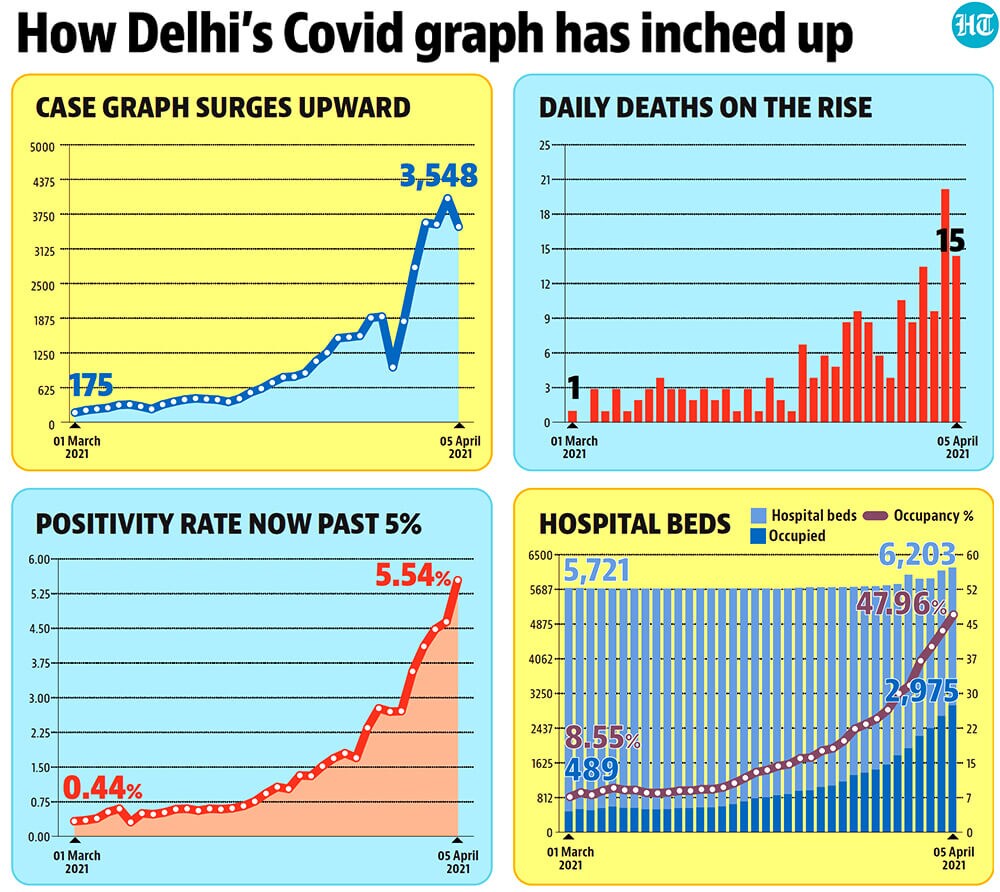
Delhi’s test positivity rate past 5% mark after 124 days
The senior official, who asked not to be named, also said the government has not decided when the curfew will be imposed from, or its timings.

 Prefer HTon Google


The Delhi government is considering imposing a night curfew in the city to stem a severe surge in Covid cases, a senior government official told HT, as the city’s positivity rate crossed the 5% mark on Monday after 124 days.

The senior official, who asked not to be named, also said the government has not decided when the curfew will be imposed from, or its timings.
With 3,548 cases after 64,003 tests, the positivity rate jumped to 5.54% on Monday, up from 4.64% the previous day. The Capital had not crossed the 5% mark since December 2, and this number also fell below 1%, and stayed beneath that threshold for 82 days.
Experts regard the test positivity rate as a crucial metric to gauge the spread of an infection in a region. The World Health Organization (WHO) recommends a positivity rate below 5% for a two-week period for an infection to be considered under control.
The number of tests conducted dropped on Sunday as compared to the previous week, when more than 72,000 samples were collected on average in the city each day.
Click here for complete Covid-19 coverage
“We have increased testing to between 80,000 and 90,000 a day. Whoever is found positive is isolated. We are tracing 20 to 30 contacts for each positive case and trying to contain them as well. We are also making micro-containment zones so that the spread of the infection is curtailed,” Delhi health minister Satyendar Jain said in a press briefing on Monday.
The government also ordered 65 government and private hospitals to increase the number of Covid-19 beds, as hospitalisations continued to rise. The number of hospitalisations has inched close to 3,000, with 2,975 people admitted across city hospitals as on Sunday night.
Jain on Monday also urged people who have recently recovered from the infection to donate plasma.
He said the donations dropped over the last two months because there were few eligible donors, owing to the low infection rate over the last few months.
“I appeal to all those who have recovered from Covid-19 to donate plasma,” said Jain in a press briefing.
“The cases have gone up suddenly, and it appears that the virus is more infectious. The behaviour of the people adds to the problem. New cases had gone down so much that people thought it [the pandemic] is over, and nobody thought it would come back. But we foresaw this. We saw the increase in cases in western countries,” said Dr Suranjit Chaterjee, senior consultant of internal medicine at Indraprastha Apollo hospital.
The numbers reported on Monday correspond to tests carried out a day before, which is typically fewer in number on account of it being a weekend.
A comparison of weekend case numbers captures how the situation in the Capital took a worrying turn over a span of four weeks: On March 15, 368 cases were reported from the tests a day earlier at a positivity rate of 0.6%.
The following week, new cases grew to 888 while the positivity rate inched up to 1.3%.
On March 29, the day of Holi, the positivity rate at 2.7% was double compared to a week ago. That day, 1,904 cases were recorded.
In the week since Holi, when experts and officials urged people to minimise celebrations and visits to people outside of their household, the positivity rate rose exactly by double to clock in at 5.4%.


