
 E-Paper



Delhiwale: Discover the beauty in silence
One of the most beautiful and calmly temples in the Walled City


The temple is immersed in utmost quietude, so much so that you feel that if you concentrate enough, you might hear Devi Durga breathe. Attired in an orange fabric, her idol faces the door.
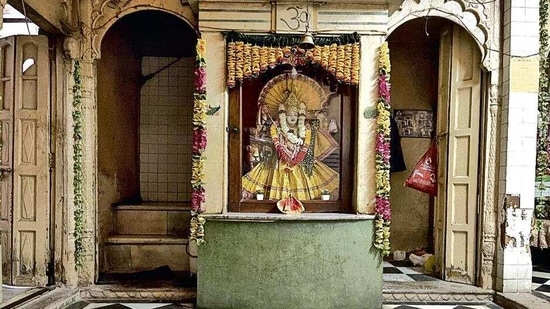
Hidden in a narrow alley of Old Delhi’s Galli Choori Wallan, Hara Mandir has the hushed remoteness of rarely frequented pilgrimage sites, like those found in the snowy reaches of the Himalayas. You rarely see visitors here. Its exquisite beauty remains largely untouched. Its name derives from the wall outside, painted green, or hara. Inside, the most striking feature is of the chessboard floor. The walls are sculpted at various places with taaks, or arched niches, a disappearing element of architecture. Hefty brass bells hang from the roof.
The temple is very small, and yet extensive—like a piece of paper folded many times, each fold consisting of a self-contained world. The main shrine, devoted to Gauri Shankar, is atop a platform. A corridor runs around it for parikrama, or circumambulation. A taak in the corridor has been turned into a tiny shrine with a statue of Shirdi’s Sai Baba, decorated with marigolds. A 2018 wall calendar printed by Ashish Radio (“deals in speaker parts, mega phones, dj professional equipments”) shows Lord Ram with consort Sita. The corridor’s door consists of painted panes arranged in a tilted row. One of the panes is missing, like a leaf fallen from a tree branch.
The alcove on the other side of the temple is devoted to Lord Shiva.
And now a young CA student appears. Abhishek lives on the temple’s first floor — “which is our home.” He is the son of the shrine’s priest, Pandit Dev Kumar Dixit Chitrakootwale. “Pitaji has gone to Karol Bagh to preside over a prayer ceremony.” He shows a foundation stone on the wall detailing the origins of the temple—it was built in the 19th century by Lala Bhagwan Das and his son Parneshwarji Das. A part of the adjacent wall is lined with the portraits of a series of turbaned men descending from the temple’s founders.
The accountancy student tiptoes into a small chamber to show a hidden kuan (well), which lies unused, under a lid, the access to it blocked. Returning to the chessboard floor, he stands by the temple’s main door, confirming that it is also the way to the family home upstairs. “The mandir is for the public, though very few people come.”
The temple opens daily at 7 am with the morning arti, and closes at 8.30 pm. If the grill is locked, just give a shout and somebody will come down to open.


Stay updated with all top Cities including, Bengaluru, Delhi, Mumbai and more across India. Stay informed on the latest happenings in World News along with Delhi Election 2025 and Delhi Election Result 2025 Live, New Delhi Election Result Live, Kalkaji Election Result Live at Hindustan Times.


