
 E-Paper



Delhiwale: Millennium City’s monuments
Here are some landmarks that add history to this ultra-new metropolis of malls and high-rises.


Nobody associates Gurugram, the so-called Millennium City, with monuments. That’s a mistake. Here are some landmarks that add history to this ultra-new metropolis of malls and high-rises.
Kaman Sarai
It is one of the city’s few public buildings to be nearing 200 years. Kaman Sarai gateway was built around 1825 and housed a police station during the British era. The gateway is sandwiched within bazaar shops, near the town’s bus stand. Weedy grass has taken over this edifice of stone and lakhori bricks. The roof is broken. The gateway’s arches support a tunnel-like corridor; the backside has many picturesque windows and niches. Out of the original four chattris at the top, only one stands.
Ghamandan Sarai
This is the most picturesque landmark of Gurugram’s Sadar Bazaar, if you don’t include the beautiful Jama Masjid, which is just across a garden. While it is impossible to know the exact age of the gateway, it certainly came up after 1820, before which this area was a jungle. The pavement traders sitting about it marvel that the edifice is entirely made of stone—no brick or wood has been used. A few decades ago, locals say, parts of the gateway were demolished to make way for a narrow lane. In the evening’s soft light, the gateway looks sublime.
Agricultural Hall
Swatantrata Senani Zila Parishad Hall, in Civil Lines, originally had nothing to do with swatantrata senani, the freedom fighters. The building was called Gurgaon Agricultural Hall. It was built in 1925 to honour the memory of the then district commissioner’s son. Two old canons stand outside. The side garden is more sombre. It has a tower inscribed with the names of the area’s soldiers who were killed in the First World War, as well as those of Indian Army personnel from the district who died in the “Chinese aggression in 1962”, the “Indo-Pak conflict of 1965” and the “Indo-Pak war 1971”. The memorial is surrounded by a row of frangipani trees. The flowers frequently fall on the ground.
Church of Epiphany
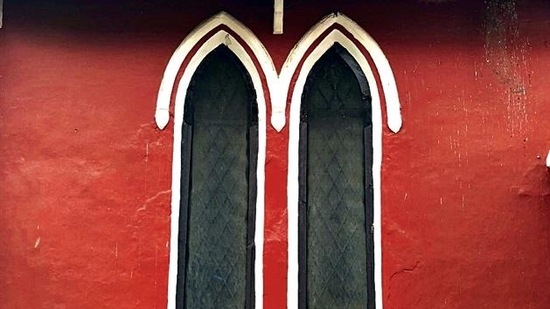
Tucked in a corner of Civil Lines, the church was consecrated in 1866 by the Bishop of Calcutta for a handful of British officers. The building is of Colonial-era aesthetics—the tall thin lancet windows, the tiny bell tower, and the gabled roof that slopes down on both sides as harmoniously as a slow-moving sonata. Inside the tiny church, the ceiling rests on a frame of timber roof truss—its coffee-coloured wooden beams feels like secret keepers of the bygone time.


Stay updated with all top Cities including, Bengaluru, Delhi, Mumbai and more across India. Stay informed on the latest happenings in World News along with Delhi Election 2025 and Delhi Election Result 2025 Live, New Delhi Election Result Live, Kalkaji Election Result Live at Hindustan Times.


