E-Paper



Farm fires in Punjab, Haryana up from same stage last year
An early withdrawal of the southwest monsoon and the subsequent early harvesting this year have advanced stubble-burning dates

 Prefer HTon Google


The number of farm fires in Delhi’s neighbouring states—Punjab and Haryana—have increased in the period from September to October when compared to the corresponding time in 2022, a month-long satellite data collated by the Indian Agricultural Research Institute (IARI) has revealed.
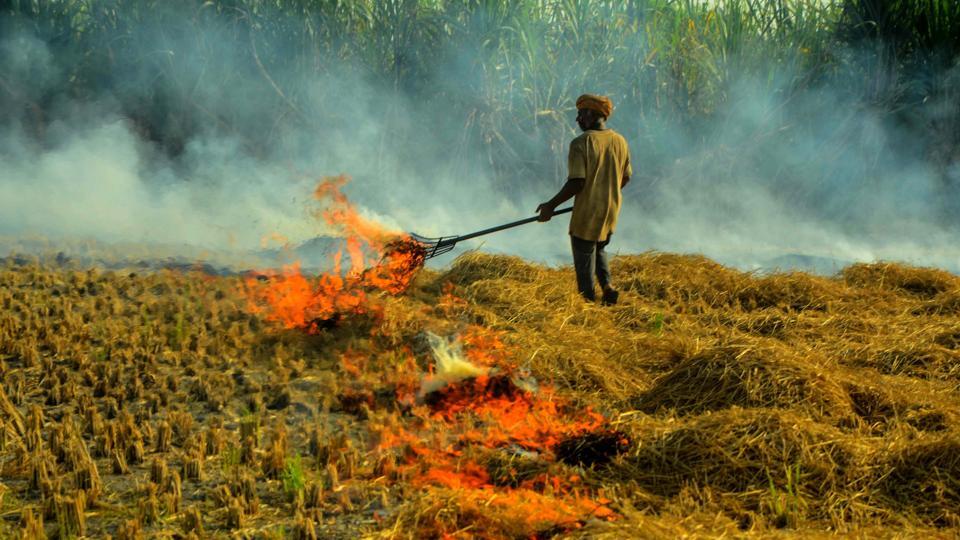
However, while farm fires in Haryana have increased nearly three times—from 168 instances last year to 542 this year, there has only been a marginal increase in the case of Punjab—with 1,238 farm fires recorded last year and 1,388 this year, the data showed. The data collected was from September 15 to October 15.
According to experts, however, an early withdrawal of the southwest monsoon and the subsequent early harvesting this year have advanced stubble-burning dates as well. But a clear trend will emerge only towards the end of October, they added.
To be sure, early harvesting can only be beneficial for the air quality if the meteorological conditions are also favourable, like at present, when the temperatures are a couple of notches above normal and accompanied by good windspeed—both aiding the consistent dispersal of air pollutants. Delhi’s air quality index (AQI) has oscillated between the “moderate” and “poor” categories for the past couple of weeks. The current rise in temperature is also owing to an approaching western disturbance, which has made the sky cloudy and might bring rain on Monday and Tuesday, the India Meteorological Department has said.
“The count is slightly higher than 2022 but last year, we saw some rains even in the first and second weeks of October. October has been fairly dry this year, barring some rains around October 10. Overall, there has not been much of a difference in the farm fires as harvesting began earlier than usual. Last year, rains delayed harvesting in large parts of Punjab and Haryana till the second week of October,” said VK Sehgal, professor and principal scientist at IARI and part of the Consortium for Research on Agroecosystem Monitoring and Modelling from Space (CREAMS).
The data is collated from each state at CREAMS before being sent to the Union ministry of environment and the Commission for Air Quality Management (CAQM).
In north India’s food-bowl states, farmers set aflame paddy stalks around October to clear their fields for their next crop. This releases millions of tonne of smoke, carbon dioxide and toxins leading to a deadly spell of air pollution in Delhi and NCR.
Sehgal added that a peak in farm fires is still expected towards the last week of October or the first week of November but even then, the numbers this year were far better when compared to 2021 and 2020.
Between September and October 2021, Punjab recorded 1,946 farm fires while it was 4,665 in 2020. In Haryana, the count in 2021 was 850 and 702 in 2020. “This early harvesting and subsequent stubble burning may give the impression that more fires are occurring this time, but more crop has also been harvested, which is leading to this count,” Sehgal added.
“If the harvesting period gets delayed, particularly due to rains, we see more fires towards October environment and early November. The number of farm fires piles up when temperatures are low and wind conditions are calm, leading to a higher accumulation of pollutants. If harvesting is done early and the stubbles are burnt earlier, the impact on air quality will be not as harsh because the meteorological conditions, like good wind speed and high temperatures, help disperse pollutants,” said Dipankar Saha, former head of Central Pollution Control Board’s air laboratory.
Data from the System of Air Quality and Weather Forecasting and Research (SAFAR), showed that peak farm fire contribution to Delhi’s PM 2.5 generally occurs in the first week of November. The highest single-day contribution of farm fires to Delhi last year was 34%, which was recorded on November 3, 2022. In comparison, the single-day peak in 2021 was 48% on November 7, while in 2020, the peak came on November 5, when the contribution was 42%, SAFAR data showed. So far, the daily contribution has been below 4%, SAFAR has said.
Delhi lieutenant governor (LG) VK Saxena on Saturday had written to the chief ministers of Punjab and Haryana, asking them to control farm fires in their regions. Saxena urged both the CMs to take necessary steps and forge an alliance with farmers to control the annual practice. Earlier in October, the Union government approved funds worth ₹600 crore for a central scheme aimed at curbing instances of paddy stubble burning in most northern food-bowl states.