
 E-Paper



Garden where Aurangzeb was crowned
Today, Shalimar Bagh is a shadow of its glorious past, and the palace within it has become a site of neglect and deterioration, despite its ASI-protected status

 Prefer HTon Google


Tucked away in northwest Delhi’s Shalimar Bagh is a Mughal royal retreat by the same name that dates back to the 17th century. One of the many royal gardens built during this period, this particular complex includes an imposing palace known as Sheesh Mahal that served as the site where emperor Aurangzeb’s coronation ceremony took place in 1658.
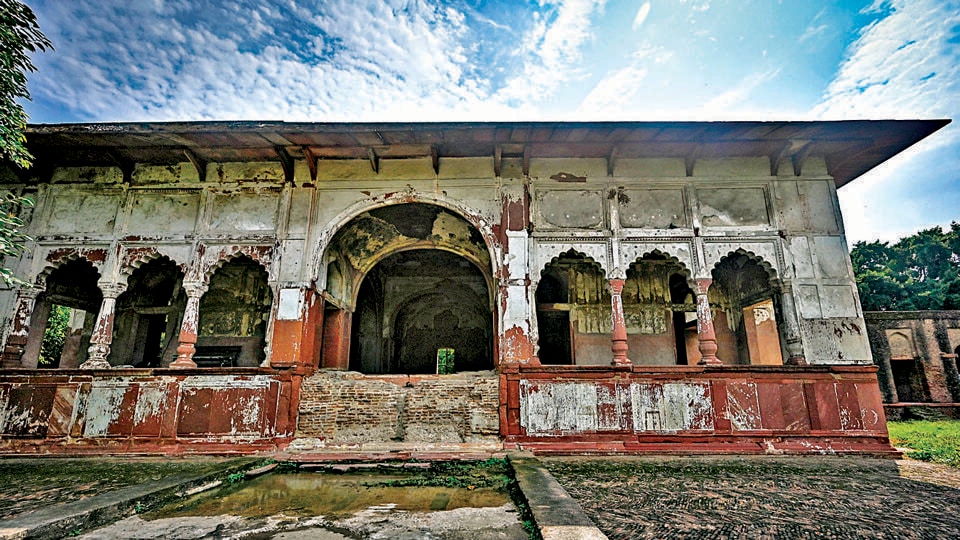
Today, however, Shalimar Bagh — under the jurisdiction of the Delhi Development Authority (DDA) — is a shadow of its glorious past, and the palace complex within it has become a site of neglect and deterioration, despite its status as an Archaeological Survey of India (ASI)-protected monument.
Shalimar Bagh finds a mention in various historical documents — it was planned by Aurangzeb’s father Shah Jahan, and some accounts say that it was commissioned by Shah Jahan’s wife, Akbarabadi Begum.
According to Maulvi Zafar Hasan, the ASI archaeologist who prepared the first list of monuments worthy of conservation in 1916, Shalimar Bagh was originally known as Aizzabad Bagh. “It is probable that the garden was known after Aizzun Nisa Begum also known as Akbarabadi Begum, a mistress of Shahjahan,” he wrote.
Author Khafi Khan, in Muntakhab-ul lubab, a historical account of the Mughal empire which was completed around 1732, wrote that Aurangzeb completed ceremonial procedures for his ascension to the throne at Shalimar Bagh.
“Aurangzeb, not caring to enter the fortress of Delhi, encamped in the garden of Aizzabad, now called Shalimar, and he sent out on advanced force, under Bahadur Khan, in pursuit of Dara (Shikoh, his brother and rival for the throne). On Friday, the first of Zulqada (July 31, 1658), after saying his prayers, and at an auspicious time, he took his seat on the throne of the empire of Hindustan, without troubling himself about placing his name on the coinage and the sending of presents to other sovereigns and nobles were all deferred to his second accession to the throne,” he wrote.
Shalimar Bagh also finds a mention in Sir Syed Ahmad Khan’s Asar-ul-Sanadid, a comprehensive description of Delhi’s architecture written in 1847. According to him, Shah Jahan himself named the garden Shalimar.
There are other notable historical moments associated with the garden complex —Nader Shah, the shah of Iran who sacked Delhi in 1739, camped near Shalimar Bagh while departing from Delhi. Sheesh Mahal, meanwhile, served as a summer retreat by David Ochterlony, the British Resident, in 1803, and according to Zafar, this was where the officer contracted the fever from which he died in 1825.
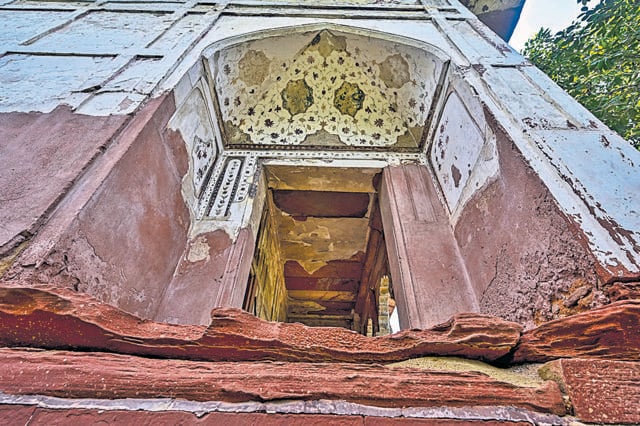
Despite its rich history, however, Shalimar Bagh today lies neglected. Over the years, Sheesh Mahal has become derelict, with the plaster on its walls chipped away, exposing the layer of lakhori bricks underneath. Cracks run across the pavilions on one end of the palace, while paintings with floral motifs and ornamental carvings, which line the ceiling of the chajja, have faded with time.
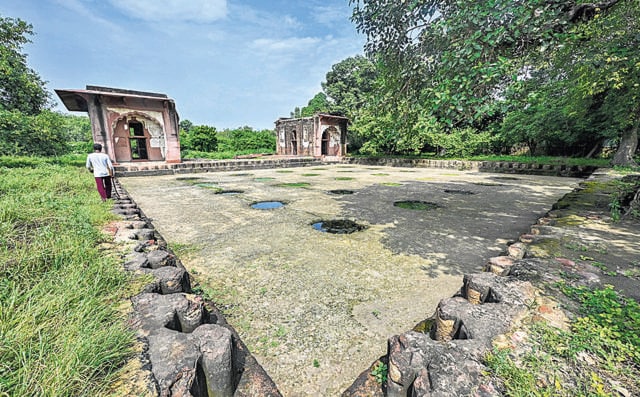
Behind the palace is a well with lakhori brick masonry, from which water was possibly drawn to water the channels of the garden. In addition, there is a square water tank with decorative ornamentation, and two square pavilions adorned with paintings and ornamentation. All these structures are in desperate need of conservation.
Over the years, several projects have been proposed to conserve the complex, but all of them failed to take off. The most recent example was in 2019, when then lieutenant governor Anil Baijal, who was also the chairman of DDA, visited the site and gave instructions to restore the monument and redevelop the park. A dialogue was also initiated with the Indian National Trust for Art and Cultural Heritage (INTACH) to work out a restoration plan, but the project subsequently went into the cold storage.
Historian and author Swapna Liddle, who was the then convenor of INTACH’s Delhi chapter, confirmed that talks were initiated, and added that Sheesh Mahal’s neglect was not a new story.
“For a long time, Sheesh Mahal was unprotected. In the 1940s during British rule, talks were initiated to protect it since it was a Mughal garden and Aurangzeb was crowned here. It was only much later that Sheesh Mahal got protection,” she said Liddle.
She said that during talks with DDA in 2019, she had suggested that the separation of heritage structures within the same periphery was not a good idea. “Sheesh Mahal is under ASI’s protection but even then, it is part of the garden complex (under DDA). We proposed that its separation from the garden was wrong and it required proper conservation,” said Liddle.
HT reached out to DDA, but officials did not respond to requests for a comment.
Praveen Singh, superintending archaeologist, ASI Delhi Circle, also admitted that the palace required conservation. “Conservation was initiated in the past but it was called off due to some conflict among locals. I was not at the helm of affairs and will have to find out the reasons,” he said.
Old-time residents speak fondly of the palace’s grandeur and the richness of the orchards it was once surrounded by, and bemoan the inadequate attention it has received.
Raj Kumar, 60, a resident of the Shalimar Bagh neighbourhood who grew up in the area, accused the government agencies of abdicating their responsibilities. “Around 2018, some work was started but it was called off. Since the structure has remained the way it is,” he said.
Kumar advocated the need for conservation and campaigns to highlight the historical importance of Shalimar Bagh. “The palace is beautiful and if it is repaired and conserved, many people will come to see it,” he said.
Even today, a few people do come to the area to visit the palace, but are usually directed through the DDA park, even though the palace can only be accessed through nearby Shalimar village.
Singh said the entry to Sheesh Mahal from the DDA park was restricted to prevent the entry of “anti-social elements”.
“Anti-social elements find it easier to enter the palace from the park. They used to create a ruckus. To prevent this, we have closed the entry from the park. Those who are genuinely interested in visiting the monument can take another entry,” he said.


