E-Paper



Haryana stopping water, says Delhi; ‘cheap politics’, responds state
Atishi said that Haryana was deliberately interrupting the water supply the apex court directed Himachal Pradesh to release

 Prefer HTon Google


Delhi water minister Atishi on Friday said the Haryana government was “conspiring against Delhi” by releasing less water into the Yamuna, depleting water levels in the river over the last five days — the latest allegation on the water dispute between the two states.
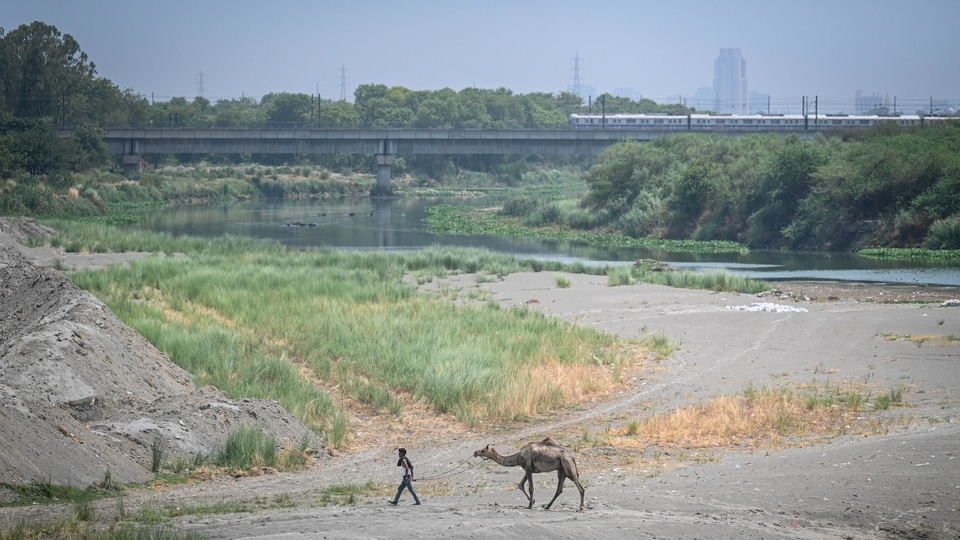
Haryana refuted the charges saying the Delhi government was playing “cheap politics” over water, and added that the state has been supplying water according to the mutual agreement.
The allegations flew from both sides a day after the Supreme Court ordered Himachal Pradesh to release 137 cusecs of surplus water to help Delhi tide over the summer water shortages, emphatically stating that there must be no politics surrounding the issue of water release.
Also Read | SC directs Himachal Pradesh to immediately release surplus water to Delhi
Atishi said Haryana was deliberately interrupting the water supply the apex court directed Himachal Pradesh to release.
“... the Supreme Court is trying to resolve the problem. Haryana is attempting [to ensure] that even if Himachal releases additional water, adequate water should not be available for Delhi. We will put forward this conspiracy before the Supreme Court on Monday,” the minister said while inspecting the Wazirabad barrage site which acts as the primary holding area for the water coming via the Yamuna channel.
The Delhi government has alleged that the surplus water released by Himachal would not help the city recuperate from the crisis if Haryana slashes its own share as the surplus water takes around 48 hours to reach the Capital’s reservoirs.
Also Read | Delhi’s water augmentation plans fail to take off
However, Haryana chief minister Nayab Saini said the Delhi government was politicking the issue.
“They [Delhi government] are getting involved in cheap politics. During a meeting of the Upper Yamuna River Board attended by bureaucrats from the Union government and the two states, Delhi officials accepted that Haryana is giving its share of water. We informed that we also have shortage of water, but if Himachal Pradesh agrees to release water, it will be checked,” said Saini.
A Haryana government official from irrigation department reiterated Saini’s claim, and said the Delhi government is trying to hide its failures by giving a political colour to this issue — something the state has been maintaining since the tussle over water supply first came to the fore this season.
Water route from Himachal
The stretch of the river from its origin at Yamunotri (in Uttarakhand) to Okhla barrage in Delhi is called “Upper Yamuna”. Of the river’s tributaries, Giri and Pabbar originate and flow in Himachal Pradesh.
Flowing through Poanta Sahib, the water reaches the Hathnikund Barrage, manned by Haryana. The river passes along the boundary of Kurukshetra, Karnal, Panipat and Sonipat before entering Delhi and reaching the Wazirabad barrage, managed by Delhi. Atishi said the water level in Yamuna on June 2 was 6,713ft which dropped to 669.7ft on June 7.
“The water level was going down even as the SC was hearing the matter. When SC directed Himachal to give extra water, Haryana reduced its own quantum being released. We will put forward this date in the court on Monday,” she added.
The data shared by the minister ssuggested that from June 2 to 7, the water level at Wazirabad was 671.3 ft, 671.2 ft, 671.1 ft, 671 ft, 670.5 ft and 669.7 ft.
Water production at record level: DJB data
On June 6, the Supreme Court ordered Himachal Pradesh to release 137 cusecs of surplus water available to help curtail the acute water shortage in Delhi. A vacation bench of justices Prashant Kumar Mishra and KV Viswanathan underscored the gravity of the situation, describing it as an “existential problem” for Delhi, exacerbated by the extreme heat and soaring demands.
It pointed out that since Himachal Pradesh has shown willingness to share 137 cusecs of surplus water with Delhi, Haryana must provide the “right to passage” at the Wazirabad barrage.
The bench said water will be released on June 7 with prior intimation to Haryana and the Upper Yamuna River Board shall measure the water for onward supply. “... Haryana shall facilitate the flow of additional water from Hathnikund through Wazirabad...,” the court added.
To be sure, the daily bulletins issued by the Delhi Jal Board (DJB) have pointed out that the water production by the water utility is at record levels.
Though the peak summer target is 1,000 million gallons per day (mgd), DJB said that it has supplied over the target over the past five days.
According to DJB data, the water production on June 3 was 1,002.61 mgd, 1,002.67 mgd on June 4, 1,004.18 mgd on June 5, 1,003.05 mgd on June 6 and 1,002.89 mgd on June 7, the bulletins said, adding that the nine WTPs are operating above their maximum capacities.
After the apex court’s directions, Omkar Chand Sharma, additional chief secretary of the Jal Shakti department, Himachal Pradesh, said the state has been releasing water according to the agreements between Delhi and HP. “An MoU was signed between DJB and HP in December 2019. Since then, we have been releasing our share of water for Delhi as per agreement. If there is any issue, it is between Delhi and Haryana.”
Delhi government spokespersons and DJB did not respond to questions on how they plan to treat the additional water procured from Himachal.
Delhi BJP president Virendra Sachdeva said that Atishi is blaming Haryana government falsely for Delhi’s water crisis. “How long will the minister mislead Delhi residents about the water problem? Delhi’s water problem is not due to a lack of raw water or purification but because of the wastage caused by the sludge-filled storage ponds,” said Sachdeva.