
 E-Paper



How Covid killed the calendar
Paper calendars survived the digital age, but their sales have suffered a massive drop in the past two years of the pandemic, what with unprecedented disruption in social, personal and professional lives, rendering calendaring not- so- necessary

 Prefer HTon Google


It is afternoon on New Year’s Day, and Babu Lal, a retailer of calendars in Delhi’s Nai Sarak, home to some of the country’s biggest calendar companies, is waiting for customers. Early January is peak business season, but he says there are few takers for his vast range of wall and desk calendars.
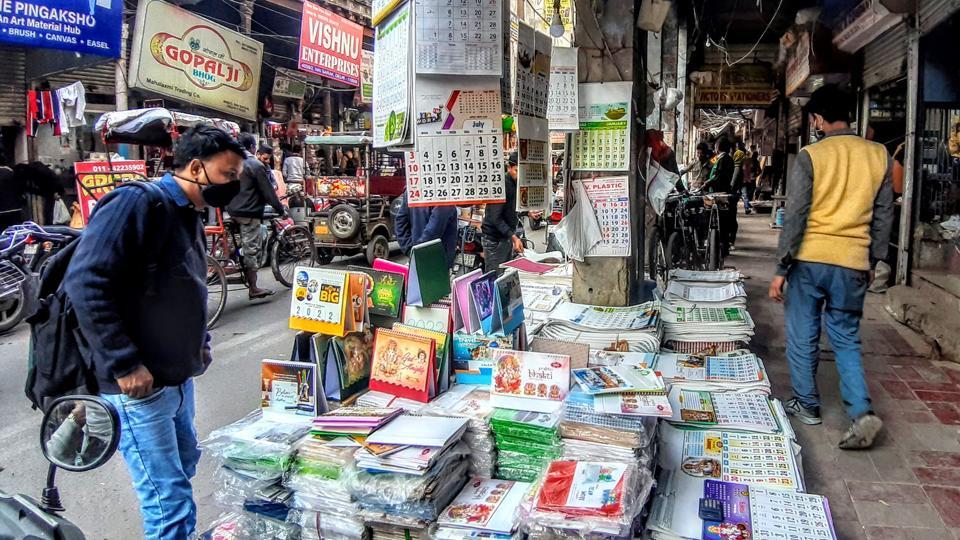
“The pandemic has killed calendar sales. Earlier I used to sell 500 calendars a day in December and January; now I am lucky if I sell 50 a day. Many of my old customers for whom buying a calendar was an annual ritual for decades have not shown up in the past two years,” says Lal.
He is not the only one—calendar manufacturers and dealers at Nai Sarak say sales of paper calendars, which survived the digital age, have suffered a massive drop in the past two years, what with the pandemic causing unprecedented disruptions in the social, personal and professional lives of people, rendering calendaring not- so- necessary.
“My orders are down by 60%, and it has to do with the fact that a lot of people have worked from home with few personal and professional engagements to keep in the past two years, ” says Gulshan Kumar, who runs Sunshine Enterprises, a manufacturer and wholesale dealers of calendars at Nai Sarak.
“Besides, businesses that bought calendars worth lakhs of rupees every year from us have suffered heavily and have not wanted to spend on calendars and planners in the past two years, ” adds Kumar, who, this year, has also produced a range of desk calendars with Covid-19 themes, with messages on the need for masking, taking vaccines and washing hands and others. “ These reflect the times we are living in and are selling slightly better than others.”
In fact, over the past two decades, Delhi-NCR has emerged as a major hub of calendar manufacturers. Calendar companies, which have printing presses in areas such as Okhla, Naraina, Kundli and Sahibabad, start printing calendars in August for the sale season that starts during Diwali. “In 2020 and 2021, I had to trash thousands of unsold calendars, suffering a huge loss. Unsold calendars have no use and have to be trashed, ” says Prakash Chandra Gilotra, who runs Subhash Calendar Co, one of the biggest calendar manufacturers and dealers in Delhi. The walls of his first-floor shop at Nai Sarak are adorned with new 2022 calendars of various sizes, featuring gods and goddesses. “ Looks like Omicron, the new variant of the coronavirus will kill the sales for the third year running,” says Gilotra.
Ranjeet Singh, one of the most celebrated contemporary calendar artists in Delhi, is equally worried. Singh says he used to produce about 40 new artworks for calendars – paintings of gods and goddesses such as Shiva, Ganesha, Vishnu, the Buddha--in a year. “ But I have not received a single commission from calendar manufacturers since the pandemic began two years ago. This has never happened in the 73-year history of our art studio,” says Singh, who runs Rangroop studio with his artist brother. The studio, famous for calendar art across the country, was set up by his father in 1951. “Calendar manufacturers are using old paintings for the few calendars they are printing during the pandemic,” he adds.
He feels that the coronavirus has dealt a severe blow to calendar art, an essential art of India’s visual culture and tool of advertising.
Indeed, in the 1920s and 1930s, brands such Sunlight Soaps, Woodwards Gripe Water, and British Alizarine Company were among the first to bring out calendars featuring the art of Raja Ravi Varma. Later, Vasudev H Pandya, who was known for his paintings of Krishna, was commissioned by many brands for calendar art.
“New art is key to sales of calendars and we commissioned artists to do fresh paintings every year, but during the past two years we have not done commissioned any new art,” says Ankit Jain, who runs Jain Calendar Company at Nai Sarak. “ Last year even the Central government stopped bringing out new year calendars. I just hope the companies do not take a cue and turn to digital calendars in a big way”.
In January 2021, the Union ministry of information and broadcasting launched an Android and iOS mobile application for a digital calendar and diary, doing away with its decades-old practice of bringing out GoI (Government of India) paper calendars and diaries. “Every year we printed close to 1.1 million calendars and 90,000 diaries, but we have gone digital this year,” said Prakash Javadekar, then information and broadcasting minister while unveiling GoI digital calendar. “Last year, around ₹7 crore was spent in printing the calendars and diaries. This year the ministry has gone digital and the cost is ₹2 crore,” he added.
But compared to over a million paper calendars the government printed, so far, there have been only about 50, 000 downloads of the official Government of India Calendar-Diary’s Android App.
Proponents of paper calendars say digital planners and calendars are no match for the good old paper calendars—one of the cheapest and most effective means of advertising for businesses of all sizes and a way for brands to make and maintain their social and commercial connections since the early 20th century.
“I used to receive at least five desk calendars but this year, I am yet to receive any, which is a very strange feeling. I still have many calendars from 2019, which makes me feel I am caught in a time warp; these old calendars also keep reminding me that there was a normal, happy pre-corona world, ” says Suhani Gupta, 34, a graphic designer.
“I love this analogue way of time management and hope that calendars will soon stage a comeback. It is only a matter of time, ” says Gupta.


