
 E-Paper



Late night processions recurring nightmare for southeast Delhi residents
Despite a wide band of fines in place to penalise violations of noise pollution norms, transgressions pick up sharply during Navratri, Durga Puja and Diwali


Residents of neighbourhoods in south and southeast Delhi have been on the receiving end over the past week of what has become a recurring nightmare — a large number of religious processions related to Navratri celebrations, often accompanied by stacks of loudspeakers loaded on to trucks, blaring deafening tunes late into the night.
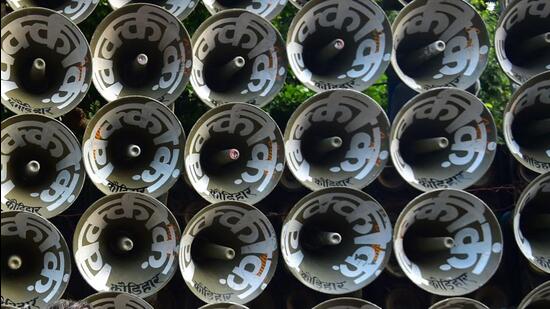
The festival season in north India, between September and early November, traditionally coincides with the annual air pollution scourge, but it also obscures another major concern — noise pollution levels that spike well beyond safe limits. Despite a wide band of fines in place to penalise violations of noise pollution standards and loudspeaker norms, transgressions pick up sharply during Navratri and Durga Puja, peaking during Diwali.
Separate norms govern general sound levels and sounds from loudspeakers. However, as a blanket norm, Delhi Police disallows the use of any loudspeakers beyond 10pm. On September 22, the Delhi government had relaxed the timing of the use of loudspeakers, giving Ramlila and Durga Puja organisers a two-hour extension till midnight.
However, religious processions armed with boom boxes and high-decibel speakers have openly flouted these restrictions, keeping residents in and around Mathura Road awake till as much as 3am.
The Central Pollution Control Board (CPCB) permits a maximum noise level in residential areas of 55dB(A) between 6am and 10pm. This threshold falls to 45dB(A) from 10pm till 6am. Db(A), or a weighted decibel, is a measure of how loud something sounds to the human ear. For loudspeakers, the rules mandate that the noise level at the boundary of the public place where a loudspeaker or public address system is being used shall not exceed by more than 10dB(A) the noise standards for the area or 75dB(A), whichever is lower.
But these rules have little footing on the ground, and a general disregard for noise guidelines, lax imposition of rules, and authorities reluctant to take action against violators has translated into an agonising experience for residents.
Bhupesh Kumar Rakhra, the president of the Siddharth Enclave RWA, said that processions are being allowed to pass in violation of all rules.
“The noise is so loud that the window panes of houses in the colony start vibrating. Over the last two days, these DJs have played music till 1-2 am, deep into the night, and we have been unable to sleep. There has to be some form of regulation or permission mechanism to stop these violations,” he said.
On the opposite side of the road, Triveni Mahajan, the secretary of the Friends Colony RWA, said that violations of noise regulations have become an annual feature, with a large number of processions heading from Kalkaji towards Noida and Greater Noida with senior citizens, children and people ill unable to cope with the situation. She added that the processions start around 10pm and continue till 2-3am.
“After every 5 to 10 minutes you have trucks booming music so loud that vibrations can be felt inside homes. Since the night traffic starts after 10pm, it also adds to traffic jams and congestion on Mathura Road. Twice a year, residents of Friends Colony, Maharani Bagh, and Ishwar Nagar go through the same nightmare — once for kanwar yatras, and once for Navratri processions. The government, police and local councillors all know about it, but nothing is done to control these violations of traffic as well as noise pollution,” she said.
Several residents also shared their grievances on social media.
A person with the username Kanika Saraf shared a video of processions passing near CSIR apartments on Ring Road at around 1am. “Delhi police should take immediate charge of the roads near Kalka Mandir especially Mathura Road. They are absolutely out of order. This extreme situation has happened on the city roads causing havoc to the residents and commuters nearby!” Saraf posted on X (formerly Twitter), also sharing a video of trucks mounted with multiple speakers and disco lights passing near the residential locality.
A police officer from southeast district police, who declined to be named as he is not authorised to speak to the media, said that for the past few days, multiple religious groups from various parts of Delhi, Faridabad, Ghaziabad, Noida, and Greater Noida have been visiting Kalkaji temple to illuminate lamps, which they then take back to their respective pandals and place before the idol of goddess Durga as part of the Navratri festivities.
“It’s an annual affair that has been going on for several years. However, the scale has changed — in the past, people in small groups visited the temple to perform traditional rituals and would, at most, beat drums and crash hand cymbals (manjiras) together on their way to and from the temple. Nowadays, the trend has changed — as youngsters join such groups, they bring along DJ music systems, dancing to devotional songs,” the officer said.
On being asked if religious groups seek permission from the police for carrying out their processions, another police officer said, “They neither ask for any permission nor we give any. But at the same time, stopping the groups from walking on the roads isn’t easy. If we try, they become aggressive and even resort to violence – all in the name of their religious festival. All we do is to ensure their procession moves fast and cause less inconvenience to commuters and residents.”
A third police official said that with Navratri celebrations already starting, the number of such processions is now likely to go down. “We are also increasing the deployment along the routes and if anyone is found violating the rules after 10pm, we will take strict legal action. against them,” the official said.
HT reached out to the Delhi government, but officials there did not comment on the issue.
Sound norms are even more stringent in zones around hospitals (known as silent zones), with 50dB(A) permitted during the day and 40dB(A) beyond 10pm. But even the sections of Mathura Road with hospitals located on them have not been spared.
Aarti Saluja, a resident of Sarita Vihar, who lives near Apollo hospital, said the processions are in clear violation of the noise rules. “This is simple noise pollution. These people are taking idols on Mathura Road but the volume is so loud that we are unable to sleep even around 2.30am,” she said.
In 2021, the Delhi Pollution Control Committee (DPCC) issued guidelines that defined penalties for separate categories of violations of noise regulations. According to the rules, a fine of ₹1,000 will be issued for loud firecrackers being burst in residential and commercial areas, a penalty that jumps to ₹3,000 if the area is a silent zone. People responsible for using loudspeakers or PA systems at volumes beyond the permitted limit can be fined ₹10,000. Fines between ₹10,000 and ₹30,000 will be imposed for the use of loud firecrackers in rallies, weddings and other events. Noise level breaches by construction equipment will be fined ₹50,000, while loud diesel generator sets (above 1,000kva) will be penalised ₹1 lakh. Importantly, these fines are all compounding, which means repeat offenders will be penalised significantly heavier amounts, going up to ₹5 lakh.
A senior DPCC official said that the noise enforcement powers have been given to police and revenue departments.
However, the enforcement is not reflecting on the ground, residents rued. Kaustubh Prasad, a resident of the area took to X to post that all rules and orders of Supreme Court are being violated openly. “Bass levels so high they would be considered dangerous on multiple levels. This keeps happening every year, multiple times a year. Mathura Road major sufferer,” he posted.
Ashish Ved Sharma posted: “It is really sad that law is only relevant to the middle class whereas the ones abusing the law are dancing away at 3:15am with loud music that is coming from a distance yet there is no action to stop it. Windows are rattling from such distances. Strict measures need to be taken as I feel this will go out of hand in the coming days, months and years. Remember there are old people, small children, etc who get extremely troubled by such things. The decibel levels have to be low after 10pm.”

Stay updated with all top Cities including, Bengaluru, Delhi, Mumbai and more across India. Stay informed on the latest happenings in World News along with Delhi Election 2025 and Delhi Election Result 2025 Live, New Delhi Election Result Live, Kalkaji Election Result Live at Hindustan Times.


