E-Paper



Local emissions top Delhi’s bad air mix
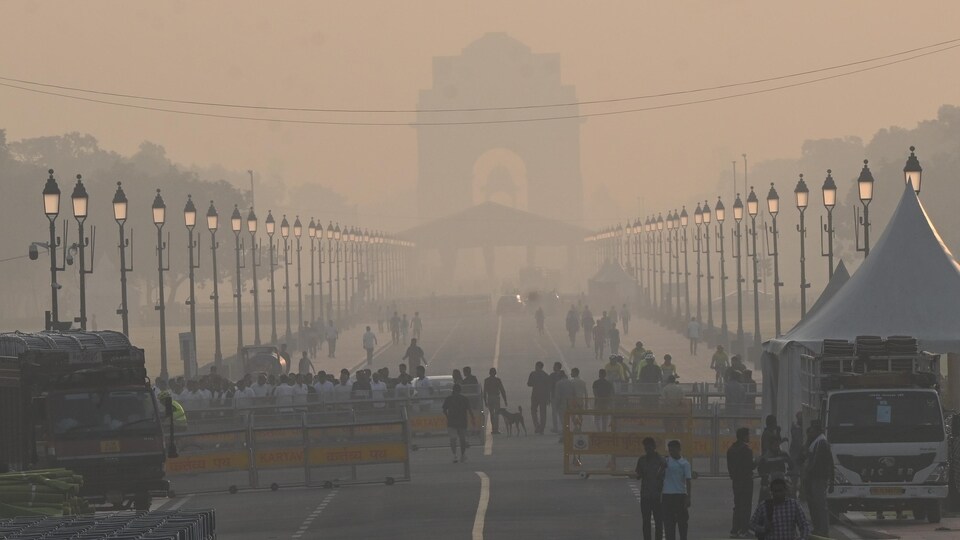
Delhi's air quality deteriorated to its worst level this season due to vehicular emissions, pollution from neighboring regions, and stubble burning.

 Prefer HTon Google


Vehicular emissions and pollution from the neighbouring regions were on Monday the major reasons behind Delhi’s deteriorating air quality, which was the season’s worst for the day, data from the Union ministry of earth sciences showed.
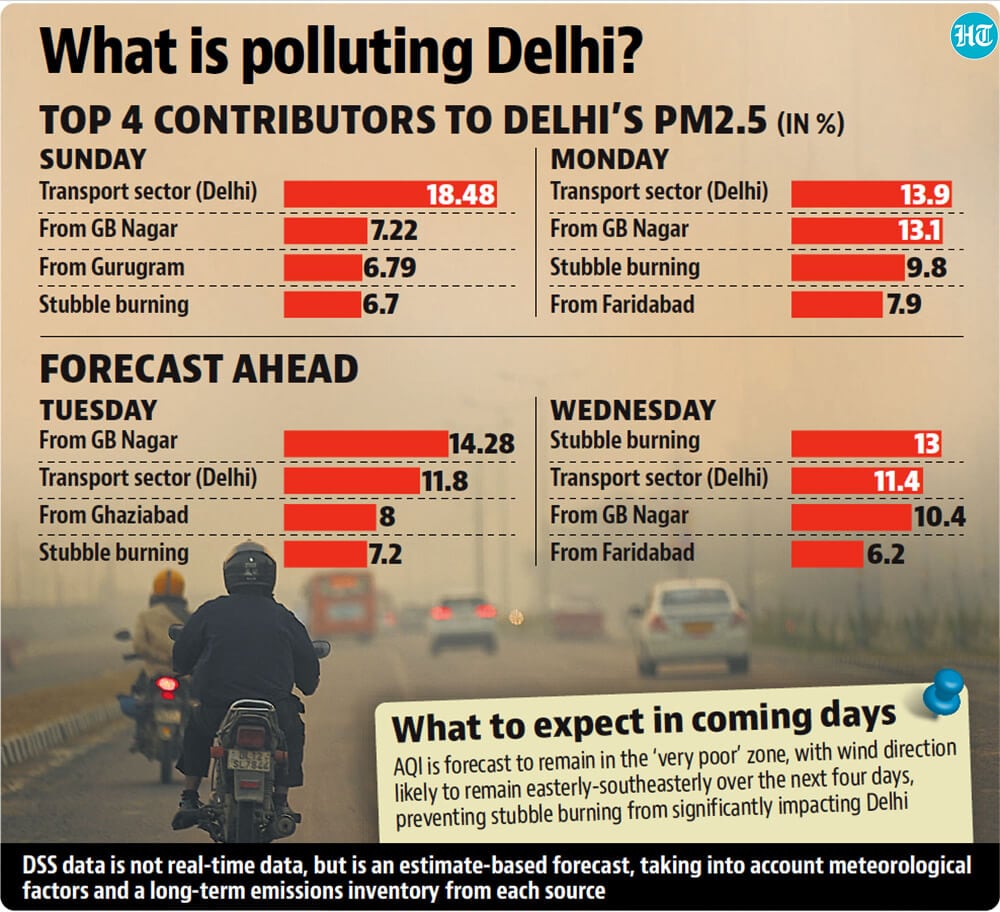
Smoke due to stubble burning was the third major contributor to the pollution in the city, according to the Decision Support System (DSS), which estimates the contribution of different sources of pollution to Delhi’s particulate matter (PM) 2.5 every day. According to DSS, vehicles contributed around 13.9% to the “very poor” air quality on Monday, followed by 13.1% pollution from Gautam Budh Nagar, while the share of stubble burning share for the day was pegged at around 9.8%.
All of these combined, apart from other minor sources of pollution, both in the city and outside, led to a deterioration in the air quality with a reading of 347 (very poor air, according to the Central Pollution Control Board) from 325 a day ago. Forecasts show that the air quality index (AQI) is likely to remain “very poor” over the next three days, with “severe” air unlikely till November 8, according to the Early Warning System.
Meanwhile, farm fires continue to rage across the northern plains, with Punjab on Monday recording over 1,000 fires for the second consecutive day. However, a favourable wind direction of easterly-southeasterly since Saturday is preventing considerable stubble intrusion to the Capital, according to the weather department.
The India Meteorological Department (IMD) said a change in wind direction to northwesterly is unlikely over the next three-four days. But wind speeds are expected to remain low, which may lead to accumulation of pollutants locally, it said.
Kuldeep Srivastava, scientist at IMD, said wind speed remained below 8km/hour during the day on Monday, with winds almost calm at night, when the temperature is low. “Though the wind direction is not northwesterly, slow winds which turn calm at night are leading to accumulation of pollutants,” he said.
The transition back to northwesterly may happen towards the second week of November — a period when farm fires are generally at their peak. Data from the Indian Agricultural Research Institute showed 1,030 farm fires were recorded in Punjab on Monday, with 52 fires in Haryana.
DSS’s forecast for Tuesday showed that around 14.3% of Delhi’s PM2.5 concentration will be from Gautam Budh Nagar, followed by 11.8% from vehicles in Delhi, around 8% from Ghaziabad and 7.2% from stubble burning.
A measure which may help bring down both transboundary pollution and vehicular pollution in the region is the Commission for Air Quality Management’s (CAQM) restriction on buses that are non-BS-VI, CNG or electric from plying within NCR and to and from Delhi. This restriction will come into force from November 1 as part of the third stage of the Graded Response Action Plan (Grap).
Experts, however, said more action is needed – both in Delhi and in the neighbouring NCR towns, particularly measures that are scalable. “This upcoming restriction should help to an extent, but we need more restrictions, particularly on private vehicles. Until public transport is increased, we cannot take off vehicles off roads,” said Anumita Roychowdhury, executive director, research and advocacy at the Centre for Science and Environment. “For transboundary pollution, measures such as sprinkling of water or mechanised sweeping should be enforced on the same scale across these neighbouring towns.”
Sunil Dahiya, analyst at the Centre for Research on Energy and Clean Air (CREA) said even though the Grap’s are pre-defined, CAQM should still look at enforcing certain measures in the higher stages based on DSS data. “We also know sources of pollution in the neighbouring towns, for instance the coal-based Dadri thermal power plant is a major source of pollution in Gautam Budh Nagar, therefore, focus should be on such industries,” he said.
In terms of temperature, Delhi recorded a maximum of 33.5 degrees Celsius – three notches above normal, with the minimum recorded at 16.2 degrees Celsius, which is around normal for this time of the year.