E-Paper



Measures fail but rain steps in: AQI improves from 437 to 279 in Delhi
The 24-hour AQI was recorded at 279 (poor) according to the Central Pollution Control Board’s (CPCB) national bulletin at 4 pm.

 Prefer HTon Google


After gasping under its longest spell of bad air days this year, the Capital’s air quality improved and moved out of the deep red zone on Friday following unexpected showers and strong winds that swept the city and its adjoining regions overnight.
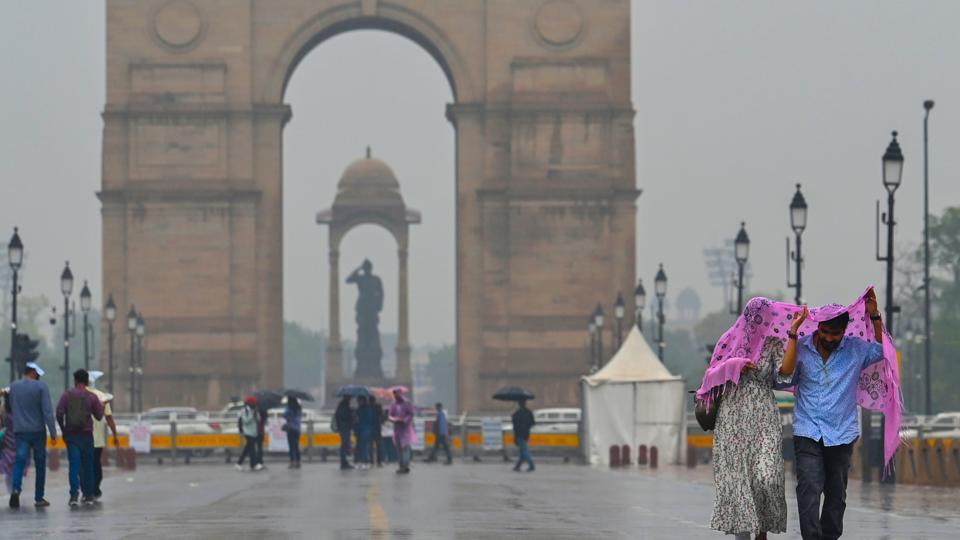
The 24-hour average air quality index (AQI) was recorded at 279 (poor) according to the Central Pollution Control Board’s (CPCB) national bulletin at 4 pm — a tremendous dip of over 150 points from Thursday’s 437 (severe). By 9pm, the AQI had plummeted further to 239, due to the meteorological factors that naturally washed away pollutants.
Though Delhi’s average AQI is calculated over 24 hours, its real-time particulate matter (PM) 2.5 concentration data showed the level at 1am on Friday was 398 micrograms (µg) per cubic metre — over six times the national standard of 60µg per cubic metre. The drizzle began in parts of Delhi between 11pm on Thursday and 1am on Friday, but the rain clouds gathered significant momentum by 3am. CPCB data showed an immense dip in PM2.5 concentration in a span of three hours — at 3am it was 322µg per cubic metre, plunging to 194µg per cubic metre at 4am and a mere 88µg per cubic metre at 5am.

This dipped to as low as 37µg per cubic metre at both 6am and 7 am — levels that are well within the national standards. The city received intermittent spells of localised light rain continuing till the early hours of Friday leading to a visibly clear and relatively pollution-free morning.
In contrast, PM2.5 levels peaked at 488µg per cubic metre at 12pm on November 5, which was the fourth consecutive day when the air was in the “severe” category.
Weather officials said further improvement in air quality can be expected on Saturday, with wind speeds remaining strong and touching up to 18km/hour, although Sunday -- the day of Diwali --- could end up making matters worse if people choose to flout the ban on bursting firecrackers.
Delhi’s maximum temperature also dropped due to the rain and winds and was recorded at 22.7°C — seven notches below normal and the lowest maximum for November since it was 22°C on November 29, 2019.
“We saw the impact of the western disturbance, which is influencing northwest India. This is what led to this rain spell and from Saturday, moisture in the air will again reduce and the air will be cold and dry,” said Kuldeep Srivastava, scientist at the India Meteorological Department (IMD). Srivastava added that though the wind direction will switch to northwesterly on Saturday, from the predominantly southeasterly winds on Friday, the dispersal of pollutants will continue.
“Winds may go up to 18km/hour during the day. This wind speed will then begin to dip on Diwali day, but should still be around 8-10km/hour,” he said.
This change is also likely to bring in the first of the winter chill. “The winter chill will set in since there has been some snowfall over Jammu and Kashmir, which will lead to cold winds. We can expect another western disturbance around November 15th,” said Mahesh Palawat, vice president, climate and meteorology, Skymet Weather.
Safdarjung observatory, representative of Delhi’s weather, recorded 5.8mm of rainfall till 8.30am on Friday, adding another 4.2mm in the next nine hours. Till 8.30 am, Jafarpur received the highest rainfall in the Capital (12mm), with some amount of rain being recorded at all Delhi stations, barring Narela and Mayur Vihar.
Delhi’s minimum temperature, meanwhile, was recorded at 16.2°C — two notches above normal. IMD forecast a dip in the minimum temperature to 13°C by Monday. The maximum is forecast to rise to 27°C by Saturday and 29°C by Sunday.
Dipankar Saha, former head of CPCB’s air laboratory, said this was not the first time Delhi has had to rely on meteorological conditions to escape a highly polluted spell.
“We have seen multiple times in the past that sudden rain due to a strong western disturbance has been the only reason why the AQI has dipped sharply in November or December. Barring that, the only factor that can help Delhi is strong winds, which remains a rare occurrence, particularly in November,” said Saha.