
 E-Paper



Miles to go for a Metro as Covid curbs limit train capacity in Delhi
Commuters at several stations said they had to wait up to an hour that resulted in a prolonged travel time. They added that since both government and private offices are still open, and there were no curbs on movement of people during the day, adequate public transport arrangements should have been made.

 Prefer HTon Google


Commuters waited in serpentine queues before Metro stations across Delhi, Ghaziabad and Gurugram on Wednesday as the Delhi Metro Rail Corporation regulated entry of passengers to prevent crowding as well enforce the DDMA rule to allow only 50% seating capacity that was issued under the Yellow Alert on Tuesday, after a fresh spike in Covid cases and the positivity rate staying above 0.5% for two consecutive days.
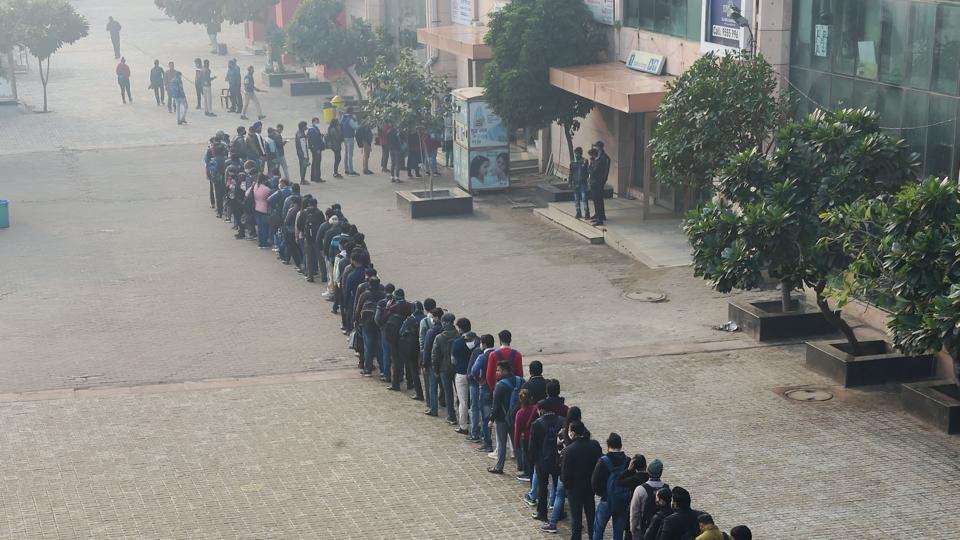
Commuters at several stations said they had to wait up to an hour that resulted in a prolonged travel time. They added that since both government and private offices are still open, and there were no curbs on movement of people during the day, adequate public transport arrangements should have been made.
Travellers also said that since DMRC allowed passenger entry from few gates, it led to long queues outside the station, and flouting of social distancing norms. Public bus users too complained that they had to wait for nearly an hour at bus shelters due to limited carriage capacity.
The DDMA order says that both Metro and public buses will be allowed to carry passengers up to 50% seating capacity, and that no standing travellers will be allowed.
At Laxmi Nagar Metro station in east Delhi, there was a long queue outside the station in the morning. A similar situation was reported from Akshardham, Mohan Garden, Rohini West, Kirti Nagar Metro stations in Delhi, and Shaheed Sthal (new Bus Adda) and Arthala stations in Ghaziabad. In Gurugram, there was rush outside Iffco Chowk and Huda City Centre stations, but only in the evening.
In the evening, hundreds of people were seen waiting outside several gates to the Rajiv Chowk Metro station.Office goers were also seen waiting outside Mandi House and Barakhamba Metro stations.
Many Metro commuters tweeted to share the inconvenience they had to face to enter the station as well as prolonged travelling time.
Pronjoy Kumar Ghose, a banking professional, tweeted, “Shame on Delhi metro @ArvindKejriwal we bank employees need to attend office any how and you are letting us stand in kilometre long que ! Please arrange priority entrance for essential service provider (sic).”
To manage the crowd at the stations, the Metro on Tuesday decided to open just one or two gates at all stations. Of the total 712 gates at its stations, only 444 were kept open on Wednesday, said a DMRC official.
In some cases, however, all gates at a few stations for shut to regulate the crowd. But, they were opened soon.
Pradeep Singh, who works with a private firm, waited for nearly 20 minutes outside the Laxmi Nagar station on Wednesday morning before taking an auto to reach his office in Karol Bagh. “I usually take the Metro, as it takes just half an hour of commuting time. Today, I had to take an auto since there was a long queue before the station, and couldn’t waited so long to board the train. Instead of reducing the capacity by 50%, they should just ask Metro to ensure social distancing in trains,” he said.
Transport experts also pointed out that the Metro systems are designed to provide more standing capacity than seating in order to carry a large number of commuters.
According to DMRC officials, on an average around 1,800 passengers can travel in a six-coach train in one trip. But as standing passengers are not allowed and seating has been reduced to 50%, only 300-odd passengers can travel on one trip.
With almost 400km-long network in Delhi-NCR, the Metro is considered the transport lifeline of the capital. But post-Covid pandemic, there have been several challenges for both for the commuters and the operators in order to ensure Covid protocols are followed.
Metro services were closed for over five months since March last year when the nationwide lockdown was announced due to the pandemic. Even after the services resumed in September last year, Metro operated on 50% seating capacity. In July this year, the Delhi government allowed 100% seating, and standing passengers (30 per coach) were allowed last month.
Raja Chowdhury, who works with a private firm, said, “It was the fastest and most convenient mode of travel in Delhi. But today, it was a pain, as I had to wait for almost 40 minutes outside Rajiv Chowk in the evening. Now I’ll take a cab or auto till this restriction continues.”
Metro deployed multiple teams to check violations of Covid norms in trains and at stations.
Anuj Dayal, executive director, corporate communications, DMRC said, “As part of the intensified measures for containing Covid-19 spread, 15 flying squads have been deployed across the Delhi Metro network to ensure that the Covid safety protocol is strictly adhered to by the passengers inside trains and premises. The frequency of checking drives is also being increased to ensure strict adherence to the guidelines and offenders are also being penalised on the spot.”
Some Metro users requested the DMRC on social media to increase the number of security check counters at the stations. Ankit Sharma, a Metro user, tweeted, “It is fine that some gates have been closed due to the new restrictions due to the rise in the number of Covid cases. But please increase the number of security check counters so that there is no crowding at the platform.”
Public buses
For lakhs of Delhiites, especially in rural areas or those not having direct Metro connectivity, the cluster and Delhi Transport Corporation buses are crucial for daily commute. But with the carrying capacity of buses restricted, those dependent on public bus service faced difficulty in travelling to their workplaces on Wednesday.
There are currently over 6,700 DTC and cluster buses in the capital. At its full capacity, including standing passengers, these buses carry about 4.2 million people every day.
A senior transport department official said, “Due to the restriction, the capacity capacity has reduced drastically as only 50% seating is allowed.”
When asked if the DTC was planning to rope in private buses to enhance the bus fleet till restrictions are in place, the official said, “Private buses are roped in during peak pollution time, especially during odd-even. But this restriction is related to Covid. There is no plan as of now to rope in private buses.”
Due to the restriction, the capacity of para transit such as autorickshaws, taxis, e-rickshaws etc has also been restricted to two passengers per vehicle.
Experts speak
Transport experts say that there is a need to make short and long-term plans to address the challenges in order to stop public transport users from switching to personal vehicles.
To immediately address the problems being faced by the commuters, the experts suggested that the government should add buses to the public fleet, and coaches to Metro trains to enhance carriage capacity.
Sewa Ram, professor of transport planning at the School of Planning and Architecture, said, “There is an urgent need to augment the capacity of the public transport infrastructure. The Metro should add more coaches and the number of public transport buses should be increased so that commuters don’t face much problem. This will also prevent people from switching to personal vehicles for daily commute.”
He said that private bus operators can be roped in, like it was done during the odd-even scheme, to provide better services.
Anumita Roychowdhury, executive director, research and advocacy at the Centre for Science and Environment, said that augmenting the bus fleet will provide immediate relief to commuters, but measures should also be planned for short distance travel. She also suggested that staggered working hours should be implemented.
“A lot of people use public transport or personal vehicles for short distance travel within 3-4 km. There is a need to develop efficient and safe walking and cycling infrastructure so that people can walk or cycle. Staggered working hours will also help in bringing down the pressure on the public transport system during peak hours,” she said.


