E-Paper



New waste mounds creep up on Capital
The emergence of new waste mounds is a major cause of concern and points to a larger problem of systemic inadequacy and inability to manage waste production

 Prefer HTon Google


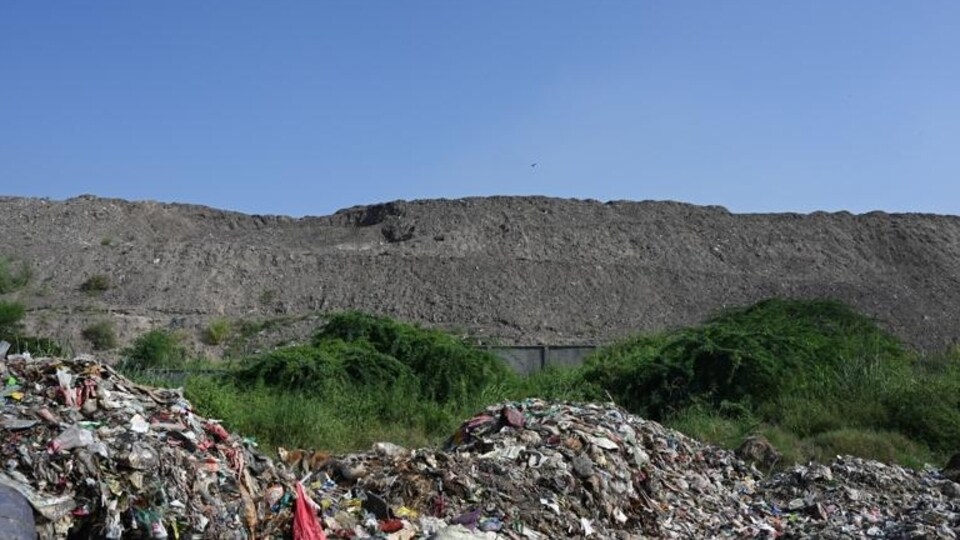
While civic agencies in the Capital have been focussed on tackling the three giant waste mountains plaguing the city, two new mounds have quietly been in the making on the outskirts of north Delhi — at Singhola and near Bawana.
Also Read: Less than 20% bulk waste generators in Delhi complying with norms: Report
With efforts lasting more than five years, more than 14.8 million tonne of legacy waste has been removed from the three waste mountains at Okhla, Bhalswa and Ghazipur, largely due to increased scrutiny by the green tribunal and courts. Though the projects have moved at a snail’s pace, the progress is visible — both Okhla and Bhalswa sites have reduced to half of their original volume. The deadline to clear these sites of waste has been pushed to 2028, according to an affidavit filed by the Municipal Corporation of Delhi (MCD) in the Supreme Court.
Also Read: Bandhwari landfill to get new waste-to-charcoal facility: Khattar
However, the emergence of new waste mounds is a major cause of concern and points to a larger problem of systemic inadequacy and the inability of agencies to manage waste production.
Also Read: BMC mulls over imposing solid waste management tax on citizens
Near the JJ colony in Bawana, the emerging waste mountain adjoining the Narela-Bawana waste to energy (WtE) plant now rivals the 13-storey residential buildings in its height. Around 8km away, near Singhola village towards GT Karnal Road, is a seven-acre plot that was used to dump silt. The area faces a similar problem. Both sites are starting to be visible from at least 2-3kilometres.
When HT reached out to the civic body, it did not acknowledge the existence of a waste site at Bawana.
“No site (is) at Narela Bawana. For Singhola, we have received bids for 9 lakh MT of waste and after award target to complete work in six months,” MCD officials stated.
‘Space constraints’ at Singhola
According to an October 23 MCD report, the Singhola site faces “space constraints”. It said the site had been bursting at the seams, with no area left for “further disposal of silt”. The site is located near Khampur village, GT Road, and is spread over 7.2 acre. The site was transferred by the Delhi Development Authority (DDA) in April 2018 to the municipality to dispose of silt from east and north Delhi areas.
“The site cannot be raised vertically further... Further dumping may cause sliding/slipping of silt towards adjoining areas. Hence, there is an urgent need to reduce the load of silt and create space for dumping of silt and create more space for dumping further at this site,” the report, a copy of which was seen by HT, said.
Monsoon has covered the waste mound with grass and weeds but residents living in nearby villages of Tikri Khurd, Khampur and Hameedpur, continue to battle the repercussions daily. MCD has declared the site as oversaturated with “no more capacity to hold additional silt”.
Rajveer Singh, 42, a worker at the Narela wholesale apple market next to GT Karnal road said the mound is actually a “khatta” (waste dump). The apple market Singh works at is against the backdrop of the waste pyramid, now covered with post-monsoon vegetation. “The grass will soon go dry and the stench will return,” said Rajveer.
“The site was used to dump silt collected during the annual pre-monsoon desilting exercise of Delhi’s drainage system. It has accumulated around 900,000 tonne of silt mixed with plastic, waste, and construction and demolition waste. The open dumping at Singhola has been a serious concern. There are directions from the National Green Tribunal to clear such sites at the earliest,” an MCD official said, asking not to be named.
The civic body has an expenditure sanction of ₹70.4 crore to flatten the silt dump, and material derived after the biomining exercise is expected to be used for the construction of roads. Biomining separates various components of legacy waste such as plastic, paper, cloth, sand, and bricks by passing them through trommel machines, which act as cylindrical rotating sieves.
Baljeet Singh, a resident of Khampur village, said locals had protested the site being used to dump waste when it was first demarcated in 2018. “Who wants to have city waste dumped in their neighbourhood? They say it is only silt but the muck from drains contains a lot more than just soil,” Baljeet said.
The civic body said it has been in touch with the National Highways Authority of India (NHAI) so the accumulated silt can be used to lay the base of roads. However, silt mixed with waste is a hurdle. The site was last inspected by NHAI in December 2022.
“NHAI conveyed to us that the available material has a lot of plastic and garbage, and to make it suitable for use in the construction of highways, silt will need to be segregated from other fractions,” the official cited above added.
Meanwhile, the saturation of the Singhola site has led to silt being diverted to the Bhalswa landfill and dumping of fresh waste has reversed the progress there.
Narela-Bawana’s towering problem
Barely 700m away from the Munak CLC canal in Bawana, a massive mound of waste adjoining the Narela-Bawana waste to energy is threatening the area’s ecology. It is towering close to the 13-storey DDA buildings and is more than 700m long along the northern end. Crows and kites make routine aerial surveys above the mound even as waste trucks climb its slopes. The site is spread over approximately 24acre and is a familiar sight of the waste management crisis in the Capital. The Bawana mound comprises rejects, inerts and waste not useful for boilers. The predicament, perhaps, is also an explanation for the unsold DDA flats in the area, according to some locals.
The erstwhile North Delhi Municipal Corporation (NDMC) had conceived the project to construct a modern landfill and a 24MW WtE plant at Narela, with a capacity to handle 4,000 tonne of solid waste per day. The construction was delayed due to a dispute between the developers and North DMC, but the project was finally commissioned in March 2017.
An MCD official said that solid waste collected door-to-door from households in several North Delhi zones like Rohini gets transported to the Bawana site, from where it goes through a material recovery facility.
“The waste is segregated to obtain refuse-derived fuel (RDF), which is burned at over 1,000°C to generate electricity in the plant,” the MCD official added.
The locals, however, disagreed. Kashi Patel said that the presence of the waste mound is also a reason for the thousands of housing flats remaining unsold.
“The stench from the mound is bearable right now but no one wants to live next to a waste mountain,” he said.
Manvendra Sahu, a resident of the nearby Bawana colony, said the landfill has kept growing in size over the years. “Munak canal had breached a few months back and the entire colony was flooded. Thankfully, there was a wall barrier between the waste mound and the overflowing water from the canal which flooded the nearby residential areas. Otherwise, water would have reached the base of the waste mound as well. If MCD is clearing waste at other sites, this should also be removed,” Sahu added.
Bharati Chaturvedi, an environmentalist and founder of Chintan Environmental Research and Action Group, said that stopping wet waste from being dumped at landfills is not possible without developing decentralised infrastructure and a market for compost. “This is essential because about 50% of the city’s waste is organic or wet. Markets mean policy formation, including state procurement at minimum prices and quantities as well as enabling micro-entrepreneurs to sell compost, provide infrastructure and initial running cost. All this is cheaper than the damage done to our health and environment from landfills.”