
 E-Paper



North Delhi air quality stations max out at 500 AQI
What has heightened concern is that the stations are in areas around dense residential neighbourhoods, exposing large populations to extreme pollution levels


Even as residents across Delhi continued to gasp for breath, parts of north Delhi were exposed to what is arguably the worst possible air that can be recorded, with the air quality index (AQI) maxing out at 500 – the highest value on the official scale – at two monitoring stations, Rohini and Wazirpur, for the second consecutive day.

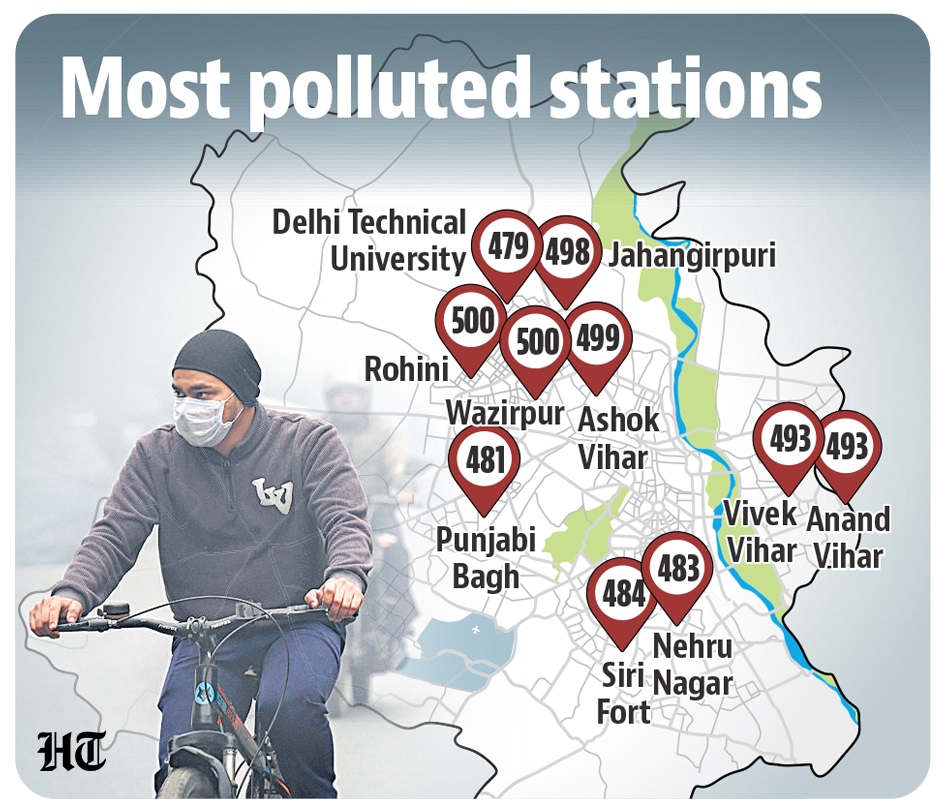
What has heightened concern among experts and residents alike is that both stations are located in areas surrounded by dense residential neighbourhoods, exposing large populations to extreme pollution levels.
At Rohini, one of Delhi’s largest residential localities, the AQI touched 500 at around 6pm on Sunday and remained pegged at that level till 1pm on Monday. After 2pm, the station’s AQI data went missing, with the Central Pollution Control Board (CPCB) website stating that “data was insufficient for computing AQI.” The absence of real-time AQI readings from a residential hotspot even as pollution levels remained dangerously high has raised questions about data transparency and monitoring reliability.
According to CPCB norms, the AQI for a location is calculated based on sub-indices of eight pollutants – PM10, PM2.5, nitrogen dioxide (NO2), sulphur dioxide (SO2), carbon monoxide (CO), ozone (O3), ammonia (NH3), and lead (Pb). The pollutant with the worst sub-index determines the AQI for that station. However, for an AQI to be computed, data must be available for at least 16 hours of the day and for a minimum of three pollutants, one of which must be either PM2.5 or PM10. If this criterion is not met, the system flags the data as “insufficient.”
HT examined Delhi Pollution Control Committee (DPCC) data for Rohini and found that while PM2.5 data was missing for part of Monday, PM10 data was available for at least 22 hours, along with readings for several pollutants. Officials from CPCB and DPCC did not respond to queries on the missing data.
Wazirpur, meanwhile, continued to reel under extreme pollution, with the AQI remaining stuck at 500 for nearly 17 hours since Sunday afternoon, only dipping marginally to 499 at 9am on Monday. Although Wazirpur is known as an industrial area, it is surrounded by densely populated residential colonies such as Ashok Vihar, Pitampura and Shalimar Bagh, placing a large number of residents directly in the path of hazardous air.
Conditions elsewhere in the Capital remained grim as well. Several monitoring stations hovered close to extreme levels for the second day in a row, including Ashok Vihar (499), Jahangirpuri (498), Anand Vihar (493), Vivek Vihar (493), Siri Fort (484), Nehru Nagar (483), Punjabi Bagh (481) and Delhi Technical University (479). Of the 39 active monitoring stations in Delhi, 28 recorded “severe” air quality on Monday. NSIT Dwarka logged the lowest AQI at 328, which still falls in the “very poor” category.
Experts said the spike in north Delhi is likely driven by a combination of local emission sources and unfavourable meteorological conditions. “A proper on-ground assessment is needed. While Wazirpur is a known industrial area, Rohini is largely residential, so construction activity, road dust and vehicular emissions are likely contributors. With northwesterly winds, pollution from nearby industrial clusters such as Narela and Bawana could also be adding to the load,” said Mukesh Khare of IIT Delhi.
Health experts warned that sustained exposure to such conditions poses serious risks even for healthy individuals. “At these levels, fine particulate matter like PM2.5 and PM10 penetrates deep into the lungs, bypassing the body’s natural defences. This can trigger acute airway inflammation, reduced oxygen exchange and symptoms such as breathlessness, chest tightness, dizziness and extreme fatigue,” said Dr Arunesh Kumar, director and head of pulmonology at Paras Health, Gurugram.
Residents said daily life remained severely disrupted. Naveen Garg, president of the Rohini Sector-16 Residents’ Welfare Association, said Monday offered little relief. “The situation was similar to Sunday. Water sprinkling was intensified and I saw the SDM inspecting construction sites, but a thick smog continued to hang over the area,” he said.
Stay updated with all top Cities including, Bengaluru, Delhi, Mumbai and more across India. Stay informed on the latest happenings in World News along with Delhi Election 2025 and Delhi Election Result 2025 Live, New Delhi Election Result Live, Kalkaji Election Result Live at Hindustan Times.


