E-Paper



Not in good taste: PM2.5 levels take the smoke out of tandoors
The curbs on use of charcoal ovens have altered a touchstone of Delhi’s cuisine indelibly, and perhaps irreversibly, forcing restaurants to reinvent their kitchens

 Prefer HTon Google


Irshad Qureshi, 34, wears a scowl as he flits between the cash counter at the front of Qureshi Kebab, a famous eatery in old Delhi, and the tandoor and sigdi (stove) at the back. The orders have started piling up — five plates of chicken seekh kebab, three plates of mutton seekh kebab, 10 roomali roti, extra chutney, extra onion.
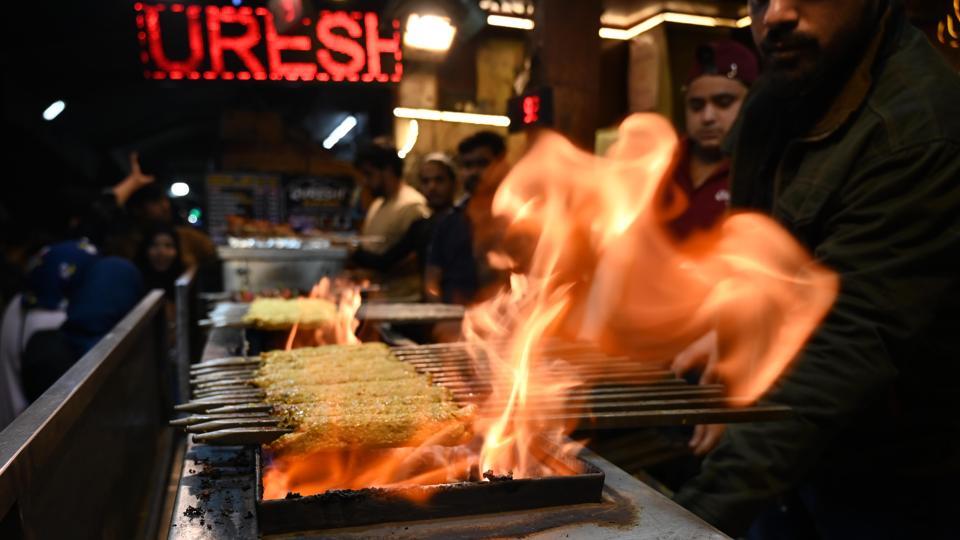
The Qureshi family has served customers from the small outlet for six decades, and little has changed in that time. The location, the neighbourhood, the menu, the recipes – most of the ingredients that power the tandoori store have been largely unchanged since its shutters were first lifted. Except one – the tandoor itself. The wood-charcoal fired tandoor has stepped aside for one fuelled by LPG, a behind-the-curtains change that has fundamentally altered the national capital’s decades-long love affair with the kebab
The once-ubiquitous wood-charcoal fired tandoor has faded from kitchens in Delhi’s restaurants since 2018, when authorities began clamping down on their use as a pollution-control measure. These curbs have altered a touchstone of Delhi’s cuisine indelibly, and perhaps irreversibly, forcing restaurants to reinvent their kitchens and residents to reacquaint their palates.

Many, like Irshad, believe pollution has killed the kebab.
He is forced to shift to the LPG gas-operated tandoor every winter. “But the real taste comes only with the traditional fire. Our elders had it right. The kebabs don’t cook uniformly on gas, but we are trying to master it to overcome the change,” he added.
Necessary as it may be, it isn’t a change that he, or Delhi, is pleased with.
The meat of the matterEvery winter, as pollution levels skyrocket into poisonous territory, the Municipal Corporation of Delhi (MCD) goes about destroying tandoors in eateries across the city. Over the past month alone, the civic body demolished 1,322 tandoors in a bunch of restaurants.
“Each year, we destroy 1,000-1,500 tandoors or turn them into LPG or CNG units,” an MCD official told HT.
In June 2018, the Delhi Pollution Control Committee (DPCC) laid out the first restrictions on the use of wood charcoal in tandoors, allowing their use only with “channelisation or control systems”.
The agency argued that charcoal-fuelled tandoors and grills were a key source of PM2.5, ultrafine particulate matter that often rises 30 times beyond international safe limits in the Delhi air every winter. A major share of these PM2.5 emissions is down to smoke from farm fires in upwind Punjab as well as vehicular pollution.
Restaurant owners and associations retort that the modification has demolished the authenticity of Delhi’s tandoori food, particularly in winter, when it is the most popular.
Bobby Kochhar, who runs Colonels Kebabz in Defence Colony, said he switched to the LPG fired tandoors just over a month ago.
“We had been using firewood coal for the last 30 years, and it added that smokiness to the non-vegetarian dishes. We haven’t been able to achieve that with LPG entirely. Delhi is the capital of the country. We should be more careful about these issues,” Kochhar said.
Anubhav Sapra, the founder of Delhi Food Walks, agreed that the absence of that smokiness has left behind a sour taste.

“We go on food walks in old Delhi frequently and all famous vendors — Qureshi Kebab, Aslam’s, and Karim’s — have moved to gas grills. Iconic kebabchis complain that they’re unable to prepare them as they could earlier since the heat application is not even. The radiating heat from the wood charcoal fire gives it a charred flavour, which is now missing.”
The origin storyThe tandoor is usually shaped like a large urn, sheathed in a metal body, with a hardened clay lining inside. In some cases, it’s sunk up to its neck in the earth.
Filmmaker Sohail Hashmi, who chronicles Delhi’s history, said that there are debates about the origin of the tandoor.
“The tandoor has evolved over its travels from central Asia, Afghanistan, North-West Frontier Province, and Punjab. The word is derived from the Persian word tanur (derived from Akkadian word tinuru, which means mud oven) and as it moved from one place to another, its name changed,” he said.
Traditionally, a charcoal fire is lit inside a tandoor and allowed to smoulder for hours, shrouding the oven in dark smoke that in turn coats any meat placed inside it.
The first tandoors were said to have been used to bake flatbreads, a technique that has survived while cooking roti, Afghan naan, and Turkmen chorek.
Confusion in the guidelinesThe precise guidelines that regulate the use of traditional tandoors have been tangled in bureaucratic confusion. For instance, the DPCC gazette notification of June 29, 2018, said that “wood charcoal for tandoors and grills of hotels/ restaurants/ banquet halls/eating houses having emission channelisation/control system” can be used.
This, said experts, means that eateries can still use their old tandoors as usual, provided they have chimneys in place.
An April 2, 2023 order by the Commission of Air Quality Management (CAQM) reiterated this.

However, a CAQM order, dated October 6, 2023, which enforced Stage 1 of the Graded Response Action Plan (Grap) to combat pollution, enforced a ban on “coal and firewood in tandoors in restaurants and hotels”. It did not mention wood charcoal.
This has led to confusion among restaurant owners.
An MCD official from the public health department, who asked not to be named, said the use of wood charcoal with an emission control system is permitted in Delhi.
The National Restaurant Association of India (NRAI) has held several meetings with the DPCC in the last five years regarding the tandoor demolition drives.
“DPCC has permitted wood charcoal with chimneys and emission control systems, but the enforcement teams do not discriminate between different types of fuels. If they see a tandoor with no LPG or CNG, they think it’s illegal and should be destroyed,” said Sandeep Anand Goyle, a member of the NRAI managing committee who also runs Essex Farms in south Delhi.
DPCC officials declined to comment on the matter.
“We have heard from so many restaurant owners that just to avoid being harassed by the MCD annually, they have switched to LPG,” said Goyle.
The science behind the curbsThe tandoor demolition drives began six years ago when the Indian Institute of Technology (IIT)-Kanpur released their 2016 “Comprehensive Study on Air Pollution and Green House Gases (GHGs) in Delhi”.
The study found that approximately 9,000 hotels/restaurants out of 36,099 units in the city were using charcoal-fired tandoor – which is polluting.
The survey found that, on an average each of these 9,000 eateries were using 30kg charcoal a day and that hotels and restaurants were emitting 3,493kg of PM10 and 1,758kg PM2.5 every day.
Anumita Roychowdhury, executive director (research and advocacy) at Centre for Science and Environment, called the change “encouraging”.
“These tandoors not only contribute to the worsening ambient air quality, but also have a direct impact on people in close proximity,” she said.
Even as restaurant owners and food critics mourn the demise of the traditional tandoor, a second MCD official from the public health department, who also asked not to be named, said the change in taste due to the modified oven was “only a matter of perception”.
“We have not found any change in taste. Most restaurants in the organised sector have switched to LPG tandoor in the last five years. The demolition drive now mostly covers roadside vendors, dhabas, and smaller outlets,” said the official. To be sure, he did not profess to be a culinary expert.
Some outliersSoaked in twilight, the Moti Mahal restaurant in Daryaganj gears up for the dinner service. Legend is that the restaurant’s founder Kundan Lal Gujral, along with his friend Kundan Lal Jaggi, “invented” dishes that define Delhi, even north /India – butter chicken, dal makhni, and tandoori chicken.
Last year, the restaurant was pulled up for using the tandoor, but the owner said that he has decided not to give up on the traditional oven.
“I don’t want to lie. I have not switched to LPG despite being fined. We use a chimney and an emission control system,” said Vinod Chadha, the managing director at Moti Mahal restaurant at Daryaganj for 30 years.
“Food cooked using LPG does not have the same flavour. No amount of extra heating in LPG tandoor can bring the same taste as a traditional oven,” he added.
Hashmi agreed.
“Traditionally, we have relied on slow-cooking methods. Similarly, traditional tandoors have uniform application of heat due to the heat it radiates, and the hot air that gets trapped. A gas flame won’t do that,” he said.
In fact, several restaurants, include Qureshi Kebab, revert to wood charcoal after winter.
Next to Chadha, a cook pressed glazed balls of dough, rolled into flat cakes inside the tandoor. Within seconds, the naan was ready. “LPG tandoor-baked naan and roti are no match to the slightly burnt texture that the actual tandoor provides. This, I believe, will impact tourism,” said Chadha.
In the last five decades, he has watched the food and beverage industry go through a number of changes – from the beginning of food delivery apps to fierce competition between outlets. But the shift away from wood charcoal fuel has been particularly hard to overcome, he said.
“I have worked in this industry for 50 years across multiple countries, but no other place takes such extreme steps to kill its own local cuisine,” he said.