
 E-Paper



Number Theory: 3 factors that will decide Delhi elections
.
Published on: Feb 4, 2025, 16:13:47 IST

 Prefer HTon Google
Share via


Copy link

Delhi will vote in the assembly elections today. Will the Aam Admi Party (AAP) come back to power for the third consecutive time? Or will the Bharatiya Janata Party form the government for the first time in 27 years? The answer to these questions will depend on three factors: class, micromanagement and anti-incumbency. Here are four charts that explain this in detail.
3 factors that will decide Delhi elections
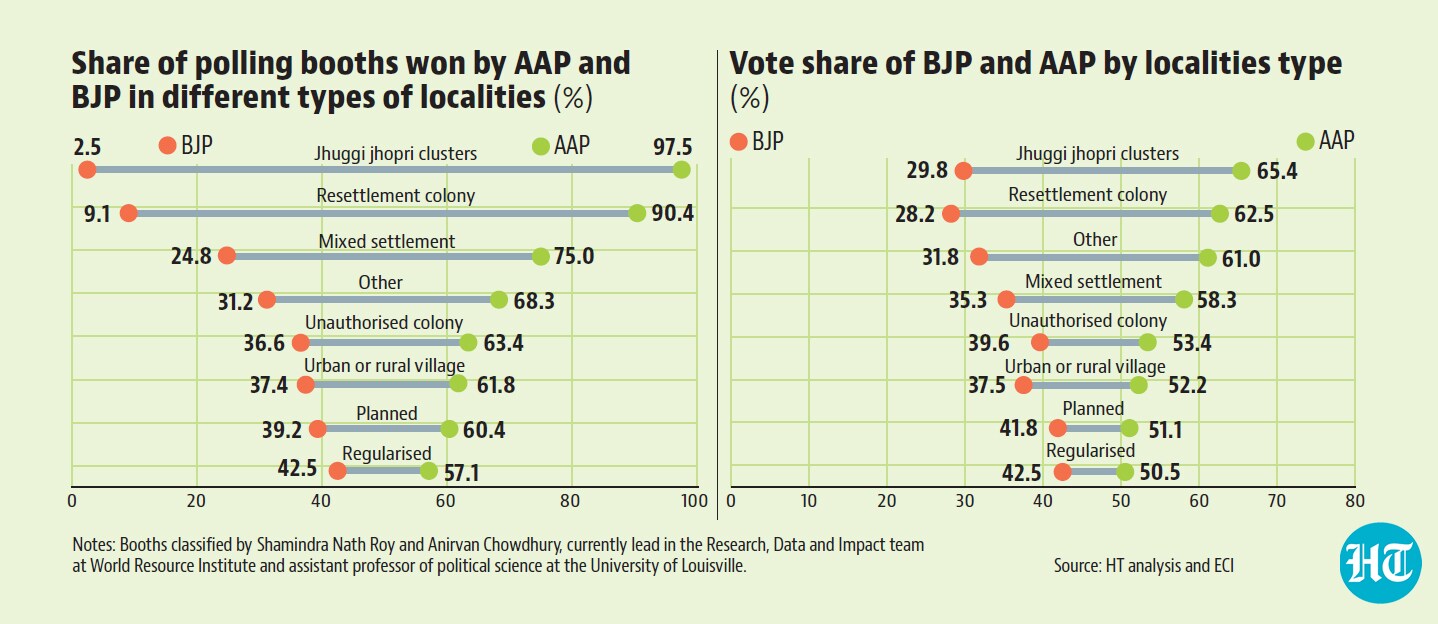
 Class: AAP’s core vote bank is among the poor in DelhiAn HT analysis of booth-wise results in the 2020 Delhi elections clearly established that the ruling party is extremely strong among the economically weaker sections. The analysis, which looked at all 13,747 polling booths in Delhi, matched them to different types of localities – authorised, regularised, planned, resettlement, and jhuggi jhopri (JJ, or slum) clusters – that serve as good proxies for income levels. The analysis was based on a dataset prepared by Shamindra Nath Roy and Anirvan Chowdhury, currently lead in the Research, Data and Impact team at World Resource Institute and assistant professor of political science at the University of Louisville respectively. The database found that at least 50% of the polling booths in 2020 were located in urban/rural villages, resettlement colonies, and JJ clusters, which are likely to be poorer; while one-third were found in planned and regularised localities, relatively well-off than others. The remaining polling booths are in mixed settlements or belong to Delhi’s older neighbourhoods. The AAP won 97.5%, 90.4%, and 75% of the booths in the JJ clusters, resettlement colonies, and mixed settlements respectively. In contrast, it won 57.1% and 60.4% of the booths in comparatively wealthier localities, such as regularised and planned areas. Even in terms of vote share, the difference between AAP and BJP’s vote share -- the AAP got 54% and the BJP 38% across Delhi -- was highest in JJ clusters, resettlement, and mixed localities at 35.6, 34.3, and 23 percentage points respectively. The gap was lower in regularised and planned localities at 8 and 9.3 percentage points. Almost all of the AAP government’s policies are targeted towards securing the support of the underclass in Delhi. Unless there is an erosion in its lead in this segment, the AAP should not be in big trouble. But even a small crack in this support base, however, could make it extremely vulnerable in the vote-to-seat-conversion dynamics. The BJP’s vote share in Delhi is far from insignificant.
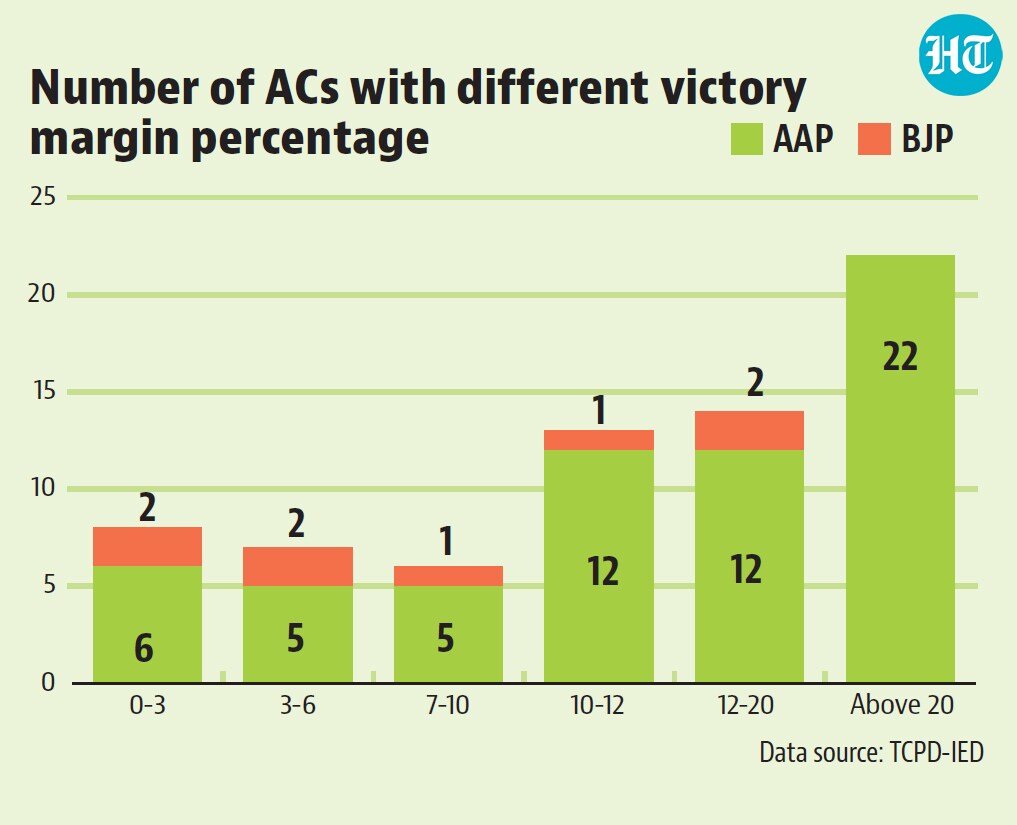
- Micromanagement: Both BJP and AAP will try to wrest ACs they lost narrowlyIn the 2020 elections, the median winning margin for AAP candidates was 14.7 percentage points. However, there were assembly constituencies (ACs) where the AAP’s victory margin was not as high. It won six ACs with margins smaller than 3 percentage points. Additionally, in five other ACs where the AAP emerged victorious, the winning margins were between 3 and 6 percentage points. It is only logical that the BJP is putting in extra effort in winning ACs which it lost by a smaller margin. To be sure, even the BJP’s eight AC victories in 2020 were not with very high margins, the median being half of the AAP’s median margin. The AAP is making a similar effort to wrest these seats from the BJP. This is where the organisational strength of the two parties will come into play.
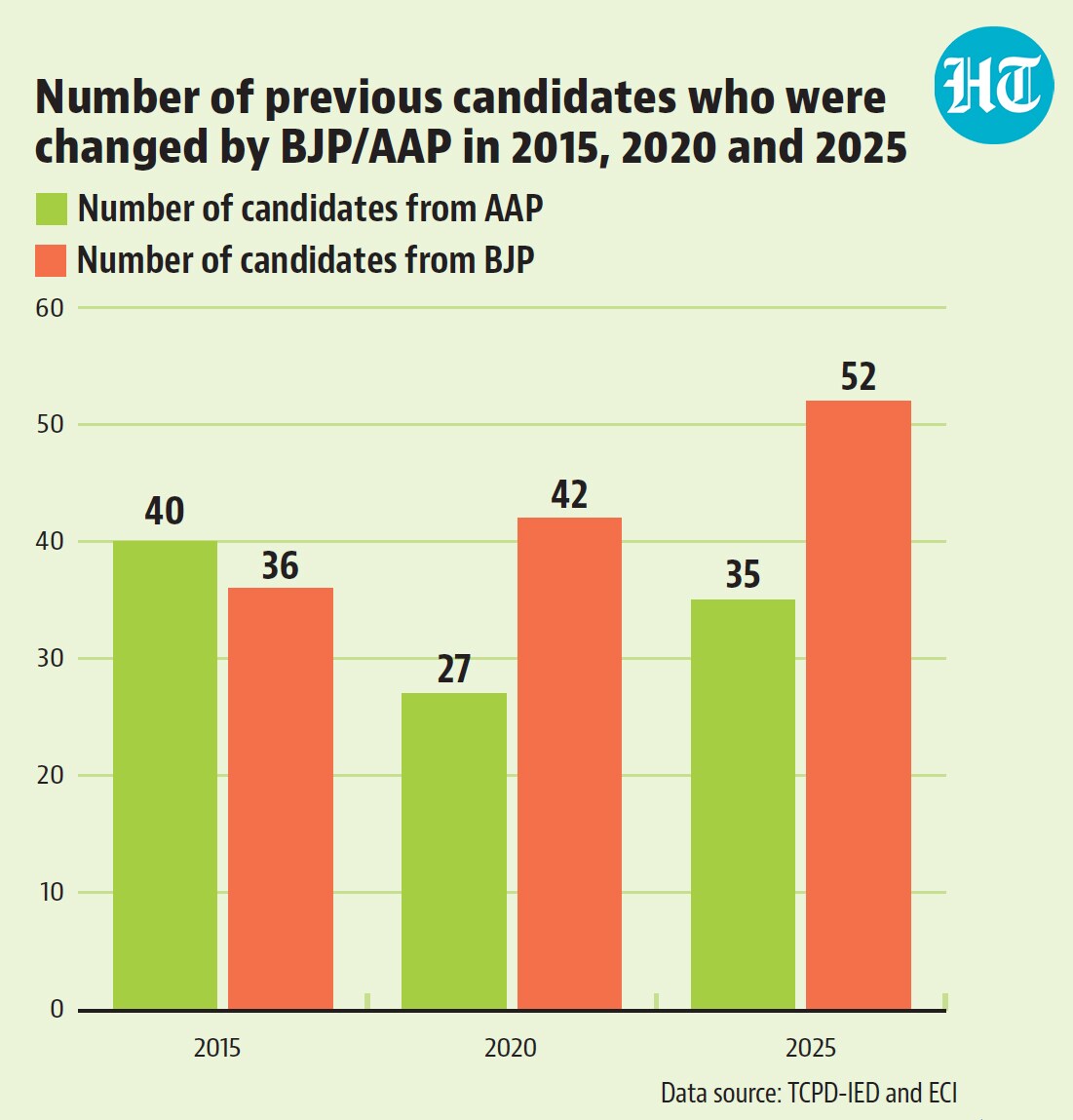
- Local anti-incumbency: AAP has been dropping a big chunk of its sitting MLAs in past elections as wellThe BJP and the AAP have either not fielded some of their MLAs at all or shifted them to other ACs. Only 35 out of the AAP’s current 62 MLAs are contesting the elections this time from the same AC that they won in 2020. Does this mean the AAP is battling serious local-level anti-incumbency? Not necessarily. Even in the 2020 elections, the AAP had fielded only 43 out of its 67 sitting MLAs from the seat they then represented. In the 2015 assembly elections, the AAP fielded 19 out of its 28 sitting MLAs from the same seat. These numbers suggest that changing its sitting MLAs to beat anti-incumbency has been a crucial component of AAP’s electoral strategy. To be sure, even the BJP, the principal challenger to the AAP in these elections, has changed six of its seven sitting MLAs (one of its eight MLAs — Ramvir Singh Bidhuri — won the 2024 Lok Sabha election) and 52 of its candidates compared to 2020 elections. While the strategy has worked well for the AAP in 2015 and 2020 elections, the BJP has clearly failed to reap its dividends. To be sure, in the 2017 Municipal Corporation of Delhi (MCD) elections, the BJP dropped all its incumbent councillors and managed to win a majority.


Catch every big hit, every wicket with Crickit, a one stop destination for Live Scores, Match Stats, Infographics & much more. Explore now!
Stay updated with all top Cities including, Bengaluru, Delhi, Mumbai and more across India. Stay informed on the latest happenings in World News along with Delhi Election 2025 and Delhi Election Result 2025 Live, New Delhi Election Result Live, Kalkaji Election Result Live at Hindustan Times.
Stay updated with all top Cities including, Bengaluru, Delhi, Mumbai and more across India. Stay informed on the latest happenings in World News along with Delhi Election 2025 and Delhi Election Result 2025 Live, New Delhi Election Result Live, Kalkaji Election Result Live at Hindustan Times.


