
 E-Paper



Number Theory: A peripheral shift in Delhi politics
Delhi’s changing demographics, and the role of migration and economic transformation in this process is a matter of interest for ethnographers and demographers.

 Prefer HTon Google


Delhi, through its history has been attacked and conquered many times. These have triggered migrations. The last time such a large disruption occurred was during Partition when a large number of refugees from what is now Pakistan came to Delhi and eventually settled here. India’s independence put an end to military conquests or politically triggered (such as during Partition) large episodes of migration. But what the political did not do, the economic has been doing in the last seven decades.

Delhi’s status as the national capital became an important magnet for attracting migrants from all parts of the country. The first wave of migrants were government employees who came to work for the nascent state as it started building and expanding its apparatus. A large number of them were accommodated in government colonies such as Rama Krishna Puram which were then on the outer fringes of the city. As economic activity expanded and private capital, both big and small, started its activities, workers from other parts of the country, first in manufacturing and then services came to the city in big numbers. A lot of this migration, especially of blue-collared workers and their families, happened in the outer fringes of the city. Delhi has also seen students coming to the city to study (or prepare for competitive exams such as IAS) and eventually settling here.
To be sure, the metropolis has also forced some of its poorest people from the centre to the periphery over time, first through executive orders and then on orders of the courts.
Delhi’s changing demographics, and the role of migration and economic transformation in this process is a matter of interest for ethnographers and demographers. However, as the city-state prepares to hold its assembly elections on February 5, there is merit in looking some of these issues in detail. This is because Delhi’s changing demographics has had a transformative effect on its politics as well. While this is often spoken about in anecdotal terms, HT has looked at hard data to give a quantitative explanation of these changes. Here is what the data shows.
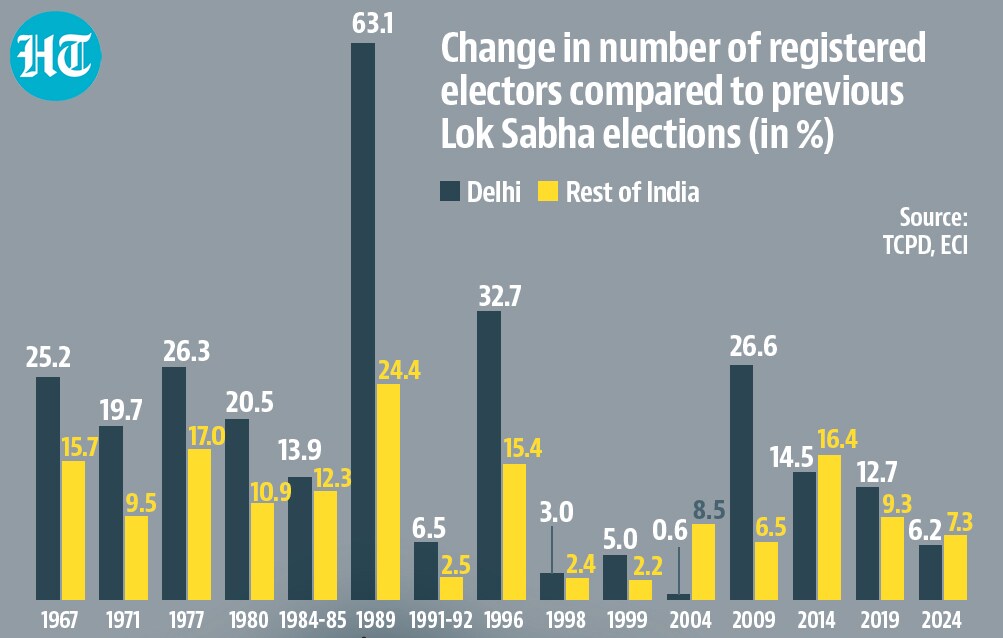
 Delhi has seen a higher growth in number of voters than the rest of the countryDelhi’s natural growth rate of population is similar to or lower than the national figure since at least 1995, the earliest year for which data from the Sample Registration System is available. Despite this, the number of registered electors in Delhi has grown faster than in other states in most elections since 1962 (the 2004 and 2014 elections are the only exception). This suggests that migration has been a big driver of growth in the number of voters in the city.
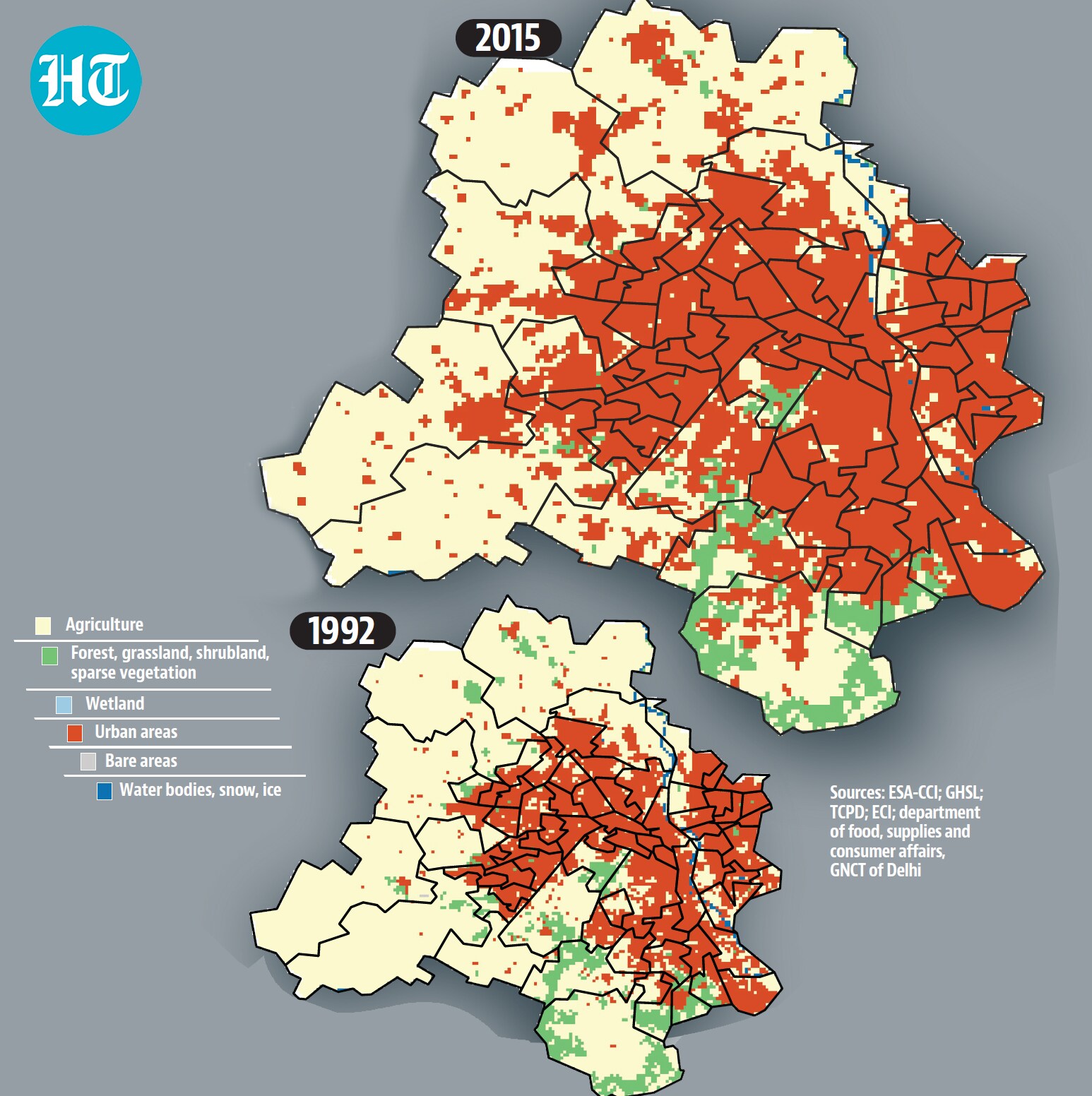
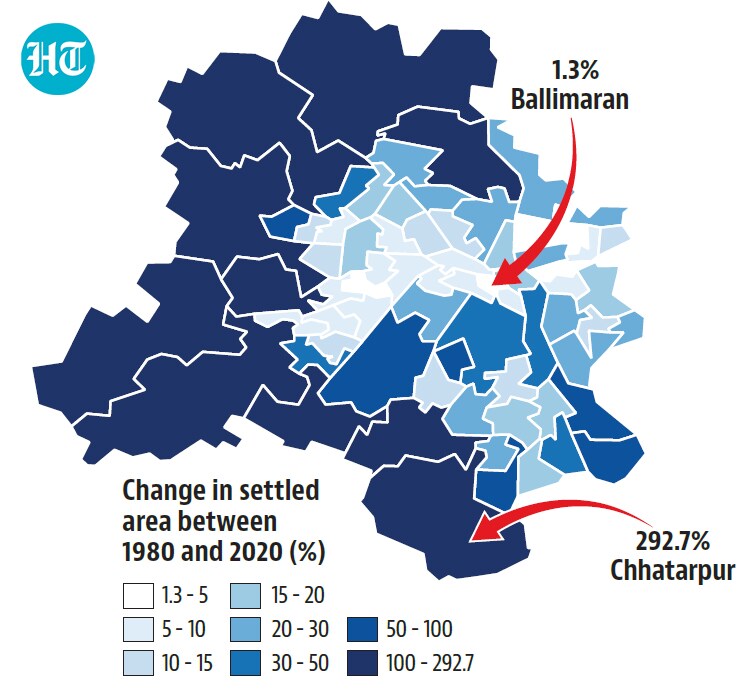
- And this growth has been on account of higher growth in the periphery of the cityOne can look at this in two ways. A lot of Delhi’s population today lives in areas which were not inhabited or sparsely populated even a few decades ago. While the issue has been well-documented even in policy documents such as Delhi’s master plans over time – they have seen a growth in urban area and a decline in rural – the best way to look at it is to compare satellite data on land cover. This shows that settlements have grown in the outer periphery of the city largely at the cost of agricultural land and sometimes at the cost of forests or forest-like vegetation. How does this work out in Delhi’s electoral politics? Reading satellite data on growth of settlements with present day assembly constituency (AC) boundaries solves the puzzle. All ACs which saw a doubling of their settled area between 1980 and 2020 – the earliest and latest satellite mapping which is available – are located on the outer circumference of the city. Once again, this should not surprise people who have known the city. Delhi’s core has hardly seen any growth in built-up area, although it might have seen a massive gentrification in the past few decades.
- How does this work out in Delhi's electoral politics?Reading satellite data on growth of settlements with present day assembly constituency (AC) boundaries solves the puzzle. All ACs which saw a doubling of their settled area between 1980 and 2020 – the earliest and latest satellite mapping which is available – are located on the outer circumference of the city. Once again, this should not surprise people who have known the city. Delhi’s core has hardly seen any growth in built-up area, although it might have seen a massive gentrification in the past few decades.
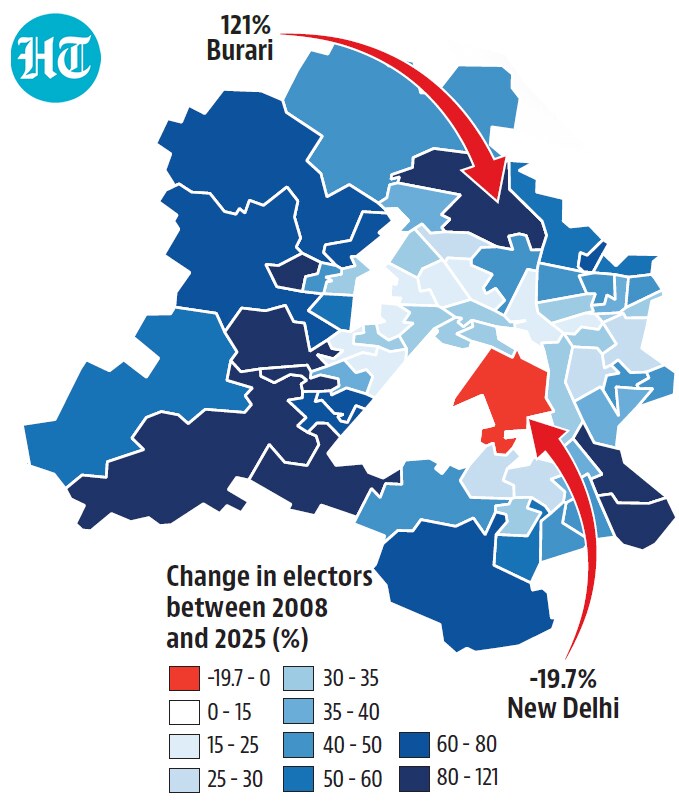
- Delhi’s growing population in the peripheries is still an ongoing processUnfortunately, we do not have latest population data to establish this fact with certainty. The last census (2011) is now 14 years old and a lot has changed in the city in this period. However, one can try and answer this question by looking at the growth in number of electors at the AC level between 2008 and 2025. Because delimitation changed AC boundaries in 2008, it is not possible to track this change in the pre-2008 period. The heat-map of change in electors across ACs is similar to the one of growth in settled area in the earlier section. The logic is simple. As the city expanded, largely on account of migration, migrants eventually became voters and added to the overall count.
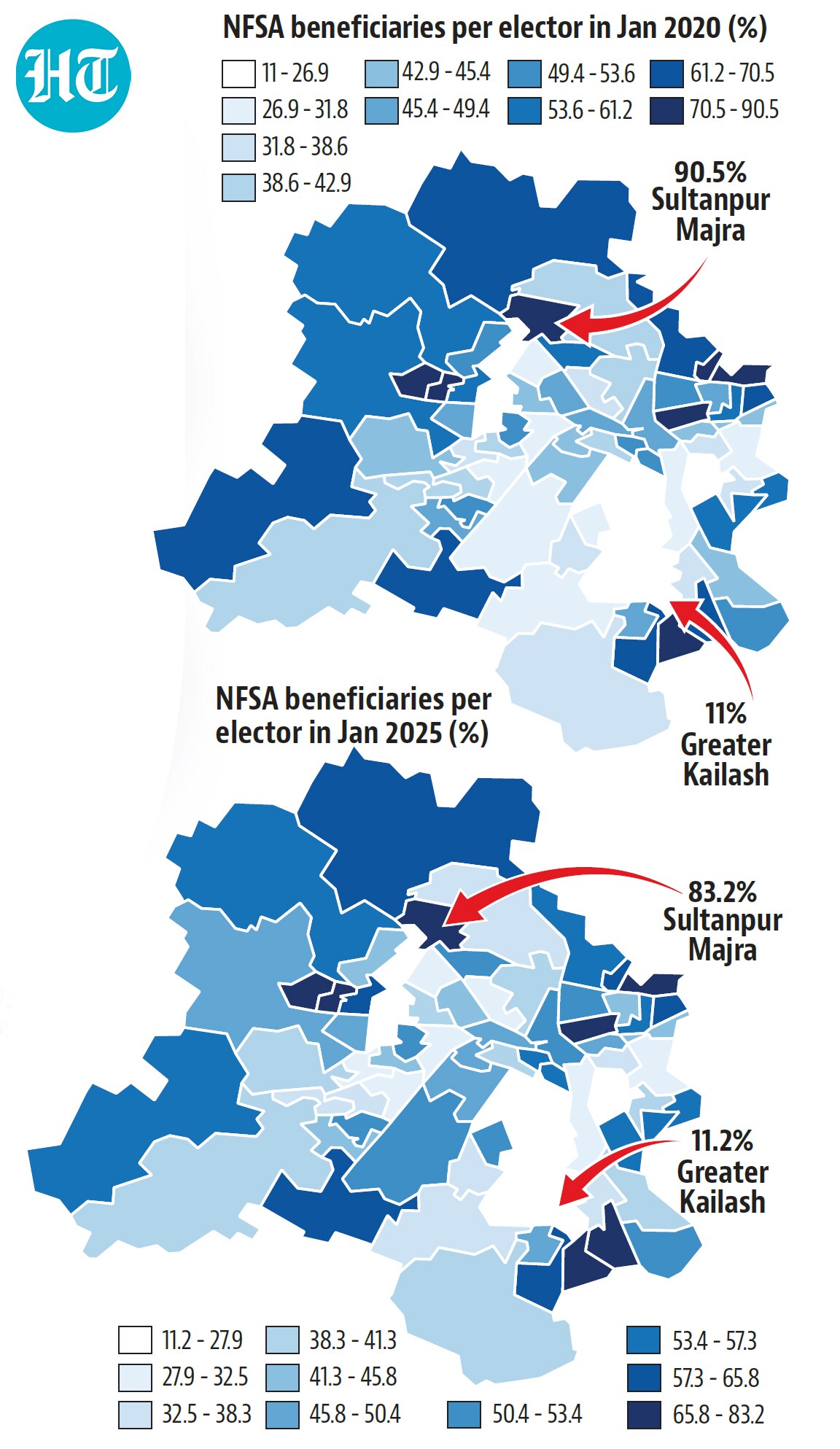
- What is the quantitative proof that Delhi’s periphery is poorer than its core?Once again, this is not an easy question to answer. India has not published official poverty data since 2011-12. Moreover, for a city like Delhi, poverty is anyway a relative rather than an absolute concept. The best proxy for economically vulnerable population, HT could come up with, was the number of ration card beneficiaries as a proportion of registered electors. The number of ration card holders in Delhi is available for Delhi at the AC-level, which can help in checking which ACs have a higher proportion of poor. “The eligibility for priority ration cards under NFSA is on the basis of geographic (residential), occupational and social deprivation with further exclusions based on income and electricity consumption. Therefore, although many poor and migrant populations who need support from the PDS are still excluded, the inclusion errors (error of including the not-deserving) are not very high. Priority ration card holders are mostly those working in the informal sector and living in precarious housing conditions,” said independent economist Dipa Sinha. The data supports our theory of Delhi’s periphery housing a lot more poor people than its core.
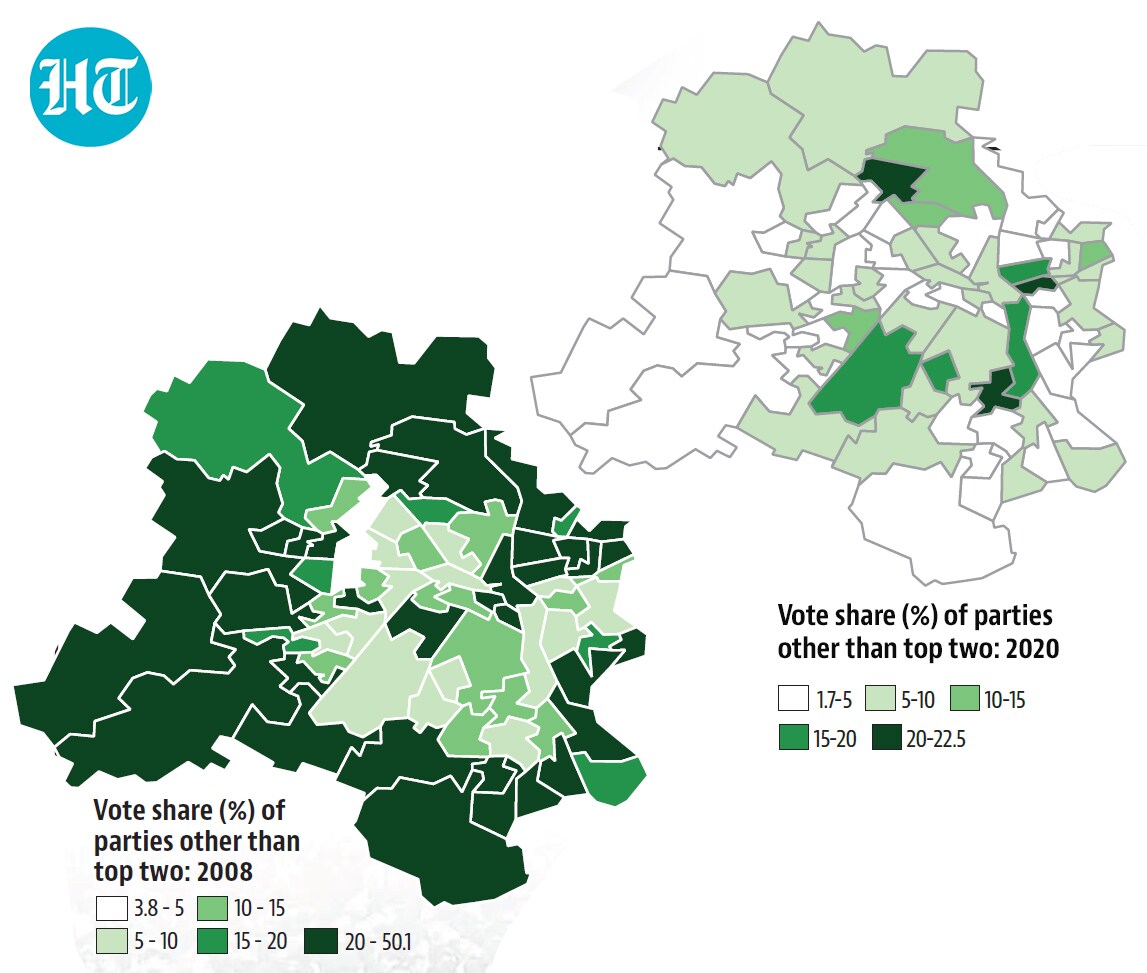
- So, what does this mean politically?This is a question which can have multiple correct answers. But here is one of the most fascinating ones. Delhi’s politics suffered a tectonic shock in the 2013 assembly elections when the AAP first broke ground as a political party in the city-state winning 28 ACs to become the number two party in the assembly. It ran a 49-day government with outside support of the Congress before Arvind Kejriwal resigned from the chief minister’s post. When elections were held in 2015, AAP shocked everyone with a landslide victory winning 67 out of the 70 ACs with a vote share of 54.3%. Things were largely unchanged in 2020 when the AAP won 62 ACs with a vote share of 53.6%. Another remarkable feature of post-2013 politics in Delhi has been the complete marginalization of any third political force in the city apart from the AAP and BJP. While Delhi’s politics is completely bipolar in terms of seats won in the assembly even before the AAP made its entry, vote shares were quite fragmented in previous elections. For example, the Congress and BJP had a combined vote share of just 76.6% in 2008. The share of top two parties increased to 86.5% in 2015 and further to 92.1% in 2020. Even this political consolidation in Delhi has a geographical aspect to it. The fall in vote share of parties other than the top two is much larger in ACs on the periphery than in the center of the city. The former, of course, had a larger political fragmentation than the latter earlier. When read with the fact that migrations have largely been concentrated in the peripheral areas of Delhi, it also suggests that migrants, before the AAP came into the fray, were a politically fragmentated lot, but not anymore. This is a question we will return to in these pages.




Stay updated with all top Cities including, Bengaluru, Delhi, Mumbai and more across India. Stay informed on the latest happenings in World News along with Delhi Election 2025 and Delhi Election Result 2025 Live, New Delhi Election Result Live, Kalkaji Election Result Live at Hindustan Times.


