E-Paper



Number Theory: How Delhi decimated its great walk-up to Diwali
Fires in Punjab and Haryana can hardly be blamed for bad air in Delhi when Delhi itself is bursting firecrackers despite a ban
Published on: Nov 14, 2023, 08:11:24 IST


Share via


Copy link

On Sunday, Delhi woke up to blue skies with barely a hint of the winter smog that characterises days in the capital at this time of the year. It was, the best Diwali morning in years. But thanks to Diwali celebrations on Sunday night, Monday was more normal — grey, more polluted, with among the highest PM 2.5 levels the city has seen this year. How bad is the post Diwali air this year compared to other years? Here are four charts that answer that question.

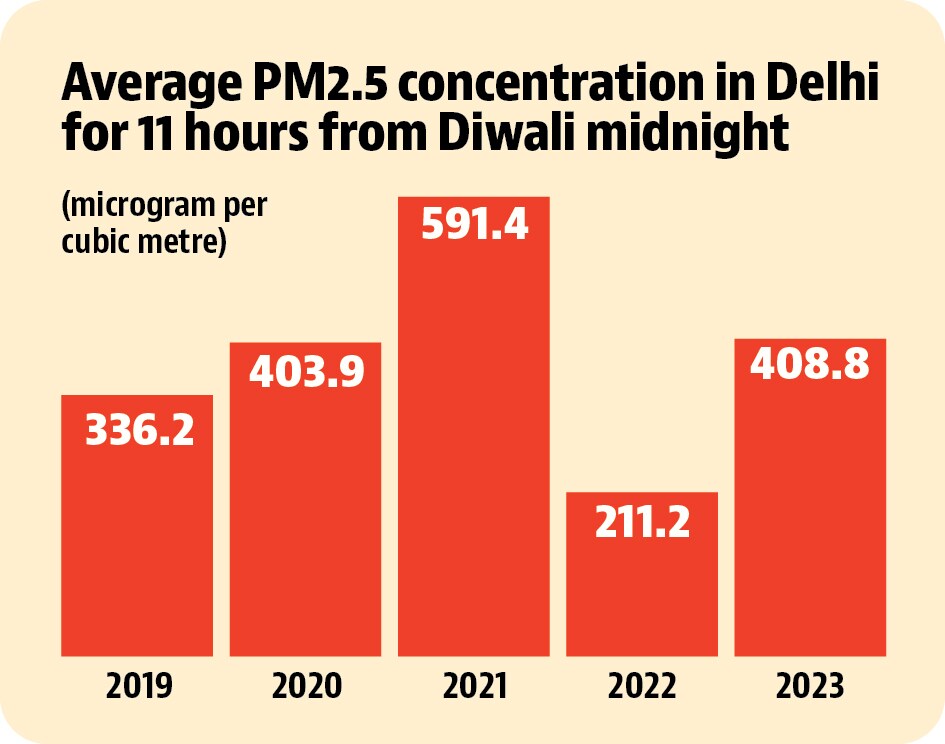
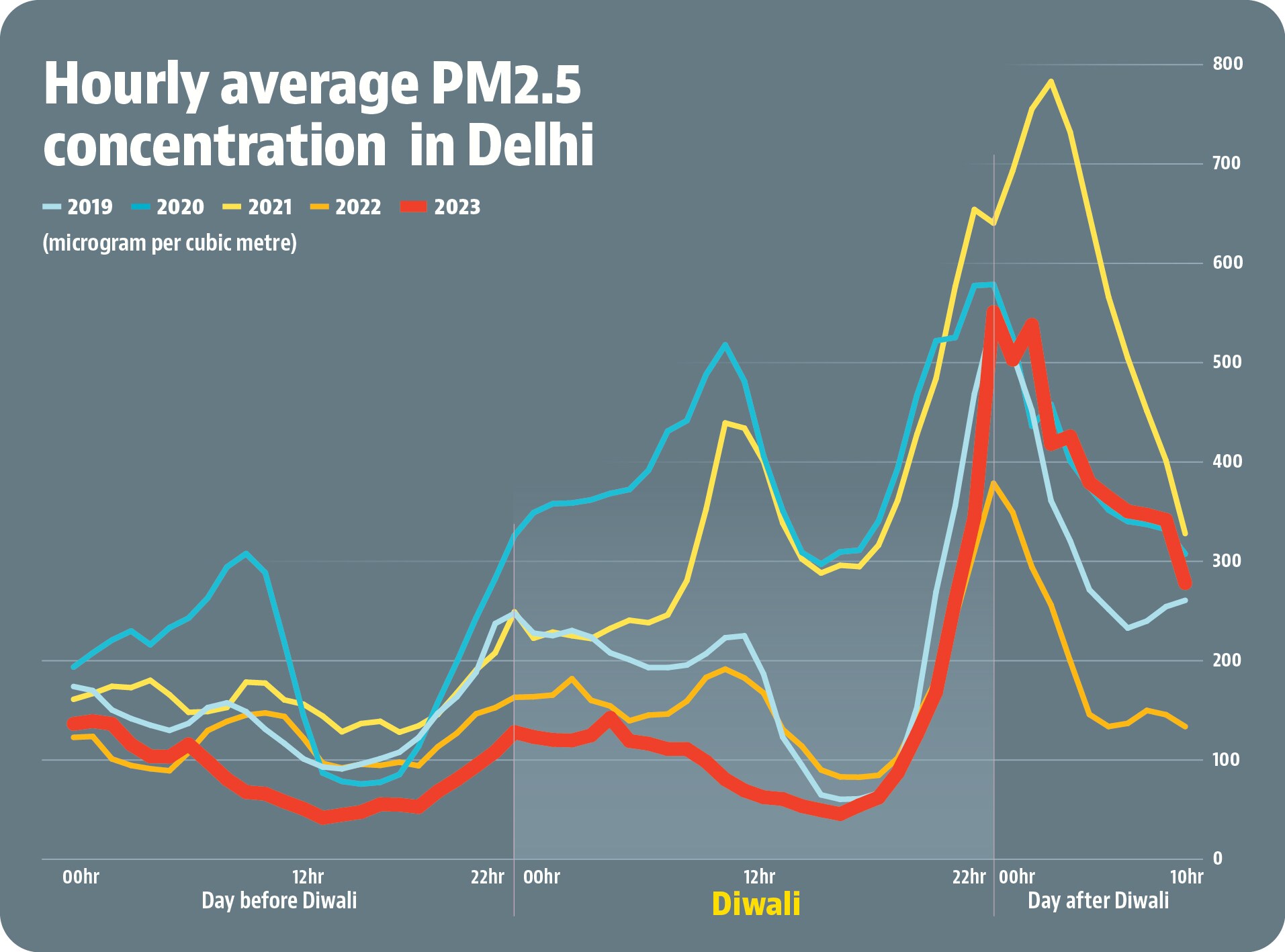
 Delhi's post-Diwali air is second-worst in five yearsDelhi’s post-Diwali air is about the second worst air after 2021 in the past five years. To study Delhi’s air on Diwali and in its aftermath, HT analysed hourly PM2.5 (these are particles of diameter 2.5 micrometer or less and are usually the most prominent pollutant in Delhi) concentration in Delhi from a day before Diwali to 11 hours after celebrations for the past five years. The average PM2.5 concentration from midnight to 11am this year is the second-worst since 2019, and almost twice as bad as last year’s. It was in the “severe” category continuously from 10pm on Diwali day to 11am on November 13. To be sure, it is possible that some stations performed significantly worse or better. But these trends are based on four air quality stations that have data for nearly all hours for the period described above for all the five years: Narela, Punjabi Bagh, and Sri Aurobindo Marg stations run by the Delhi Pollution Control Committee (DPCC) and the Aya Nagar station run by the India Meteorological Department (IMD).
- Deterioration happened from the best pre-Diwali air since at least 2019What is troubling about the deterioration of Delhi’s air to “severe” levels after Diwali this year – a usual annual event – is that unexpected rainfall had given Delhi a clean run-up to Diwali. The average PM 2.5 concentration from the midnight of the day before Diwali to 7pm on Diwali was just 88 micrograms per cubic metre this year, below even the “poor” range that begins at 91 micrograms per cubic metre. The cleanest Delhi’s air had been in these 44 hours before Diwali night in earlier years was last year, when the 44-hour average PM2.5 concentration was 129 microgram per cubic metre, which is in the “very poor” range. If these 44 pre-Diwali hours are compared with the 11 hours post Diwali, the deterioration is the worst this year. Delhi’s post Diwali PM2.5 concentration this year is 4.7 times the pre-Diwali year. This ratio was 2.2 in 2019, 1.4 in 2020, 2.6 in 2021, and 1.6 in 2022.
- This discounts the weather's role in polluting Delhi's airWhile firecrackers are a new source of pollutant in Delhi’s usual inventory every Diwali, the weather conditions are rarely the same every Diwali. This is because it is celebrated at different times of the year , which can have an effect on the temperature conditions prevailing on Diwali day. Lower temperatures can trap pollutants closer to the ground and increase the exposure to firecracker pollution. Temperature data shows that this was one of the cooler Diwali years by both maximum and minimum temperatures. However, this was true also of the days leading up to Diwali. Moreover, this year, Delhi received stronger winds than in the past five years even up to the noon of Diwali day. This only reinforces the argument that firecrackers are to blame for Delhi’s air post Diwali, not the weather. The only weather disadvantage that one can list against 2023 is that the winds were not fast enough to clean up after the firecrackers had been burst. Faster winds helped clean up Delhi after last year’s firecracker celebrations.
- Can’t blame farm fires in Punjab, Haryana eitherFires in Punjab and Haryana can hardly be blamed for bad air in Delhi when Delhi itself is bursting firecrackers. Nonetheless, it is important to check how fires were doing in the neighbouring states in the run up to Diwali. This can tell us if they added to the pollution being caused by firecrackers. However, data from multiple satellite sources shows that not only were fires in the neighbouring states fewer than last week, they were also historically low compared to the Diwali days in the 2019-2022 period. Clearly, the pollution on Monday was largely on account of firecrackers rather than farm fires. With more vehicles returning to Delhi’s roads after the long weekend on Tuesday, and farm fires expected to pick up again, residents of the capital can look forward to another bad week unless the wind decides otherwise -- and they have only themselves to blame.