
 E-Paper



How Skyroot Aerospace rewrote Indian space history
This article is authored by Gunwant Singh, scholar, international relations and security studies, Jawaharlal Nehru University.

 Prefer HTon Google


The dawn of a new space era has officially arrived over the coastal horizons of Sriharikota, signalling a monumental paradigm shift in how humanity reaches the cosmos. The successful debut orbital flight of Vikram 1, developed by the Hyderabad-based deep tech startup Skyroot Aerospace, has shattered legacy boundaries by placing multiple satellites into low Earth orbit. This maiden orbital mission, aptly named Mission Aagaman, propelled India into an elite triad of spacefaring nations alongside the US and China that possess fully domestic, privately engineered orbital launch capabilities. It is a triumph that transcends the mechanical execution of ignition, staging, and payload deployment; it serves as a powerful declaration that Indian private enterprise has evolved from sub-tier manufacturing into end-to-end orbital architects. From its all-carbon composite airframe and 3D-printed liquid engine upper stage to its precise satellite deployment, Vikram 1 stands as a testament to indigenous innovation, commercial audacity, and the structural liberalisation of a nation's high-technology ecosystem.
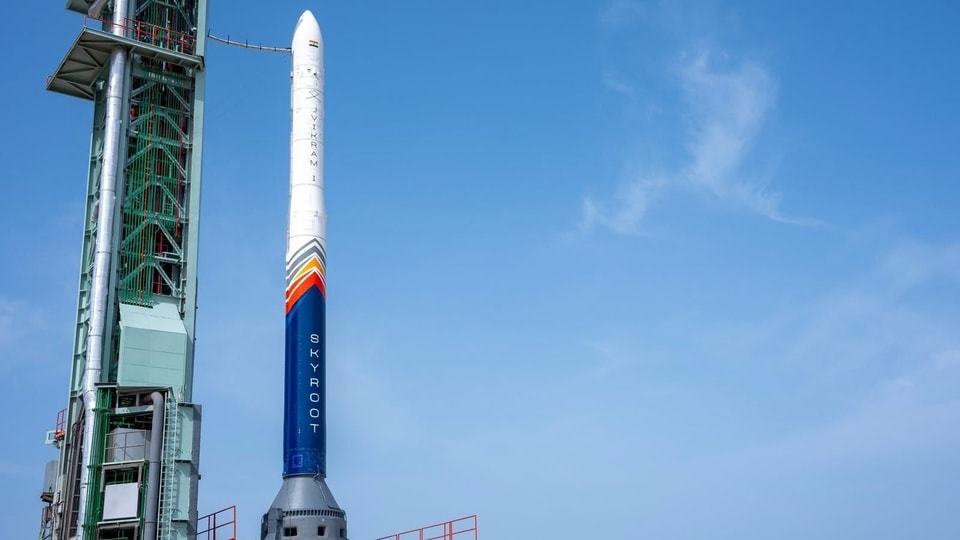
To fully appreciate the historical gravity of Skyroot’s achievement, one must view it through the long, painstaking evolution of the Indian space programme. India’s cosmic journey famously began in the early 1960s with sound rocket parts transported on bicycles and bullock carts across the fishing village of Thumba. Under the visionary leadership of Dr Vikram Sarabhai, after whom Skyroot’s rocket series is proudly named, the Indian Space Research Organisation (ISRO) prioritised societal upliftment, rural telecommunication, weather forecasting, and agricultural monitoring over competitive space races. Over six decades, ISRO built an enviable reputation as a global leader in high-efficiency, cost-effective space exploration, mastering heavy-lift vehicles like the PSLV and LVM3 while achieving landmark interplanetary feats like Chandrayaan and Mangalyaan on modest budgets. However, for decades, this ecosystem operated under a strict government monopoly where private vendors were limited to supplying components rather than building complete launch systems. Skyroot's orbital success represents the maturation of that foundational legacy, proving that the technical rigour cultivated by ISRO has successfully trickled down to empower a vibrant commercial industrial base.
The economic and strategic dimensions of this private space revolution are vast, serving as a catalyst to unlock India's potential in the multi-hundred-billion-dollar global space economy. Historically, ISRO’s primary mandate was focused on national strategic priorities and scientific research, leaving its commercial arm, Antrix and later NewSpace India Limited, to capture only a small fraction of global commercial launch demand. By allowing private entities like Skyroot Aerospace, Agnikul Cosmos, and Pixxel to design, build, and fly their own launch vehicles and constellations, India is rapidly diversifying its space architecture. Small satellite launch vehicles like Vikram 1 provide rapid, hyper-customised, and frequent access to orbit for global commercial satellite operators, bypassing the lengthy wait times associated with rideshare missions on massive State-owned rockets. This surge in commercial agility attracts foreign direct investment, fosters domestic high-tech manufacturing, and propels the nation toward its goal of expanding its footprint in the global space market.
Crucially, the success of private space programmes relies on a symbiotic, dual-engine policy framework rather than a zero-sum competition with the state. The creation of the Indian National Space Promotion and Authorisation Centre as an autonomous single window regulator, combined with the comprehensive Indian Space Policy, has transformed ISRO from a sole operator into a supportive catalyst. During Mission Aagaman, ISRO provided access to its world class solid motor casting, static test facilities, and launch pads at the Satish Dhawan Space Centre, while IN SPACe facilitated seamless technical reviews and regulatory clearances. This public private synergy frees State scientists to concentrate on deep space scientific exploration, human spaceflight programmes like Gaganyaan, and advanced planetary robotics, while leaving routine low Earth orbit transport, satellite communications, and commercial launches to a thriving private sector.
Ultimately, Skyroot Aerospace’s historic triumph symbolises a profound democratisation of technological capabilities, turning space from an exclusive realm of sovereign states into an open frontier for entrepreneurial innovation. The successful deployment of diverse commercial payloads ranging from orbital debris capture robotic arms and nanosatellites to advanced technology demonstrators demonstrates that Indian startups can solve complex engineering challenges with unprecedented agility and speed. As startups leverage high-rate production facilities like Skyroot’s 200,000 square foot Infinity Campus in Hyderabad to produce scalable rockets on demand, India is cementing its posture as an indispensable global hub for end-to-end space solutions. Skyroot’s leap into orbit is not merely the arrival of a single rocket; it is the ignition of an unstoppable commercial engine that will power India’s technological leadership deep into the 21st century.
(The views expressed are personal)
This article is authored by Gunwant Singh, scholar, international relations and security studies, Jawaharlal Nehru University.


