E-Paper



Plan outlined to ease traffic on Delhi’s chock-a-block MB Road
The interventions, officials said, have been designed to significantly reduce snarls on the 11.5-km stretch.

 Prefer HTon Google


The state government plans to build two underpasses and two flyovers on the key Mehrauli Badarpur (MB) Road, which is a vital link between Delhi and Gurugram, in a bid to decongest the arterial corridor, according to a plan prepared by the Public Works Department (PWD).
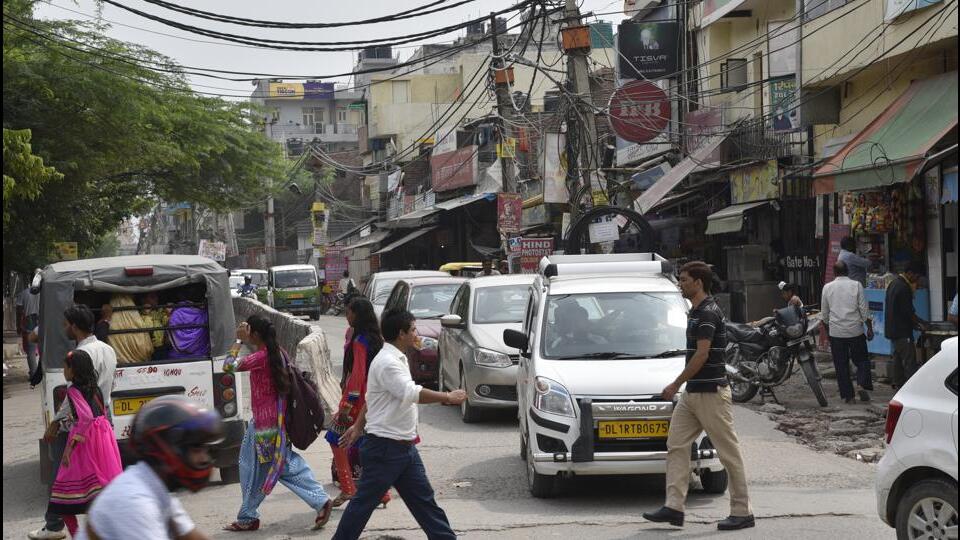
The interventions, officials said, have been designed to significantly reduce snarls on the 11.5-km stretch. At least 16 T-intersection junctions along MB Road exacerbate snarls on the corridor, which has seen some disruptions to traffic movement, owing to constructions for the Delhi Metro’s Tughlakabad to Aerocity corridor.
To be sure, two of the interventions planned to decongest the stretch are also part of the Metro’s Phase 4 expansion plans.
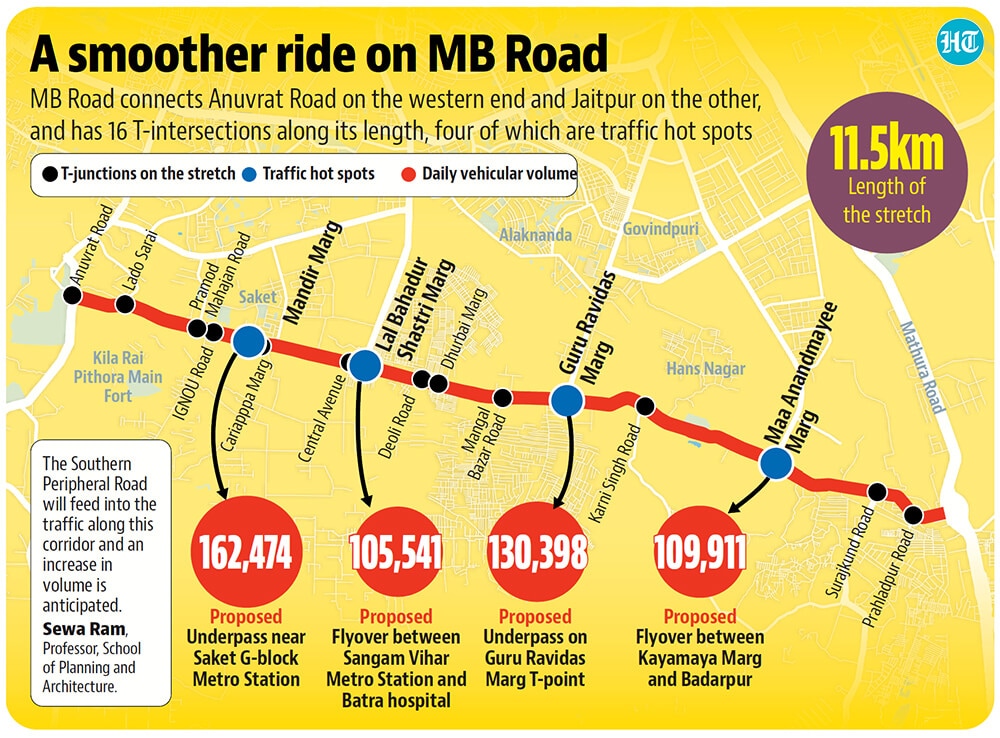
The first underpass will be developed near the upcoming Saket G Block Metro Station, and a 2.5-km-long flyover will connect Sangam Vihar and Batra Hospital. The second underpass will come up at the intersection of Guru Ravidas Marg and MB Road and another flyover will start from Kayamaya Marg and end just before Badarpur, the report said.
A senior PWD official said the department was earlier planning to develop four underpasses along the corridor, but redrew their drafts in line with suggestions it received from the Unified Traffic and Transportation Infrastructure Centre (UTTIPEC), a transport planning body.
MB Road connects Anuvrat Road on the western end and Jaitpur on the other.
“The stretch has 16 T-intersections along its length. PWD carried out a study to identify the major congestion nodes [on the corridor], and found that snarls were reported from MB Road’s junctions with Saket Mandir Marg, Lal Bahadur Shastri Marg, Guru Ravidas Marg and Maa Anandmayee Marg where the daily vehicular volume count is very high,” the official said.
The study showed that the MB Road-Saket Mandir Marg junction sees 162,474 passenger cars per day, while the Lal Bahadur Shastri Marg junction gets 105,541 vehicles. Meanwhile, the MB Road and Guru Ravidas Marg junction gets 130,398 vehicles a day, and the junction with Maa Anandmayee Marg sees 109,911 vehicles every day.
According to the status report filed by the PWD, the revised proposals for the underpasses at Guru Ravidas Marg junction and Kayamaya Marg flyover have been submitted to UTTIPEC for final approvals.
“The other two [flyover] projects will be carried out with the Delhi Metro Rail Corporation (DMRC) in the form of composite structures. Work on them has been started,” it said.
The Guru Ravidas underpass will begin just before the T-intersection and end after Maa Anandmayee Marg junction, in a bid to relieve congestion at both points.
A PWD official said the 12 T-intersections fare significantly better in terms of daily traffic volume.
Anuj Dayal, the executive director of corporate communications of DMRC said: “DMRC is engaged in the construction of the Tughlakabad Aerocity corridor of Phase 4, portions of which will pass through MB Road. A double decker road flyover cum Metro viaduct at Sangam Vihar as well as an underpass at Saket G shall come up as part of the corridor. Construction work has already been started on this corridor.”
Sewa Ram, a professor of transport planning in the School of Planning and Architecture, said that with the expansion of urban areas expected in Haryana’s Faridabad and the eastern part of Gurugram, traffic volume on the crucial stretch is likely to increase significantly in the years to come.
“The Southern Peripheral Road will also feed into the vehicular traffic along this corridor and an increase in volume is anticipated. Instead of looking at isolated junctions, we need a comprehensive plan for the entire road network along the corridor on the lines of the Delhi-Meerut Expressway. A grade-separated elevated corridor, which can separate local traffic and regional traffic, will be the ultimate solution and I hope the future needs have been taken into account,” he said.
Once revamped, the MB Road will help take some vehicular load off two arterial Ring Roads.
Gurugram and airport-bound traffic coming from south and southeast Delhi areas are likely to consider using this stretch instead of taking Outer Ring Road or Ring Road, both of which carry heavy vehicular flow.