
 E-Paper



PWD gets nod to install 600 LED screens at major junctions in Delhi
According to the arrangement, the installation agency will also be made responsible for maintenance of these sites for seven years.


The Public Works Department (PWD) has received the approval to set up 600 LED screens on arterial roads and major road junctions in the national capital at a cost of ₹475.78 crore, officials aware of the matter said on Friday.
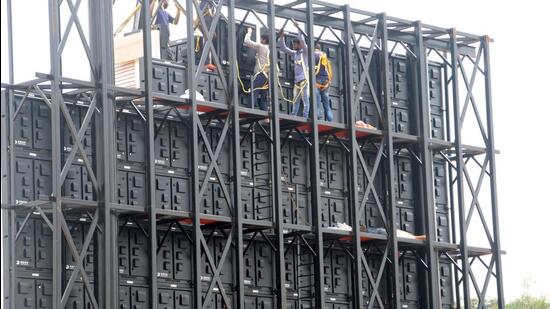
The officials added that a three-member panel has been set up to oversee the project. “Tenders will now be called for appointing private agency for installation purposes and the work is expected to be completed in one year from appointment of the agency,” one official said asking not to be named.
“These screens will be installed in various shapes and sizes, and the overall system will act as a unified public information broadcasting system to transmit information about government schemes, pollution levels among other things,” the PWD official said.
According to the arrangement, the installation agency will also be made responsible for maintenance of these sites for seven years. The PWD also plans to set up a unified control rooms at the agency’s headquarters to monitor the functioning of the 600 screens, the official added.
Traffic police screens
According to the Delhi traffic police, the city currently has 50 big LED variable messaging service (VMS) screens installed at important junctions such as ITO and AIIMS. These screens that are part of the intelligent traffic management system are operated by the traffic police from its headquarters.
In the first phase, 50 such screens were operationalised on corridors such as Mathura Road, Sardar Patel Marg, RTR Marg, Dwarka Link Road, IGI Airport Road, the Ring Road and stretches of NH8 and NH24. The boards installed are in two sizes — 5mx2m and 3mx1.5m.
The project of developing an intelligent traffic management system using VMS screens has been in the making for at least one decade. The screens were expected to provide information to commuters about the traffic situation on a real time basis. Depending on the traffic situation, the screens were expected to relay information that relates to vehicle breakdowns, repair or construction work and speed limits to equip commuters to take appropriate actions. In 2017, Delhi traffic police announced that VMS screens will be installed along 100 key stretches.
Transport experts, however, said that these screens that were initially part of the intelligent traffic management system have failed to live up to their intended purpose. They said these screens were to be used to broadcast information about traffic snarls but now, they are mostly being used for relaying public awareness messages.
S Velmurugan, chief scientist, Central Road Research Institute (CRRI), said instead of conveying information regarding possible congestion, traffic jams and alternative routes, VMS screens continue to show generic messages on wearing masks and risks of drinking and driving. “Combined with unmanned barricades this is leading to even more congestion. We have more than 100 VMS screens which should be used to warn people about best possible routes. But, the information about congestion points is only conveyed through social media. The authorities can also use vehicle mounted portable projector system in which can be parked safely on the side of the road to inform commuters 2-3 junctions ahead of a traffic jam,” he said.
Velumurgan said that relaying static messages on VMS screens is serving no purpose.
Vivek Kishore, joint commissioner of police (traffic), said there were at least 49 VMS screens operational on the major corridors of the city. “These VMS screens are being used to relay public messages related to traffic such as the importance of wearing helmets and other safety measures. In case there are congestion points on some arterial roads, the screens are being used for conveying the information related to snarls ahead on the route, nearest congestion points and traffic advisories. We regularly update the messages,” he said.
Sewa Ram, professor of transport planning in the School of Planning and Architecture, said informing commuters about traffic jam site only leads to shockwave and buildup of congestion at the site. “The information regarding diversions and road blocks needs to be given well in advance at least one or two junction ahead. In many cases, google maps are also not able to correctly provide estimated journey time. Traffic police should use VMS screens for suggesting alternate routes. The technical knowhow and capacity building of field staff needs to be carried out,” he added.

Stay updated with all top Cities including, Bengaluru, Delhi, Mumbai and more across India. Stay informed on the latest happenings in World News along with Delhi Election 2025 and Delhi Election Result 2025 Live, New Delhi Election Result Live, Kalkaji Election Result Live at Hindustan Times.


