E-Paper



Rain returns to Capital after two-day break, waterlogging leads to snarls
The Safdarjung weather station, representative of Delhi weather, recorded trace rainfall till 8.30am on Monday and 23mm in the next nine hours

 Prefer HTon Google


New Delhi
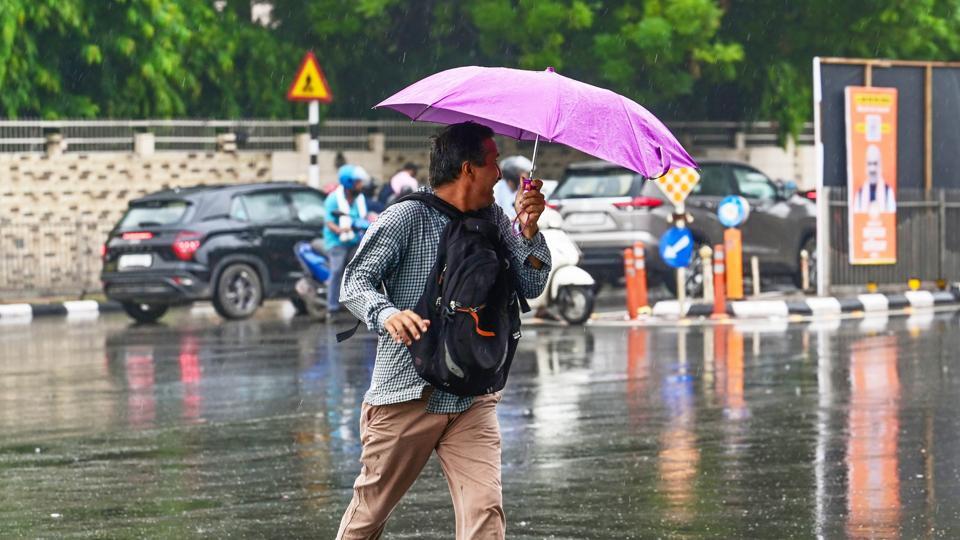
Parts of the Capital on Monday morning logged light to moderate rainfall, leading to waterlogging and traffic jams till late evening, as the monsoon trough moved closer to Delhi-NCR, according to the India Meteorological Department (IMD).
The Safdarjung weather station, representative of Delhi weather, recorded trace rainfall till 8.30am on Monday and 23mm in the next nine hours. IMD continued its yellow alert till Wednesday, following which it forecast scattered and light rainfall from Thursday to Sunday.
“With Monday’s spell, the annual rainfall has now crossed 900mm. More rain is likely throughout this week with the trough expected to stay in the vicinity,” an IMD official said.
On the day, the Palam weather station recorded 1.6mm of rain, Lodhi Road station 20mm, Ayanagar station 8.5mm, Pitampura station 4.5mm and Mayur Vihar station 1mm, all in the nine-hour interval between 8.30am and 5.30pm.
The 905.1mm of rainfall recorded so far is already higher than the annual rainfall Delhi received last year (888.6mm) and 2022 (811.4mm) and moved closer to 2021 rainfall of 1,526.8mm of rainfall, which was the second wettest year, in terms of rainfall, in Delhi’s history. The annual average rainfall is 774.4mm.
Delhi Traffic Police advised motorists to avoid the Press Enclave Road, NH-48, Ring Road from DND towards Moolchand, Okhla underpass, Outer Ring Road near Savitri flyover, Ring Road from Safdarjung towards Dhaula Kuan, Mehrauli-Badarpur Road, Mathura Road from Badarpur towards Ashram and Kalindi Kunj towards Okhla.
Traffic was also impacted on Birla Vidya Niketan Marg in Saket due to an uprooted tree.
Mahesh Palawat, vice president at Skymet meteorology, said the monsoon trough briefly pulled away from the region, leading to a break in rain activity on August 31 and September 1. “We will again see decent rain throughout this week, leading to a fairly wet September,” he said.
IMD has forecast above-normal rainfall in northwest India for September, which should see Delhi cross the 1,000mm mark, in terms of annual rainfall. The long-period average (LPA) for rainfall in September in the Capital is 123.4mm.
On Monday, Delhi’s maximum temperature was 33.6°C, which was a degree below the normal and down from 36.3°C recorded a day earlier. The minimum temperature was 26.2°C, around the normal for this time of the season and fractionally lower than 26.5°C recorded a day prior.
The short but intense spell of rainfall also improved Delhi’s air quality, with an air quality index (AQI) of 86 (“satisfactory”) on Monday, down from a reading of 99 recorded on Sunday.