
 E-Paper



Rust and red tape: What ails Delhi’s scrappage drive
There are 17 registered scrapping centres in the NCR, but only one in Delhi. Towing vehicles to faraway places adds to costs

 Prefer HTon Google


In the dusty and cluttered corners of Delhi’s urban sprawl, past the clamour of flyovers and tail lights, lie graveyards of metal and memory. Over 17,000 vehicles — rusted shells stacked in precarious towers — clog 26 impound yards across the Capital. These “open malkhanas” have become holding zones for Delhi’s End-of-Life Vehicles (ELVs), condemned by age, air pollution laws, and court orders.
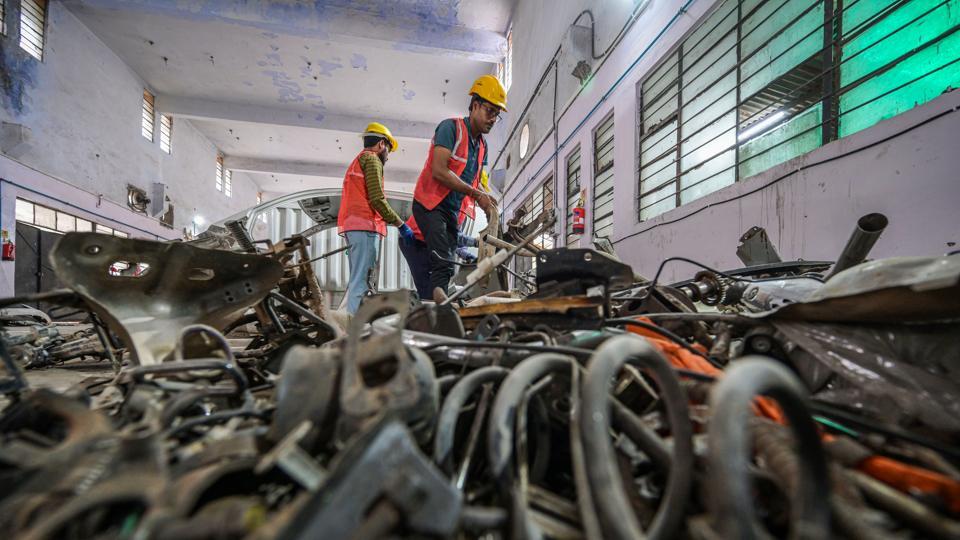
But the city’s ambitious scrappage mission is choking on its own backlog.
In early July, the Delhi government — under pressure from the Commission for Air Quality Management (CAQM) — launched yet another drive to tow and scrap ELVs. Barely 100 vehicles were impounded in the first two days. Meanwhile, the yards are nearing capacity, scrapping facilities are limited, and officials admit they’re caught in a “Catch-22”.
“There are 17 registered scrapping centres in the NCR, but only one in Delhi — and that too is just two months old. Towing vehicles to places like Sonepat or Hapur adds to our costs. At the same time, we can’t keep dumping them in yards that are already overflowing,” said a senior transport department official. “We need alternatives. Otherwise, this is a logistical deadlock.”
A legal mandate, a logistical mess
The crackdown on ELVs across NCR began with National Green Tribunal (NGT) orders in 2014, which was then reinforced by the Supreme Court in 2018 – effectively barred diesel vehicles older than 10 years and petrol vehicles older than 15 from Delhi’s roads. In August 2023, the Delhi High Court directed the administration to frame concrete guidelines to deal with such vehicles.
Those guidelines — titled Handling of End-of-Life Vehicles in Public Places, 2024 — now govern the campaign. The rules say even stationary ELVs parked in public spaces are deemed to be “plying” and are eligible for seizure.
“Our job is to enforce the law, not make exceptions,” said a senior Delhi Traffic Police officer.
Typically, impoundment begins when a vehicle is flagged — by patrolling units, complaints through the MCD-311 app, or during special drives. A team issues a seizure memo and the vehicle is towed to the nearest impound yard.
The pits in Nehru Place, Rohini, and Shadipur are among the most congested. “We’re adding 20 vehicles a day, but we barely have space. Some have been lying here for over a year,” said a guard at Shadipur.
Once impounded, each vehicle’s details — make, model, registration, condition — are logged. Owners then have a 21-day window to reclaim it, by paying penalties and providing proof of private parking or relocation outside NCR. If unclaimed — or impounded again — the vehicle is marked for scrapping. But in practice, officials say, many vehicles linger in the yards far beyond that.
These cars stay in the yards for months because many of these remain unclaimed. Also, often the transport department or police seize the vehicles and keep them in yards but do not send them to RVSFs because it involves high transportation cost for sending it to a centre in NCR, including fuel cost and taxes at borders.
At a scrapping centre
Delhi currently depends on 17 Registered Vehicle Scrapping Facilities (RVSFs) across the NCR — from Bawana to Ballabhgarh — all certified under the Motor Vehicles (Registration and Functions of Vehicle Scrapping Facility) Rules, 2021.But only one, EZWaste Recycling Pvt Ltd, operates within Delhi city limits, in Badarpur. This centre started operations only last month.
“We only accept vehicles with proper documents — either registered online or sent via the transport department,” said Deepender Yadav, who runs EZWaste. “We have to maintain video evidence for every single dismantled vehicle.”
Yadav walked us through the process: Every vehicle undergoes a thorough decontamination process, followed by dismantling, segregation, and final compaction into a 14x14 inch metal cube.
The first step is de-pollution. The vehicle is cleaned with a high-pressure washer to remove dust and carbon particles. The plant must have a functional effluent treatment plant (ETP) to process runoff.
Before dismantling, the vehicle is scanned for radiation — a safety check to prevent accidents from battery leaks or residual emissions. AC gas and CNG tanks are emptied.
“Then we drain six fluids — fuel, coolant, radiator liquid, washer fluid, grease, and brake oil. These are stored safely and transported to our Khatauli facility in UP for eco-friendly disposal,” Yadav said.
Next comes the dismantling: Pneumatic guns slice through the axle. The engine number is logged before the engine is shredded. The chassis number is also removed.
Parts are stripped one by one — batteries, tyres, plastics, metals, glass, electronics. The bonnet, bumper, dashboard, airbags, mirrors, and steering are all extracted for recycling or safe disposal. What remains is the skeletal frame.
That, too, is chopped up using plasma cutters, and the carcass is compressed into a cube using a bailing machine. “For some vehicles, the cubes are slightly larger for transportation, but the process remains the same,” said Yadav.
The final ferrous mass is weighed, and its scrap value is calculated. As per RVSF norms, the owner receives 50% of the price of the recoverable metal (estimated at 60-70% of the vehicle’s unladen weight). The amount is transferred digitally within 15 days. If unclaimed, it’s deposited with the enforcement agency.
According to Yadav, four-wheelers typically fetch ₹20,000 to ₹60,000. Two-wheelers bring in ₹1,600 to ₹2,800. The difference, however, is stark when compared to the grey market.
“At illegal scrapping centres, parts are sold off individually, and owners might get more. But that’s dangerous — those parts can end up in unsafe vehicles or even aid criminal activities,” Yadav warned. “At a registered RVSF, nothing is reused — everything is either recycled or destroyed.”
Backlog of the abandoned
Delhi has over 5.5 million deregistered vehicles, many of them still occupying public space — parked under flyovers, beside parks, or within gated societies. Only a fraction have been impounded or scrapped.
Officials admit that the scale of the problem dwarfs the existing infrastructure. “We need more RVSFs, especially within city limits,” said another transport official. “We’re trying to promote voluntary scrapping by offering incentives and streamlining documentation, but it’s slow.”
To accelerate the process, the department has issued public notices and brochures explaining the scrapping procedure. Citizens can check their vehicle’s status online and book scrapping appointments through the Parivahan portal.
But behaviour change is hard to legislate. For many owners, the vehicles carry sentimental value — or they’re simply unaware that their car or scooter is now illegal to use. Others want to extract maximum value from parts, turning to the informal sector.
The result is a growing inventory of impounded junk, mounting daily.


Stay updated with all top Cities including, Bengaluru, Delhi, Mumbai and more across India. Stay informed on the latest happenings in World News along with Delhi Election 2025 and Delhi Election Result 2025 Live, New Delhi Election Result Live, Kalkaji Election Result Live at Hindustan Times.


