
 E-Paper



8,521 new infections: Second highest Covid-19 case spike in Delhi
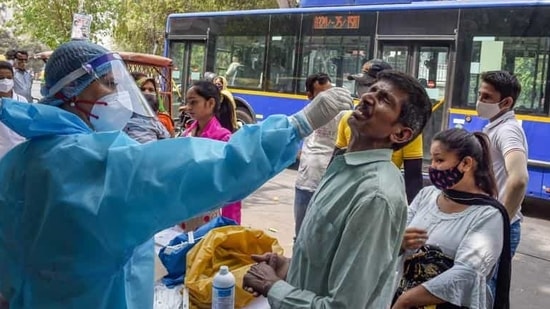
Friday’s surge came on the back of record Covid-19 testing in the city, with 109,398 samples collected, more than the previous high logged on April 6, when 103,453 people were tested.


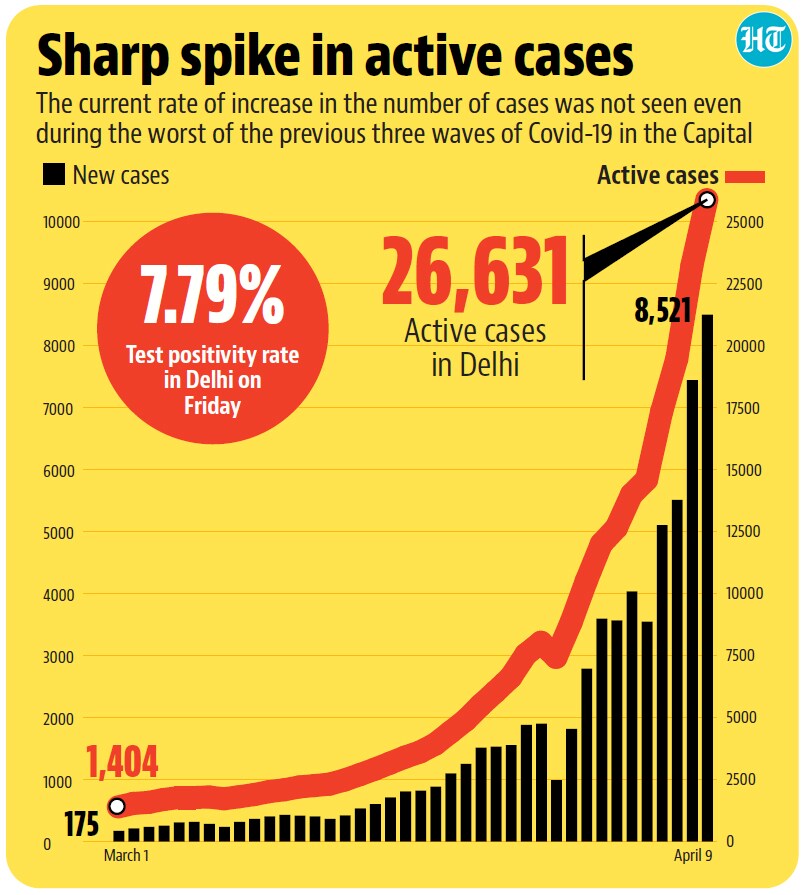
The Capital on Friday reported 8,521 new Covid-19 cases, the second-highest single-day spike in infections recorded in the city ever, as the infection continued to swell at rates not seen at any point during the previous three waves in Delhi.
Delhi’s record case-spike was on November 11 last year, when it added 8,593 infections.
Friday’s surge came on the back of record Covid-19 testing in the city, with 109,398 samples collected, more than the previous high logged on April 6, when 103,453 people were tested. Less than 65% of Friday’s samples used the RT-PCR method, regarded as the gold-standard of Covid-19 diagnosis. The Centre has urged states to ensure that at least 70% of all tests conducted use the RT-PCR technique.
While the test positivity rate fell to 7.79% on Friday from 8.10% the previous day, this is still higher than the 5% threshold that experts recommend, before an infection can be considered under control in a region.
The test positivity rate has been on the up consistently in the city during the current surge of infections, rising from an all-time low of 0.17% on February 16.
Delhi had kept the positivity rate below 5% for 124 days, between December 2 and April 4.
The state government’s health bulletin also reported 39 deaths due to the viral infection on Friday, the most in a day since 41 fatalities were recorded on December 15.
The last time Delhi saw as many cases was at the peak of the third and worst surge of cases in November.
Also Read| DDMA discusses increasing Covid beds, capping passengers in buses but no lockdown yet
The number of new cases recorded each day increased from 4,000 to 8,000 within six days during the current wave. In comparison, it took 20 days from the end of October end to reach 8,000 in mid-November.
“The pace of increase in the infections is certainly very fast this time. But, there are a lot of unknowns, including why the cases went down sharply after the November surge. I think it was because of the high sero-prevalence of 56% that reduced transmission. Then came the laxity. Everybody thought Covid-19 was over. People started mixing, partying, and not following Covid-appropriate behaviour,” said Dr GC Khilnani, former head of the department of pulmonology at the All India Institute of Medical Sciences (AIIMS).
He said the night curfew, in place between 10pm and 5am, was not enough to curtail the spread, even though it helped reduce the number of parties and late-night gatherings. “We need to increase restrictions in places such as restaurants. We should learn from the world. A study from Columbia district of Washington showed that the number of cases went down when they reduced these social interactions and shot up again as soon as restaurants were opened up,” he said.
Dr Khilnani added that disease was not milder. “The number of deaths is likely to increase sharply as well because people fall sick and die a few days after getting the infection,” he said. The current seven day rolling average case fatality ratio is at 0.39%.
The number of hospital admissions is also fast increasing, with the Delhi government having to order increases in bed capacity thrice within seven days. The number of hospitalisations has increased from over 2,700 to over 4,700 in the last six days. As on Friday night, 5,112 were hospitalised, occupying 47% of the 10,832 beds earmarked for Covid-19 treatment, according to the government’s Delhi Corona app.
Test positivity rate 1.28% at transit points: Govt
Between March 23 and April 7, the city administration tested 94,828 passengers arriving in the city at various transit points, of which 1,221 (1.28%) tested positive for Covid-19, showed government data.
At the New Delhi railway station, 4,729 samples were collected during this period, of which 113 (2.38%) tested positive. At the Indira Gandhi International Airport, Delhi cantonment railway station and Dhaula Kuan bus stand, a total of 13,821 tests were conducted, of which 197 (1.42%) passengers had the infection.
At Kashmere Gate ISBT, 361 (1.40%) of the 25,749 tests came positive. At Anand Vihar, which has a metro station, an ISBT and a railway station, 358 (1.29%) of the 27,736 tests came positive.
At the Kapashera-Delhi-Gurugram border, five people tested positive after 1,585 tests.

Stay updated with all top Cities including, Bengaluru, Delhi, Mumbai and more across India. Stay informed on the latest happenings in World News along with Delhi Election 2025 and Delhi Election Result 2025 Live, New Delhi Election Result Live, Kalkaji Election Result Live at Hindustan Times.


