
 E-Paper



Shah Jahan’s hunting lodge crumbles as it lies forgotten in Delhi
Senior officials from the state department of archaeology said the shikargah was not a notified monument under their watch

 Prefer HTon Google


Nestled near Kanjhawala in outer Delhi is an unusual urban village — Jaunti — home to over 200 families and a crumbling 17th-century “shikargah” or hunting lodge. Apart from the shikargah, smaller historical structures and urban constructions dot the entire village, buffing out the differences between what was medieval and what is urban. Amid these differences, or lack thereof, the heritage of the area remains a forgotten affair.
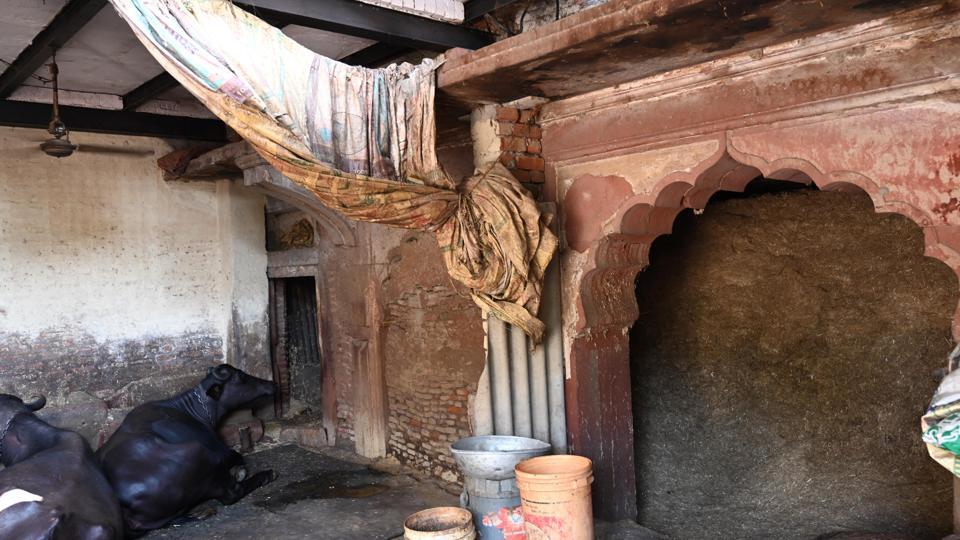
According to the residents, the shikargah itself was constructed by Mughal emperor Shah Jahan, who routinely stopped by along with his entourage during his hunting expeditions. The village, they said, grew within and around the hunting lodge. As the population grew, the village expanded and the hunting lodge or “Aam Khaas”, as it is known among the locals, shrunk to make space for newer constructions.
Yet, even after years of neglect, remnants of history can be found in every corner of Jaunti and the complex is now a pale shadow of its once glorious past.
The land occupied by the hunting lodge belongs to the Delhi Development Authority (DDA). DDA officials did not respond to queries seeking clarity on the encroachments and dilapidated state of the structures.
In 2018, the then-divisional commissioner of Delhi, Manisha Saxena, asked the archaeology department to draw a feasible plan for the restoration of the 370-year-old structure. Several agencies like the administration department, Delhi Urban Arts Commission (DUAC), and the Delhi Tourism and Transportation Development Corporation (DTTDC) were roped in to develop the village as a tourist destination but without result.
Senior officials from the state department of archaeology said the shikargah was not a notified monument under their watch. “The monument does not come under our jurisdiction. In the past, we carried out some repairs on request. We fixed the roof that sustained serious damage and was on the verge of collapse,” said an official, asking not to be named.
Nearly five historical structures punctuate the village — apart from the lodge, dating back to the 1650s. The villagers have occupied some of these structures, including havelis and the lodge itself. The lodge is perched on an elevated area in the middle of it and is one of the largest historical remains in the area. However one cannot access as the constructions that mushroomed have blocked all entrances. This also makes it difficult to gauge the exact area covered by the hunting lodge.
Birmi, 65, whose house is located opposite the shikargah, said that multiple generations of her family lived in the village and witnessed the transformation of the historical structure.
“My mother-in-law used to narrate stories about the structure’s grandeur. There used to be huge pegs made of stone at one point. Horses and elephants would be tied to these pegs during the royal times. The pegs broke and got buried under the sand,” recalled Birmi, who goes by her first name.
She and other locals also talked about the presence of a tunnel underneath the structure which meets the lake on the outskirts of the village. “Our ancestors used to say that royals used the tunnel to reach the lake. We have seen the tunnel but people who live in Aam Khaas have covered it up. It is closed from both ends,” added Birmi. In addition to the shikargah, there is also a Mughal-era well, which is no longer in use.
The shikargah and the surrounding structures are unprotected and the people who currently occupy them use all the buildings for residential purposes. Around 15 years ago, some repairs were carried out at the lodge by the Delhi government after parts of the ceiling collapsed. Besides this intervention, no conservation was undertaken in the many years.
On the western end of the lodge is a red sandstone courtyard with basements and alcoves stuffed with cow dung cakes. Another family occupies this part.
The shikargah was enclosed by a wall but only parts of it remain. Locals said that major parts of the shikargah have either collapsed or are occupied by people and cracks run across walls and pillars.
The main building is a double-storeyed structure with a central vaulted compartment on the upper floor and a compartment with a domed pyramidical roof at each end.
Suman, who lives in this part of the Aam Khaas, said that most houses in the vicinity of the shikargah are built in spaces once part of the original structure. She said that the place resembled a ruin when she first moved to the village. “I used to feel scared when I first came here since the place was almost deserted. Even now, one can spot owls and bats here. We mostly work here during the day and don’t visit the premises at night,” said the 54-year-old, who moved to Jaunti after marriage.
Suman has lived here for over two decades and has seen the village and its heritage structures transform with more people occupying the Aam Khaas. “The ceiling collapsed before I came here. Water used to trickle down from the ceiling. Around 2008, the Delhi government carried out repairs for 3-4 months and fixed the ceiling, “ said Suman, pointing to a cave-in on the roof.
The building just about suffices for Suman and her family including three children. All members stay in a room on the ground floor. The family uses the basement and the enclosures of the lodge for their buffaloes and to store hay. The second floor of the shikargah, meanwhile, is used to stack cow dung cakes. Monkeys, bats, owls, and pigeons also inhabit this dimly lit part of the shikargah. She added that there was a space crunch and the family might have to undertake fresh construction to meet the needs.
Jaunti is also among the four villages adopted by lieutenant governor VK Saxena earlier this year. In June, officials from the LG office said the village would be developed as a model village and would see improvement on various fronts including civic infrastructure. Locals, however, were not enthused. They say that similar announcements were made in the past but the village’s heritage has not received its due.
Despite its location on the outskirts of the Capital, Jaunti continues to draw history enthusiasts, from India and beyond. “Foreigners and people from far-off places come here to see the shikargah. One cannot deny that Jaunti is a historical village with royal background. However, people from the village have never made any collective effort to ensure that Aam Khaas is spruced up. If they had, so many people wouldn’t be living here,” added Suman.
Jaunti was also adopted by Bharatiya Janata Party (BJP) MP Udit Raj in 2014 under Saansad Adarsh Gram Yojana (SAGY). Raj made announcements to promote tourism in the village but nearly a decade later, no plans have come to fruition.
Raghubir Singh, 87, said the structure has not received attention from the government or the local MP who rescinded the promise of putting the village on the tourist map.
“Aam Khaas is a historical place that has now turned into a ruin. People came once for repairs but they covered only a few portions. This is not just our legacy but the government’s too. If they want, they can save the heritage structures here,” said Singh.
Birmi and others who live close to Aam Khaas said that the government carried out a survey around 2018 and promised that people living in Jaunti would be relocated and given plots in the open area on the outskirts of the village. “Officials visited our houses and numbered them. They measured the area of different houses, and even made notes about the historical parts of Aam Khaas and the newer construction that had been added over the years. Nothing came out of the exercise,” she added.
The survey did not pave the way for conservation but triggered more occupation at Aam Khaas. Fearing that the government would take up the area under its protection, locals started occupying more parts of the complex.
“When the government carried out the survey, more people occupied Aam Khaas to show their possession. They feared that if the government took control, they would have to forfeit their ownership of the land,” added Birmi.


