
 E-Paper



RRTS: Delhi govt gets two months to clear dues
The Delhi government told the top court that it was facing scarcity of funds due to the Centre’s termination of the GST compensation programme in June 2022

 Prefer HTon Google


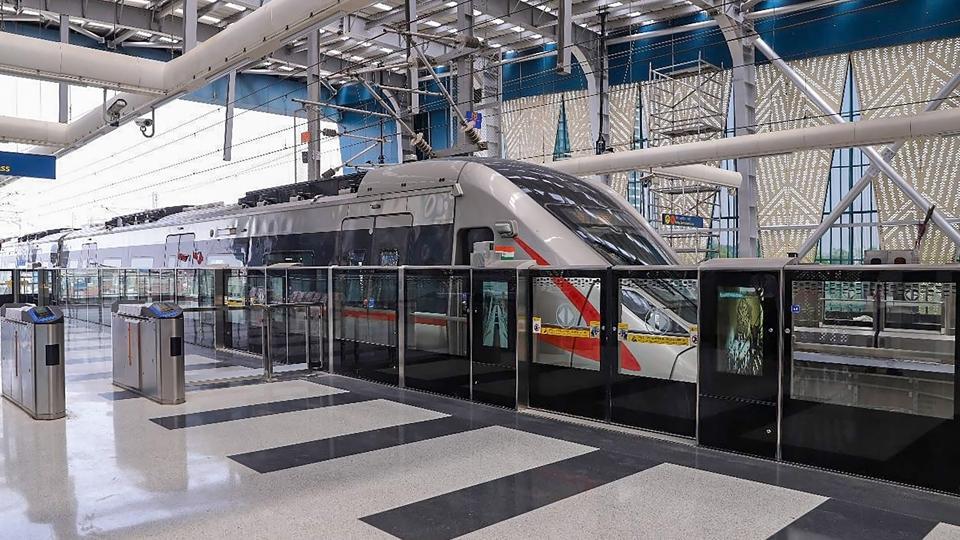
The Supreme Court on Monday gave the Delhi government two months to clear its overdue payment of ₹415 crore for the Delhi-Meerut Regional Rapid Transit System (RRTS), stressing on the importance of infrastructure projects in the National Capital Region (NCR).
Senior advocate Abhishek Manu Singhvi, appearing for the Delhi government, told the top court that the government’s intention was not adversarial, and that it was facing scarcity of funds due to the central government’s termination of the goods and service tax (GST) compensation programme in June 2022. The affidavit said that in 2022-23, Delhi received a GST compensation of ₹10,000 crore, while this year (2023-24), the state will receive only ₹3,802 crore as arrears of GST compensation.
“The sudden cessation of GST compensation has severely impacted the financial resources of the state government. This has led to a substantial reduction in the availability of funds,” the AAP government said.
It also pointed to an increase in expenditure for essential public services, such as health care, education, and social welfare.
But the court, which had in a hearing on July 3 asked the Delhi government to furnish details of its advertising expenditure, did not accept the argument.
In an affidavit last week, the Delhi government shared information about its total ad spend over the last three financial years: ₹296.89 crore in 2020-21, ₹579.91 crore in 2021-22, and ₹196.36 crore for 2022-23, adding up to a total of ₹1,073.16 crore over the period.
“If ₹1,100 crore can be used for advertisement in the last three financial years, certainly money can be paid for the infrastructure project,” said a bench of justices Sanjay Kishan Kaul and Sudhanshu Dhulia.
“Your one year’s advertisement budget is more than what you have to give for the project. We did not want to ask you for these details. But can you come and say, ‘we do not have funds’? It is for you to decide how this amount is to be paid,” the bench told Singhvi.
The court was monitoring the progress of the RRTS project in a public interest litigation (PIL) filed by advocate MC Mehta related to air pollution in the national capital.
The Delhi government was required to contribute ₹1,180 crore towards its share for the construction of the Delhi-Meerut RRTS corridor.
On two occasions in the past, the Supreme Court allowed the Delhi government to pay ₹265 crore and ₹500 crore out of the environmental compensation charge (ECC) funds to meet its liability. A balance amount of ₹415 crore was overdue, for which the Delhi government again sought to draw the sum from ECC. This time, however, the court refused.
Singhvi told the court on Monday that in national interest, and in state’s interest, the Delhi government is willing to make the payment provided it is allowed to be done in instalments spread over a reasonable period of time.
But senior advocate Aparajita Singh, assisting the court as amicus curiae, said that Delhi has overshot its deadline of paying the balance ₹415 crore for the Delhi-Meerut phase, and that this should be done within two months.
About the remaining two phases of RRTS connecting Delhi with Panipat and Alwar, Singh told the court that the Delhi government has an earmarked share of ₹2,443 crore and ₹3,261 crore which is to be paid as per a fixed schedule till the year 2028.
The bench allowed those payments to be made as per the schedule already fixed, but with regard to the Meerut RRTS contribution, the bench said: “The overdue amount (of ₹415 crore) will be paid in two months.”
The RRTS project is an ambitious venture involving semi-high-speed rail corridors that will connect Delhi to three cities — Meerut in Uttar Pradesh, Alwar in Rajasthan, and Panipat in Haryana — and is being executed by the National Capital Region Transport Corporation (NCRTC), a joint venture between the Centre and the concerned states.
RRTS is meant to provide fast, reliable travel across the National Capital Region. The project envisages to ease the vehicular pollution load on the capital.
The Delhi-Meerut corridor is expected to become operational in 2025. NCRTC earlier informed the court that the Delhi-Alwar corridor, which passes through Rewari, is awaiting sanction by the Centre, while the Delhi-Panipat corridor is awaiting the Delhi government’s nod.


